Noma pops up

491720065_a873ca0190[1]Frequently judged the “world’s best”, Noma restaurant is much less than the hype, and I intend that as a recommendation. If you feel so inclined, have the money, and can score a booking, then go, when it pops up down south.

The Sydney Morning Herald has just carried huge photographs of chef Rene Redzepi to accompany a double-page spread about his moving the restaurant from Copenhagen to Sydney for 10 weeks during their winter/our summer. But I skipped the article for a number of reasons. Mainly, it’s the hype; I don’t need any more breathless accounts of stratospherically-ranked cooking.

Reportedly flying in 35 chefs, 30 waiters and 10 reservations and administrative staff, plus “partners and children”, a so-called destination restaurant celebrating local-ness remains one of globalisation’s tragic contradictions.

An associated reason for my deliberate page-turn was that, decades ago, I was already dreading Sydney’s over-development (fellow journalist Gavin Souter assured me it had already happened), and the Barangaroo developers would seem to be supporting Noma’s relocation to lend civility to their latest harbour-side imposition.

I also admit that despite the restaurant offering a total of 5000 places, and at a projected $400 to $500 each, I can’t imagine managing to obtain a booking. Locals will be competing with diners who fly around the world to reach worse attractions.

And, finally, another confession, I’ve already been. Indeed, we almost went twice. My wife’s second Copenhagen conference let me book for a significant birthday in April 2010, but an eruption of Eyjafjallajökull grounded an estimated 10 million travellers, including us.

Not that my birthday was a total disaster, because we quickly booked trains to England via L’Arpège in Paris. To tell the truth, my actual birthday was a couple of days later, so that I celebrated again. With my wife occupied at another conference in Coventry, my daughter and I dined at what the Good Pub Guide rightly indicated would be a dream of an old inn, the Fox & Hounds, Great Wolford, Warwickshire.

491693630_5b41aa8303[1]The Noma visit in May 2007 was unforgettable, notably for its completeness. I remember numerous snips of this and that by way of found grasses, flowers, etc, quite intriguing, although more common these days. And I particularly recall tiny, cold, dense oysters. If you want more details, “YKL” had posted on egullet a few days earlier about the same menu (and I’ve borrowed two of YKL’s photographs to accompany this reminiscence).

As I say, the meal was unforgettable for its completeness, which means not just the food. There was the port location and the old building, which had been converted to promote the North Atlantic (hence Noma’s choice of ingredients). My daughter and I sat outside with a beautiful German riesling in the late-afternoon sun, awaiting my wife to cycle from her conference. We gazed across the harbour (not high-rised like Sydney) and back at the spiral church steeple that our daughter had just climbed.

Then, there was the exemplary friendliness. One little thing was that, after they had found somewhere to stow my wife’s bike, they brought out an extra round of marvellous crisps, including cracklingly-thin fish and chicken skin.

We could never forget another extra. We were keen to phone our severely disabled son back in New Zealand, which tends to sleep when Denmark is awake, and vice versa. Since this evening was an appropriate time, we inquired about a public phone. The waiters insisted that we use the restaurant’s. But you don’t understand, we said, this is a phone call to New Zealand.

Given our boy’s brain damage, “phoning” really meant singing to him down the line. It was an emotional moment, and when we were together back at the table, the waiters slipped us small handkerchiefs.

In this globalised, connected world that magnifies celebrity to an unbearable level, I know Noma to be much, much less – much friendlier and more intimate – than might be imagined. So, I skipped the double-page spread.

Then, in a phonecall, old friend Julie Rigg checked if I noticed it mentioned my gastronomic history of Australia. To write the article, Jill Dupleix had joined Rene Redzepi for a day trip of 13 hours, sourcing ingredients through Victoria. He and two assistants had already scoured the Adelaide Hills (location of our Aristologist restaurant in the 1980s and early 1990s) in the company of Adelaide chef Jock Zonfrillo (and I’ve already praised his Orana restaurant).

Dupleix reported that the team had passed by Melbourne’s Essential Ingredient in search of a copy of One Continuous Picnic. Not sure if they found one, but if Redzepi is still looking, I’ll gladly send a copy, signed “in memory of 31 May 2007”.

Food is bigger than God

250px-Peace_sign.svg[1]Food’s even bigger than Sex, although not quite up with Love. These are in Google hits. Speaking of which, Google is only half Facebook, with Twitter in between.

In billions, I didn’t find anything bigger than Facebook 15.06 with Love at 4.96, Food 3.24, Sex 1.61 and God 1.47.

Restaurant 1.58 is even bigger than God.

Water at 2.78 beats Coffee 1.03 beats Wine 0.76, on top of Beer 0.51 and Coke 0.10.

Menu is almost up with Food, but that might be helped by digital terms generally doing better than both food and religion. App scores 3.06 and Christian 1.22. Jesus remains bigger than the Beatles.

Appearing to be twice as popular as Climate Change, Kardashian beats Coal and also Pope Francis. War trumps Peace. Last on my list is Big Mac

I thank my old friend Paul for drawing my attention to Food beating God.

Facebook 15,060,000,000
Twitter 11,860,000,000
Google 7,030,000,000
Love 4,960,000,000
Food 3,240,000,000
App 3,060,000,000

Menu 3,030,000,000
Water 2,780,000,000
Computer 2,380,000,000JohnLennonpeace[1]

China 2,160,000,000
War 2,000,000,000

Sex 1,610,000,000
Restaurant 1,580,000,000
God 1,470,000,000
Tweet 1,370,000,000
Christian 1,220,000,000
Coffee 1,030,000,000
Wine 764,000,000
Peace 730,000,000

Religion 689,000,000

Jesus 627,000,000
Cooking 563,000,000
Beer 509,000,000
Obama 485,000,000
Meal 337,000,000
Muslim 301,000,000
ISIS 210,000,000
Kardashian 203,000,000
Coal 175,000,000
Tomato 135,000,000

Beatles 113,000,000
Climate change 101,000,000
Coke 101,000,000

Pope Francis 95,800,000
John Lennon 61,100,000
Big Mac 9,030,000


The collapse of dining in U.K., U.S.A., France, Australia and Barbados

The past decade has seen the collapse of British restaurants.

Something to eat at El Celler de Can Roca

They held 10 of the world’s “Best 50” positions in 2005, and now only two. Almost as disastrously, the decline in number of world-beating French restaurants has plummeted from 11 to five. The U.S.A. went from nine to six, Australia from three to one, and Barbados fell from two to none at all.

Where did all that great dining go? Spain has lifted its total from four to seven, Peru and Mexico have come from nowhere to gain three spots each; Brazil, Sweden, Japan, Thailand and China came in with two; and Singapore, Russia, South Africa and Chile snapped up one. The rest of the world stayed roughly where they were.

I’m joking. What has changed is not the quality of the national stars but the scope of the “World’s Best 50 Restaurants”. A British magazine started the annual list in 2002, and still in 2005 found the great places either down the road, or in France, the U.S. and Barbados. Over the years, the judging has expanded further across the globe.

The best in the world, “Says who?” That’s Paul Levy’s comment on the latest list, just announced. “Would any critic dare to try to name the 50 best operas/singers/actors/artists in the world, except as some sort of perverse game?” The original foodie underscores his point with the photograph (above), chosen by the “Best 50” organisers to represent their very “best” restaurant, El Celler de Can Roca in Girona, Spain.

That Paul was not overly selective with the photograph can be confirmed elsewhere. Here’s another I’ve referenced:

Restaurant magazine had asked Paul to vote in the early years, and he was not surprised that “the initial list in 2002 maintained absurdly that more of the world’s top restaurants were in Britain than in France.”

He admits to have dined at some of latest winners, and that they are “very good indeed”. The problem is that we could both name dozens of equally wonderful meals nowhere near the list. Now shut, Ritual in Nelson Bay, north of Sydney, rightfully gained a devoted following, but regularly lost scores in the local guidebook until it was dropped entirely. I’m looking forward to the emergence of Orana – or is Adelaide going to prove just too far for the globe-trotters?

As a restaurant rating groupie, I can remind Paul that even a half-decent guide is better than no guide. And another consolation is that we are watching the “Best 50’s” self-destruction. I’m not referring to its encouraging of ever-more damaging jet-setting.

Rather, my point is that the near-doubling of the number of countries on the list from 11 in 2005 to 21 is only a beginning. The United Nations has 193 members. The judges don’t appear yet to have brought in Vietnam, India, Pakistan, Iraq, Morocco … Is Canada yet to make the grade? And those other former British colonies, Hong Kong and Barbados, might yet pop back.

Soon, the near-impossibility of comparing of apples with pears will be compounded by the total incredibility of rating them against okra, lentils, cardamom, pomegranates, couscous and, let’s hope one day, Kiwi fruit.

Nine surprising food words

You might recognise “mess” as a food word, but what about “symbol” and “focus”? Here are nine too-often forgotten etymologies:

1. Mess has referred to a portion of food, a liquid food, a made dish, and a course of foods, all of which have been “messed” forth – from the Latin mittere (to send).

2. Symbol. The ancient Greeks combined sym– (together) and ballo (throw) for a “throwing together”, not least being a contribution meal, with each “contribution (properly to a feast or picnic), a share, portion” (OED) also called a symbolon. These contributions or “symbols” represent the whole thing.

3. Focus is the Latin for “hearth”, where cooks centre civilisation.

4. Foyer. From the Latin focus (hearth) derives the French and so English word “foyer” for entrance area. The German feuer (fire) is pronounced much the same as foyer.

5. Curfew for a regulation to extinguish fires at a fixed hour derives from the French couvrir (cover), feu (fire).

6. Bit. Related to “bite”. Each gigabyte on your computer takes 8000000000 bits.

7. Salary from the Roman soldiers’ regular payment of salt (sal).

8. Company. The people sharing bread (Latin cum- with panis bread).

9. Economics for “household management” from the ancient Greek oikos (household).

Almost all these examples come from my book about cooks at the heart of the human enterprise, originally The Pudding that Took a Thousand Cooks (1998) and renamed A History of Cooks and Cooking (2000).

Any further suggestions? I’m collecting a longer list.

Hospital food

IMAG0863The things people will do for a story … war reporters are one-sidedly “embedded” with troops; bloggers cook their way through Mastering the Art of French Cooking

As a food columnist for Australian Society magazine, I once hosted a dinner party using supermarket “gourmet” items. Not a successful night. Not even funny, despite our best efforts. Factory fanciness was a downer.

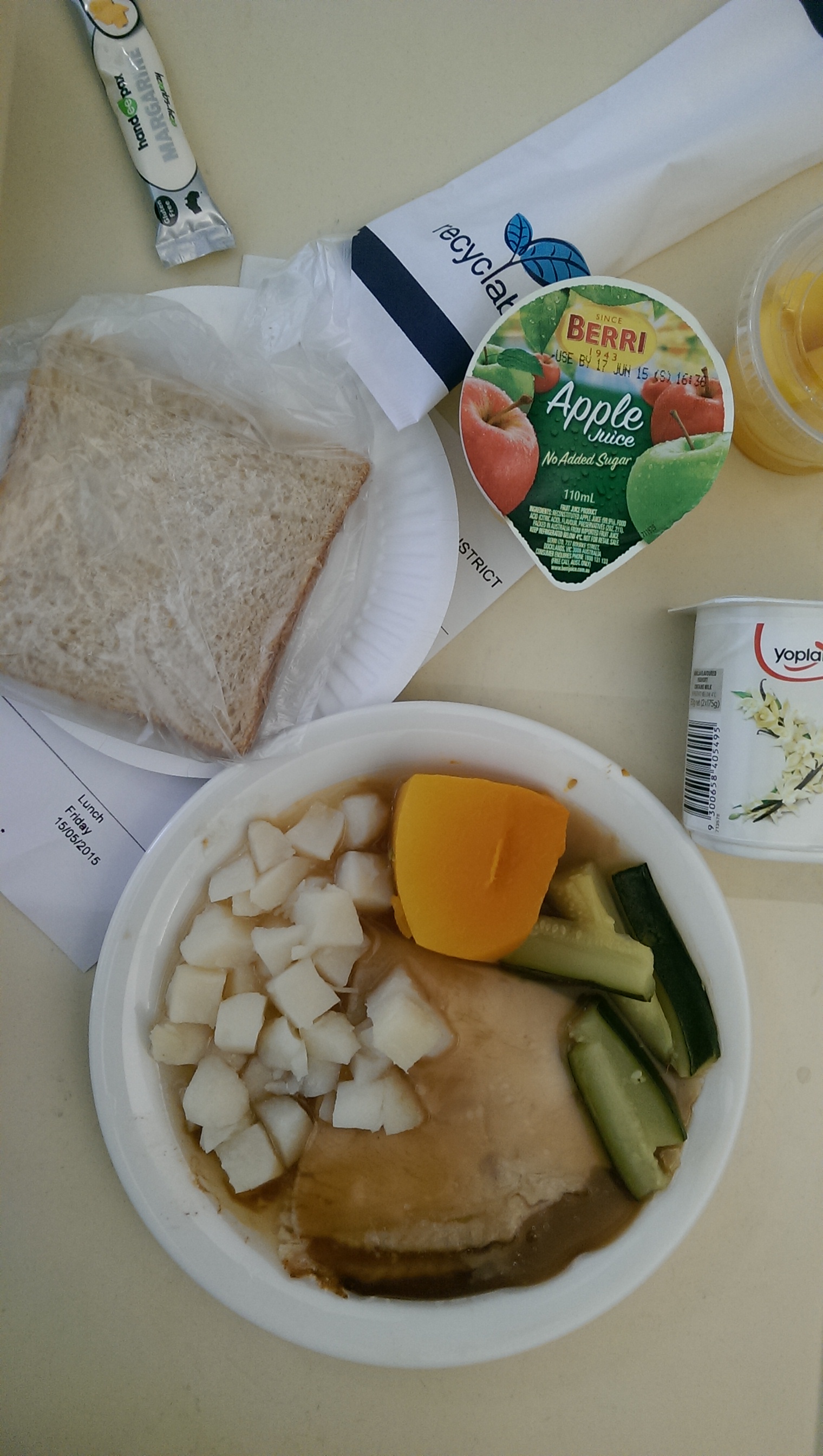
Undaunted, my latest project has been to test hospital food (and also, now that you ask, to fix a body part). Again, the succession of trays was not funny. Hospital food remains proverbially drear.

Why is it barely edible? With the underlying question: why can’t our society accept that meals matter – in particular, that table-pleasure is recuperative?

Soups seemed to work best. Sweet Corn Chowder reminded me of creamed sweetcorn from a can, when I was a child. Orange-coloured vegetables – pumpkin, kumara (sweet potato) and carrots – almost survived. The “Fish with Hollandaise Sauce” was a surprisingly edible, although from low expectations.

But chicken lost far too much taste and texture. Overly soft beans, zucchini, broccoli, potatoes and cauliflower all gained the same taint. I just had to leave much aside.

The food was brought to the ward in insulated trollies, with one side of each tray kept cold and the other warm, making the metal cutlery cold at the weekend (“recyclable” wooden cutlery was used on weekdays). The items mixed packaged foods (fruit juice, yoghurt, dessert), and previously packaged foods (meats, gravies and vegetables).

2015-05-15 18.01.43
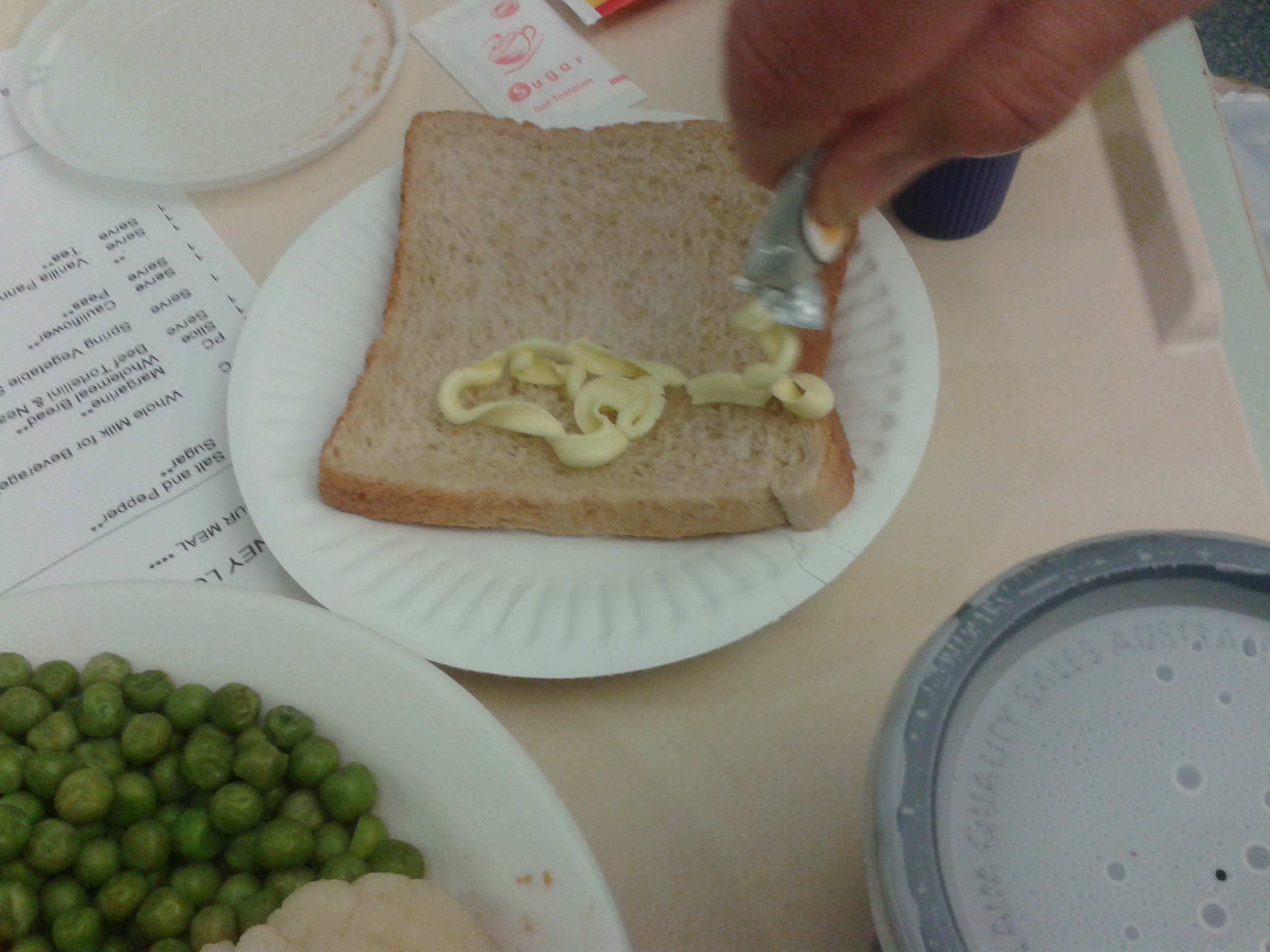
A demonstration of eezy-squeezy margarine

Berri Apple Juice No Added Sugar was “reconstituted” from imported juice; the yoghurt was “lid lickingly good”; and the “handeepax, eezy squeezy margarine” had faint echoes of molecular gastronomy. Maple flavoured syrup was “batch” made, but still “maple flavoured”.

The biscuits with morning and afternoon tea or coffee came in wrappers boasting, not reassuringly, “Nut Free, Seed Free, Egg Free”. The claim, “Easy to Open”, was “certified” by Arthritis Australia. Struggling to open the “Tear Here” cylinders of margarine, I welcomed such certification. But why no “attentively cooked” boasts?2015-05-21 21.33.48 (2)

My book, One Continuous Picnic, sought to comprehend the striking contrast between eating in Italy and industrial Australia, even more pronounced in the 1970s and 1980s. I found Italian freshness, care, taste and pride, and our detachment from the soil – Australia was a “land without peasants”. A recurring theme in the twentieth century was the “Great God Cheap”, as money trumped meals.

Likewise, expensive drugs and medical equipment presumably push kitchen cost-cutting. More doctors and nurses seem more essential than cooks.

My books have studied anti-gastronomic rationalism, but can some good cook out there get beyond the generalities and explain the core culinary problem here? Cheap ingredients? Inappropriate menus? Corner cutting? Too much freezing? Over-cooking? Standing around? Can anyone provide hospital caterers with one good tip, or is it all-the-above, and so the furthering of a grand revolution?

I sought out the wisdom of intellectual Sydney cook, Gay Bilson (Tony’s Bon Goût, Berowra Waters Inn, author of Plenty: Digressions on food). As associate director of the Adelaide Festival of Arts in 2002, she organised “Nourish”, bringing in chefs and volunteers to an un-ergonomically “monstrous” kitchen at Queen Elizabeth Hospital. She sent me an unpublished article about her experiences.

The team served dukkah, olives, olive oil and sourdough bread; chilled tomato soup; chicken salad, rice and chutney; and colourful trifle in a proper glass.

With this, they replaced the “re-hydrated dry goods” and sealed, single-serve portions “straight from a factory”. With feeding patients “an exercise in budget control”, the successful manager “spends as little as possible, ensures that prescribed dietary guidelines are adhered to … that there is no incidence of food poisoning.”

Bilson could scarcely conceal her anger at the local press’s treatment of any introduction of cooking into the Festival as a betrayal of the Arts and, further, entering a hospital as a mere foodie indulgence. The media reported, for example, that patients “volunteered” to take the festival menu, when, “in truth those who ate our food chose to eat it.” Good food was assumed to be expensive, when the team kept to a tight budget.

Bilson decided that the “Nourish” experience would have to prove valuable, if belief in “food in a gastronomic sense (that eating well nourishes the body and enhances well-being) is ever going to be taken seriously as part of caring for patients”.

A further issue, leaving aside the actual food, is the hospital meal as a social occasion, these days accepted as crucial for health. Normally, anonymous forces supply solitary diners, sitting up alone in their beds. No passing the salt, or exchanging chit-chat. Exacerbating that, I got stuck into my tray, cognizant that one man opposite was too nauseous to eat, while the other was classified “nil by mouth”, until he had passed wind (music to the ears of doctors and nurses).

Yet our separation did not feel as dire as the food, which set me pondering. Perhaps, in fact, we were otherwise unusually close. Sharing a room, we survived nights of cries and whimpers together; we saw the daytime trail of visitors (or lack of them); we commiserated about our states of precariousness (an aborted operation because unexpectedly-required equipment was unavailable; with cancer and young children …); we talked about our lives and fears.

A dear friend had advised, “think of everyone in the hospital, together, trying to get better”. At least in that general sense, we had joined some big, collaborative, health-giving meal.

Just a thought, but the expression “hospital food” overly stresses nutritive soundness, and cost-cutting, at the expense of companionship. Perhaps we could push improvements by demanding “hospital meals”?

AFR Top 100 – the view from a restaurant black hole

We live comfortably in a restaurant black hole. Sydney critics and columnists frequently rave about places in inner-city Surry Hills, the CBD, Bondi beach and the Lower North Shore. Although we’re still in the Inner West, they rarely come near us. The hipsters have not reached out this far. More tellingly, we live in a weird gap between maps in the Sydney Morning Herald’s Good Food Guide.

We’re left alone in our guidebook black hole with probably 40 restaurants within an easy walk. Along with a big choice of Chinese styles, we have a sprinkling of every other necessary type, including a fine diner. Okay, it’s actually just within a map, and a long walk so that we usually drive, but I speak of Sixpenny at Stanmore.

The two chefs, Dan Puskas and James Parry, found the restaurant’s name in my One Continuous Picnic. In the second half of the nineteenth century, numerous “sixpenny restaurants” catered to the urban labour force boom in Melbourne and Sydney.

https://i0.wp.com/www.sixpenny.com.au/files/2013/03/home6.png

Sixpenny describe themselves as a “little restaurant”, and there’s nothing grand about it – except for their charm, sommelier Dan Sharp’s selections, and their seriously great cooking, with much from the restaurant’s backyard and even more now from their own farm near Bowral. And their crab and macadamia … take a look (that’s it above). We’re talking quietly world class.

Living in a black hole, we tend to keep recommendations to ourselves, but the secret’s leaking out, and last night they were announced as No. 8 in the Australian Financial Review’s Top 500 – with rankings of the top 100

When challenged the other day to nominate good restaurants in the city of Tallinn, and never having been there, I found online the Flavours of Estonia with that country’s Top 50 selected in a two-stage process – gathering the recommendations from restaurateurs themselves, and then importing critics to make the final pick. The Australian version merely asks the industry, and a computer.

The results reveal the method’s inadequacies. I have only been to something like 20 of the top 100, and sometimes only once to a place, but even my experience shows unevenness.

As I say, I accept Sixpenny deserves to rank at least at No. 8. I must get to Sydney’s Sepia one day, and could well believe it’s No. 1, or close to it. As well as dining twice at Melbourne’s Attica (No. 2), I had a week of Ben Shewry’s cooking when he joined me while writer-in-residenceat Stratford Chefs’ School in Ontario, Canada. So, I can confirm that Attica is correctly placed in the very top rank.

I’ve dined in two manifestations of Vue de Monde (not sure why it’s not spelled Vue du Monde), and can believe No. 6. Still in Melbourne, and not everyone’s favourite, but I used to be almost a regular lunch-goer at Cafe di Stasio at St Kilda – a great restaurant at No. 20. And then there’s Sean’s Panaroma in Bondi. I would put it higher than No. 39. But that’s far from the list’s oddest ranking.

I tend never publicly to bag bad experiences, so won’t cite a couple of over-rated places. But let’s just look at Adelaide’s top two. Both good, and Magill Estate is believable at No. 44. But Orana at No. 47?

https://i0.wp.com/restaurantorana.com/wp-content/uploads/Spencer-Gulf-prawn-and-dill-700x466.jpgAdmittedly only been once, and I had some criticisms (about the need to make the space feel slightly warmer, and not relying on just one glass of champagne to last through all those fabulous introductory snippets), but surely Orana should have been placed much nearer the very top.
At least on our night, I reckon Jock Zonfrillo took Australian cooking in a new direction. Perhaps his fellow chefs have not yet had the chance to get there, or the computer isn’t all that clever, but for finally showing native foods as something supreme …

It’s expensive, so I won’t say to rush, but if you get the chance, let me know if I’m wrong.

Ten reasons you’re needed at table

SV300354 (2)

1. To be polite

… which means coming to the table as soon as called, because the cook probably has hot food ready and/or needs urgent assistance. Showing enthusiasm will be rewarded

2. As a platform

… for actual conversation. More important than social media,* chit-chat is at the heart of good living, socialisation, civilisation and word of mouth

3. To look silly

… it’s not necessary to hold bad manners dinners. Just check out, between mouthfuls, others chewing

4. To be sophisticated

… there can’t be much more to get on top of

5. For seduction

… at table together … the fundamental test of compatibility**

6. To be a family

… as Brillat-Savarin said, some couples might sleep in separate beds, but they can always share the  table, and have an endless topic of conversation: the previous meal, this, and the next one

7. For health

… solitary dining shortens life expectancy

8. To join the human race

… because, as James Boswell decided, we’re the cooking – i.e., meal-making – animal

9. For pleasure

… and, nearly forgot …

10. For physical sustenance.

* I couldn’t resist composing a listicle or list-article – rhymes with “popsicle”

** Try searching “marriage compatibility” – the results are dominated by astrological, numerological and other such sites. Sexual compatibility used to be the thing. It must be meals’ turn

Making the Mother’s Day monster (“commercial aspect … to be kept concealed”)

A holiday (or holy-day) reveals what a people finds, or is expected to find, sacred. So, Australia officially celebrates such things as the birth and death of a religious leader, the nominal birthday of the highest political figure, workers’ success in reducing hours, horse races – that sort of thing.

We’ve just had Anzac Day, which celebrates war over peace. And today is our Mother’s Day, and in other countries that follow the U.S. lead, and an automatic holiday, because “the second Sunday in May” is a God-given holiday.

Can you already see the core dilemma of our times? – commercialism as the new sacred. As in no long paying workers a bonus for working on traditional holy-days. As in interest groups promoting their trade, charity or political cause through “days”, “weeks” and, in the case of the United Nations, “years”.

The supermarket chain calling themselves the “Fresh Food People” recently marketed the claim that dead soldiers were “fresh” in our memories. Incredibly, no-one in Woolworths knew it is illegal to use “Anzac” (Australian and New Zealand Army Corps) for commercial purposes – no selling even of “Anzac biscuits”. (The corporation appears then to have spread a rumour that its campaigns are run from London.)

My interest in holidays started with the oddity of how we, in the southern hemisphere, celebrate Christmas and Easter wrongly by six months – such feasts originally marked the seasons, before calendars.

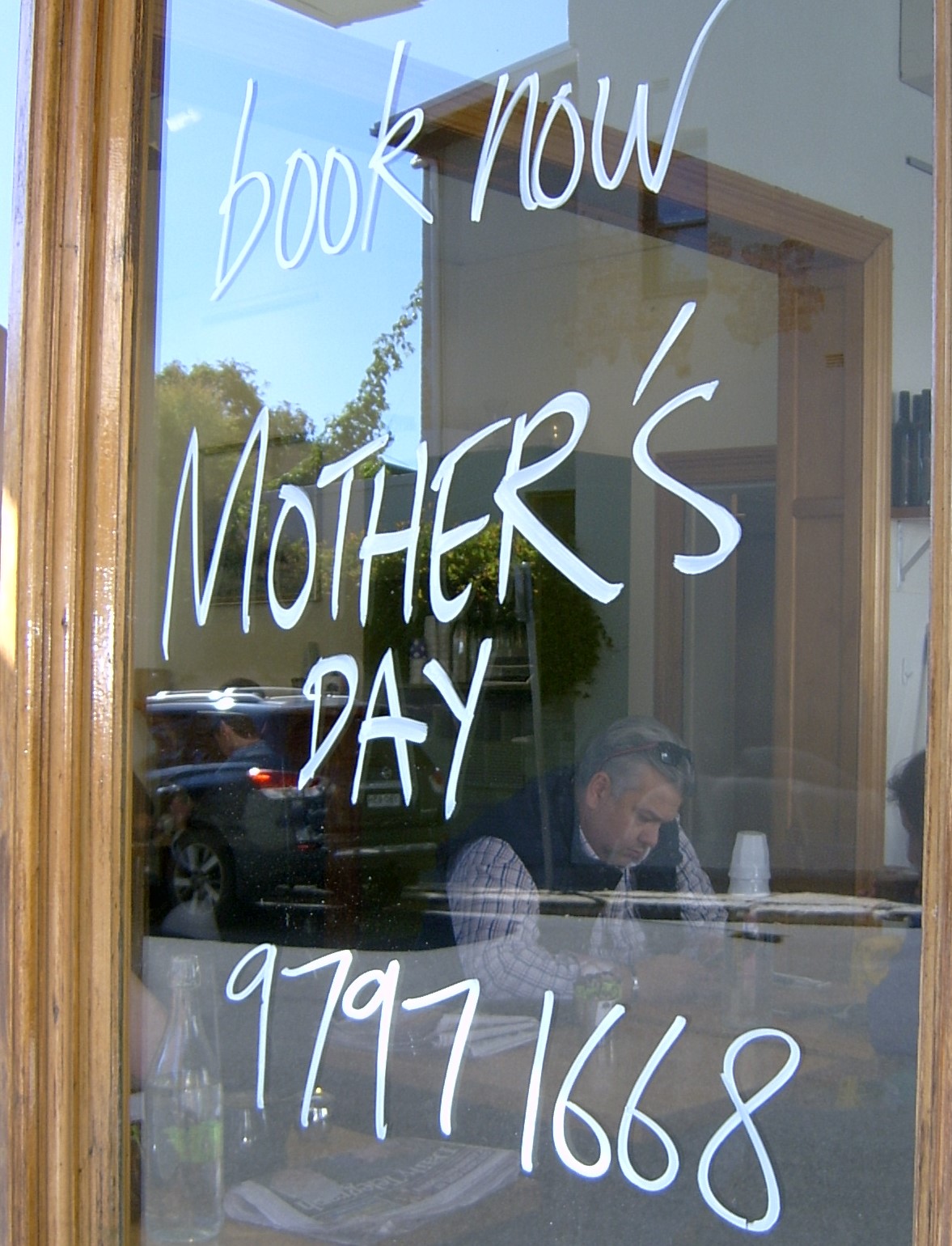
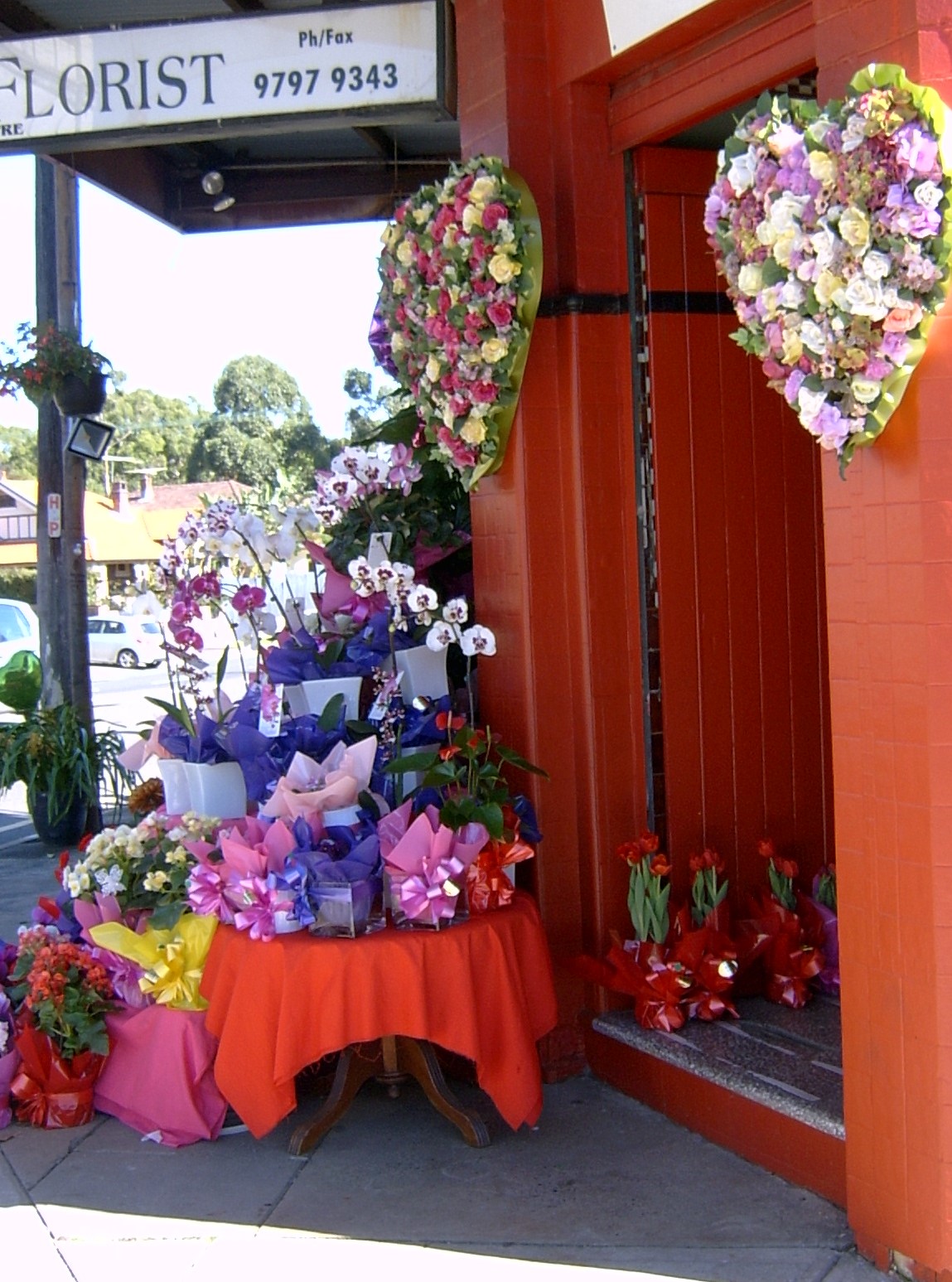
SV300357 (2)I’ve only now paid much attention to Mother’s Day, other than both decrying its commercialisation, while knowing our restaurant would be full that day. I hadn’t realised it was such an ethical, political, festival monster. Motherhood – sacred, and an even more sacred marketing opportunity.

It’s perfect blackmail – if you don’t celebrate (i.e., pay up), you don’t love your mother.

One less-commercial answer is not to buy cards, gifts, flowers and restaurant meals by relieving mother of the cooking for the day. But why only on that day – aren’t women liberated?

So what I have just learned? Firstly, an invaluable resource indicates where to place the apostrophe (and we are interested in apostrophes). Apparently, in trademarking the phrases “Mother’s Day” and “second Sunday in May” in 1912, Anna Jarvis declared:

“Mother’s” should be a singular possessive, for each family to honor its mother, not a plural possessive commemorating all mothers of the world.

But was Anna Jarvis (borrowed photo at the top) even the founder of Mother’s Day? Some quick research reveals that its invention is as confused as any other.

Let me explain origin myths. My researches (along with Helen Leach and others) have found that named cakes and biscuits almost invariably come with competing stories, none of which is exactly correct. It’s even impossible to declare definitively whether the Pavlova was invented in Australia or New Zealand. That’s the sacred national dish for both of us (and so let’s both declare Pavlova Day!)

What happens is that they are social inventions, by many hands, but through social construction, people endow the apparent solidity of a distinct concept that therefore must have a definite inventor. Or so it seems. To read more, check out my papers, “The confection of a nation” and “The cleverness of the whole number” – available through here or here.

The web tells all kinds of origin myths about today’s “Hallmark holiday”, including Anna Jarvis’s struggles against florists’ exploitation of her mother’s favourite flower, a white carnation. It’s said she devoted all her money to that second campaign, only to have the florist industry secretly pay her nursing home bills, such was their gratitude for having exploited her story.

We might suspect that’s another florists’ myth. Nonetheless, accredited scholars have interesting stuff to say. Not that they agree.

Apparently, social activist Julia Ward Howe’s Appeal to womanhood throughout the world (later known as Mother’s Day Proclamation) called on women to unite for peace. Written in 1870, Howe’s was a pacifist reaction to the carnage of the American Civil War and the Franco-Prussian War. It was also a feminist push at the political level. In 1872, Howe unsuccessfully sought government backing for a “Mother’s Day for Peace” on 2 June every year.

And Wikipedia claims: “The modern Mother’s Day is an unrelated celebration and it was established by Anna Jarvis years later.”

That is probably incorrect, contradicted by Katharine Lane Antolini in Memorializing Motherhood: Anna Jarvis and the Struggle for Control of Mother’s Day, 2014.

The encyclopaedia for our times is relying on an earlier book, Leigh Eric Schmidt’s Consumer Rites: The Buying and Selling of American Holidays, 1995. Despite (or because of) doing much research into Jarvis, he failed to find any association between the pacifist Mother’s Days and her version. And yet Schmidt knew that Anna Jarvis set out to honour a mother who would appear to have been a pacifist, involved with the earlier version, and organising “special rituals of reconciliation after the Civil War”. These Mothers’ Friendship celebrations brought together neighbours on the border regions, which the Civil War had split.

Schmidt makes much of Anna Jarvis’ insistence that “Mother’s Day celebrations … were founded by me”. Yet she had to defend her holy day from appropriation from not just religious and political interests, but also commercial, as Schmidt shows so well. His earlier paper, “The commercialization of the calendar”, concentrates on Mother’s Day, and is worth reading.

When after a long illness her mother died on May 9, 1905, Jarvis was devastated. In another irony, Jarvis was saddened that her mother’s hopes to have a college education had been thwarted by “home responsibilities”, and her “pleasure and ambitions … restrained by the ties of motherhood”.

The American calendar, Anna Jarvis insisted, was permeated by patriarchy:

New Year’s Day is for “Old Father Time”, Washington’s Birthday is for “The Father of his Country”. … Memorial Day is for Departed Fathers. Independence Day is for Patriot Fathers…. Thanksgiving Day is for Pilgrim Fathers.”

The trade newspapers – Florists’ Review, American Florist, Horticulture and Florists’ Exchange – all noted the day’s first year of observance in 1908. The Florists’ Review carried a letter: “It’s a sentiment that appeals to every man and boy, and people bought flowers that never bought before. … We hope to make it a holiday for the United States. Crowd it and push it … and [it] comes when flowers are cheap and plenty.”

In April 1910, the Florists’ Review reminded: “Well, what have you started to help along Mothers’ day? Seen the mayor abouSV300355 (2)t issuing a proclamation? Called the ministers’ attention? Spoken to the local newspapers?”

The trade saw the story of Anna Jarvis’s love for her self-sacrificing mother as “more publicity for Mother’s Day than money can buy.” Discussing advertising strategies for Mother’s Day in 1916, the American Florist advised: “The commercial aspect is at all times to be kept concealed.”

By 1920, Jarvis turned against her former allies, now denouncing the “charlatans, bandits, pirates, racketeers, kidnappers and other termites that would undermine with their greed one of the finest, noblest, truest Movements and celebrations known”.

In 1922, the Florists’ Review pronounced Jarvis’s campaign against the trade foiled for another year: “Miss Jarvis was completely squelched!” Her “vaporings” against commercialization had actually increased publicity for Mother’s Day. Even better, controversy was free.

Already in 1913 the Florists’ Review had blustered: “Mothers’ day is ours; we made it; we made it practically unaided and alone.” As Schmidt concluded:

Anna Jarvis devoted a great part of her life to building up what she called the “Mother’s Day Movement,” but she wound up spending an equal share of it bewailing “the mire of commercialism” into which her sentimental and religious occasion progressively sank.

Mind you, I admit that, when separated by distance from a meal with my mother, I have been involved in sending flowers.

SV300356 (2)Nonetheless, who will join me in the Meals Matter Movement – launching something for all seasons in all hemispheres? Let’s celebrate Private Meals Day.

Restaurants in Europe as ranked by elite diners (Opinionated About Dining or OAD)

OSV300343 (2)ne of my most valued possessions is a framed, souvenir handkerchief of the best Parisian restaurants in the 1950s. Several are still going, but I’ve only ever got to one, Chez Allard. It was still run by the family, we had the front room by the zinc bar to ourselves, and it was totally memorable. We had proper, Burgundian frog’s legs, as boasted on the cloth, and wondrous duck with turnips. It’s not just because the hanky was a gift from the late Marlis Thiersch, who had brought it back from Paris not long after the war, but also because I cannot hide my secret sin, rating restaurants. A Michelin red guide for 1931 might be useless in a practical sense, but not to me.

When the World’s Best 50 go on-line, I’m in there. With even more alacrity, I follow Opinionated About Dining, put together from diners who are both privileged and obsessive, getting to the latest and greatest, wherever they are. OAD veers towards the more classical and expensive, but I can at least read about them.

Today, I received the  latest OAD ranking of 200 in Europe, and over the years I’ve accumulated meals at, not counting, seven on the list.

L’Arpège is no 3, and Noma no. 9. I would reverse those positions, but caught Noma in possibly more exciting, early days. Also based on one experience, Guy Savoy is right up there. Continuing to talk about Paris, two visits to the original Spring were among the most rewarding experiences of my restaurant life. We’ve also found excuses to go back to Grand Véfour and Septime, and, among those outside Paris, took in Bocuse … All recommended.

What would I add? –  definitely some far-away, one-star places, such as La Petite Maison in Cucuron, Les Chênes Verts at Tourtour, and Le Maximilien in Zellenberg. That’s based on one experience each, one or more years ago.

SV300349 (2)I would like to contribute ratings, but, really, my help would be scattered and mainly for Australia, and OAD so far encompasses only the U.S., Europe and recently Japan.

Several Australian places compare well. We keep returning to Sydney’s Sixpenny, and not only because it’s nearby. I’ve had the chance to appreciate much Ben Shewry cooking – his Attica in Melbourne is ensconced in the world best list. Somewhere newer that hits such heights is Adelaide’s Orana.

At Orana, Jock Zonfrillo and team bring flawless cooking to indigenous foods. Will it appear in the World’s Best 50 for 2015, to be announced on 1 June? I would hope so, despite only one dinner there, and a couple of criticisms, especially their one glass of champagne for an extraordinary procession, half an hour or more, of little tastes – really well done, and then separate wines came with each dish. The sommelier did a memorable job blending fruit juices for our daughter to accompany each of our nine wines, but I prefer my wine early and to taper off.SV300340 (2)

Unusually for such a good restaurant, Tripadvisor immediately ranked it at no. 1 in Adelaide, and it remains on top, out of 1,378 restaurants, such is Orana’s fierce support.

Today’s lesson for fellow guidebook tragics is that these guides, however seemingly erratic or opionated, are inconsistently backed by the Tripadvisor crowd. Take the case of Noma, which returned last year to #1 in the world’s best, now rates #9 in Europe for OAD, but only #20 for just Copenhagen, according to Tripadvisor.

As to Arpège, which is #3 for the whole of Europe on OAD, and #24 in the world’s best, it is ranked #714 by Tripadvisor, and that’s just for Paris. That’s better than somewhere I must get to one day, Ambroisie, coming in at #35 for OAD, and lying down there at #2,992 for the popular vote.

Yet, as unreliable as Tripadvisor might be, any guide is better than no guide, so I haunt that one, too.

Comedians at dinner, or, Why I love Brydon, Coogan (and Winterbottom’s) Trip and Trip to Italy

A FRIEND SAW THE MOVIE version of the Trip to Italy, together with some of Sydney’s top Italian restaurateurs, and all were disappointed. New Yorker reviewer David Denby joined an audience “apparently expecting a beach-and-mountain travelogue. For a hundred and ten minutes, watching some of the funniest comedy in years, they maintained a puzzled silence.” Not everyone loves The Trip (2010) and The Trip to Italy (2014), so I promised over dinner the other night to explain my delight.

These are the adventures of comedians Rob Brydon (Welsh) and Steve Coogan (northern English), as they chat in the car during a scenic drive, compete in mimicking movie stars over a restaurant meal, pose for a snap in front of a plaque for a poet whose lines they recite, get shown to their hotel room by a young woman, sometimes have a brief encounter, and talk on the phone to a partner, child or agent or themselves in a mirror.

Without having seen the movies, I suspect the six-part series, upon which the movies are based, are preferable not only because they are longer but also because, accented with music, the same ritual every episode lends a melancholy predictability. dark-knight-rises-characters-hilariously-impersonated-by-steve-coogan-and-rob-brydon

My wife happily tolerates my enthusiasm, but wonders if our divergent opinions might invite gender analysis. True, David Denby of the New Yorker asserts: “Both movies, in fact, are about the impossibility—and the necessity—of male friendship.” However definitive that might sound, he also applauds several other basic themes. The men reveal their attraction to younger women – receptionists or at a nearby cafe table – and agree that glances are now not so usually reciprocated. I also wonder whether two female comedians might yet be allowed to retain the same dignity, while being so frequently silly, and mean, but will wisely leave further such conjectures to others.

Both series show some of the world’s loveliest scenery (the Lakes District and nearby parts of England, and the west coast of Italy), finest restaurant food and smartest comic impersonations (Michael Caine, Sean Connery, Woody Allen and Hugh Grant being ones I recognise), but the series are not particularly about any of these, nor quotations from Wordsworth and Coleridge in England and Byron and Shelley in Italy, nor celebrations of the craft of comedy, nor conversations about fading professional careers, about aging and death. Amalgamating such components, the Trips are classics of apparent simplicity, exemplified by the addictive rhythm.

The viewer accepts immediately that Brydon and Coogan play clever caricatures of themselves (Coogan more on top – including longer hair – in the first series, and Brydon winning in the second), and that they are not really reviewing the restaurants for the Observer, but a third, highly creative force is also hiding behind them. Using the same actors, director Michael Winterbottom developed some of the same techniques in Tristram Shandy: A cock and bull story (2005), and he had already done a road movie, In This World (2002), depicting the harrowing “smuggling” of two Afghan refugees from Pakistan across the Middle East and Europe to Britain.

Presumably also contributing to the minimal plots, Winterbottom has spent much of his adult life making movies far from home, probably getting used to luxurious accommodation, so that his former wife, Sabrina Broadbent, wrote Descent: An irresistible tragicomedy of everyday life (2004) about a movie director, always away, having affairs with his female actors. The shows revel in ambiguity, with the glamour constantly subverted. The beautiful food, places and people are haunted by insults and interruptions, quarrels about driving, agents sounding hopeful, relationship troubles, and time passing. As Denby reports: “Both films pursue the high and the low: a complicated deep-running sadness courses through the cynical, sybaritic adventures.” Winterbottom has captured the Nigella Lawson lesson – behind every façade lies pain (the “domestic goddess” had everything, including a nasty, public split with wealthy advertising entrepreneur husband Charles Saatchi).

A dear friend used to finish her emails with the tagline: “Be kind, for everyone you meet is fighting a great battle”, probably the invention of Scottish pastor, Rev. John Watson (1850-1907). The shows’ downers might seem casual and never worse than hit-and-miss communication, rivalry, nagging doubts and work pressures, but time is always fleeing. The implicit lesson is: “Eat, drink and be merry, … ” and I plan to write further in defence of that philosophy. For the moment, my argument is that the Trips witness the fundamental distinction between food and meals, and, at the risk of repetition, meals matter. Two or three brief shots from each kitchen show the cooks paying considerably more attention to the dishes than the two diners ever do. It is as if to say that celebrity chefs and photogenic plates have been accorded too much prominence of late.

As Brillat-Savarin wrote, table-pleasure depends not on fancy fare, but on four essentials: at least adequate setting, food and drink, companionship, and time. I’ll expand on this important point on another occasion, even if Brillat-Savarin gave two, differing lists of the four necessities (reconciled here). Nevertheless, Winterbottom has won me over by making the food and wine plainly important, but only one part of the picture. He has wondrously illustrated the peaks of all four necessary elements – glorious settings, fine comestibles, exceedingly witty and caring conversations, and apparently (only apparently) all the time in the world.