
 SOMETIMES THINGS fall into place so neatly as to be scarcely noticed. But I have never let myself forget the good fortune in discovering a simple savoury that we served to every customer from the first night of our restaurant in Tuscany in 1979 until Jennifer Hillier shut the doors on the Uraidla Aristologist seventeen years later.
The cheese savouries became minor celebrities, and various recipes have popped up in magazines and the internet over the years. Oddly enough, no-one seems to have revealed our source, until now.
To quote a recent correspondent with this blog:
Hi Michael – way back when living in Adelaide, I visited several times your lovely Aristologist restaurant in Uraidla – and so often reflect on the wonderful food that came to our table. I was wondering if your recipe for those lovely ‘cheese aperitifs’ that greeted us at the table as we began our evening was available in any publication? Sitting here in London on a grey morning, with this awful virus being the latest ‘panic’ we are facing, I was thinking how lovely it would be to be guided as to how to rekindle the taste buds with these lovely ‘bites’. If you could send me in the right direction, that would be wonderful.
with warmest wishes
Jill
A quick online search showed up this version, “Grown-up grilled tomato and cheese sandwiches” on the blog of Mardi Michels, now living in Toronto, and who admitted she first ate them “at the legendary Uraidla Aristologist restaurant in the Adelaide Hills, where I was fortunate enough to dine a few times when I was way too young to really appreciate it”.

That’s Mardi Michels’s photo, here. She wrote about them again as “Croque Monsieur bites”, which is the photograph at the top. We only ever grilled them draped in grated cheese.
On the night before we opened the Cantina di Toia, we were still desperately seeking something to serve with a glass of the Fattoria de Bacchereto’s vin ruspo, the local, fresh, light, rosato-style wine that makes an excellent aperitivo. The best Sydney restaurant back then – Tony and Gay Bilson’s Berowra Waters Inn – would open with something with a glass of champagne. If such a welcome was good enough for them, it was good enough for us. Like them, we offered a fixed price meal (with several choices), which we thought of as a “licence for generosity” (a description Gay agreed with).
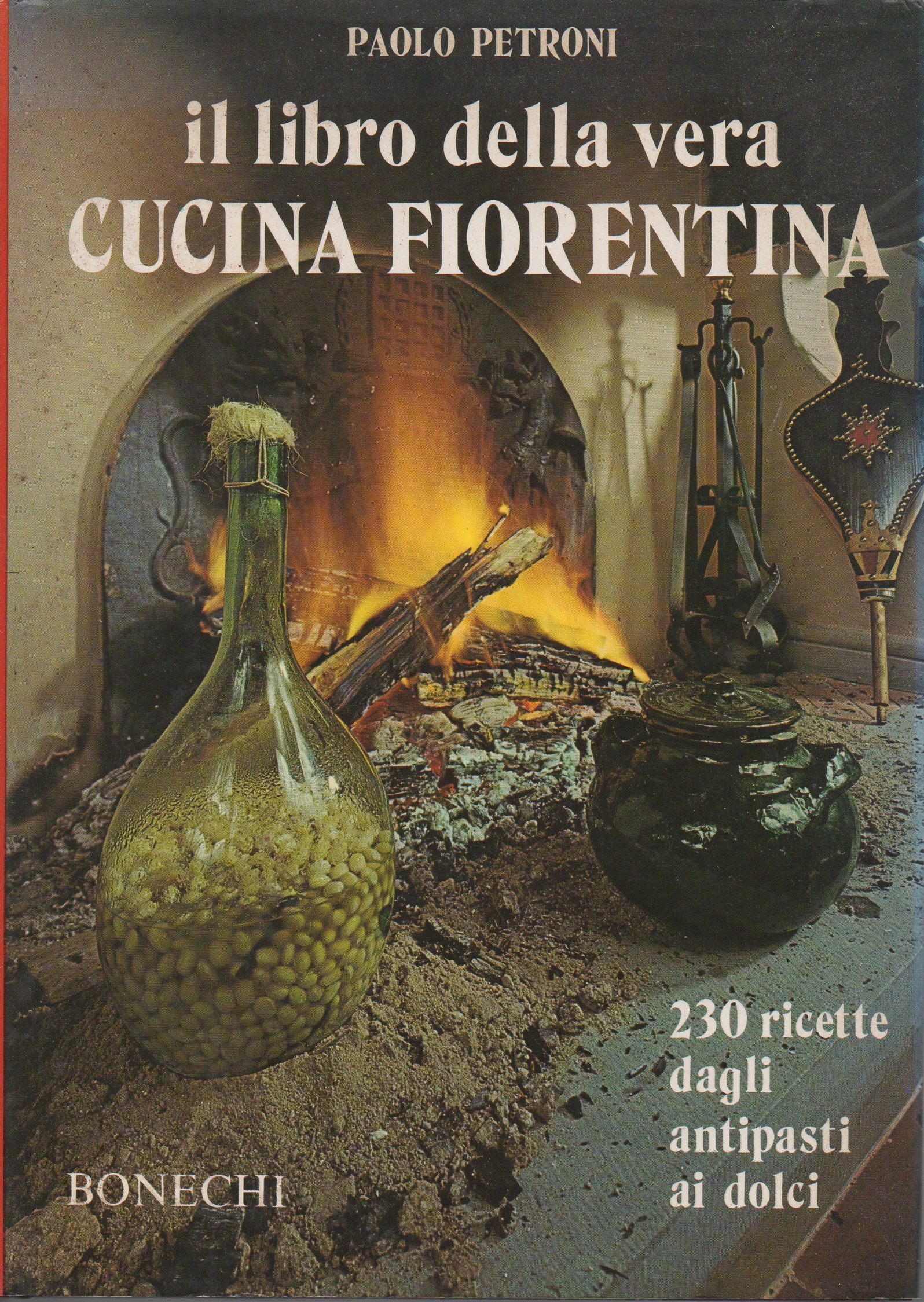
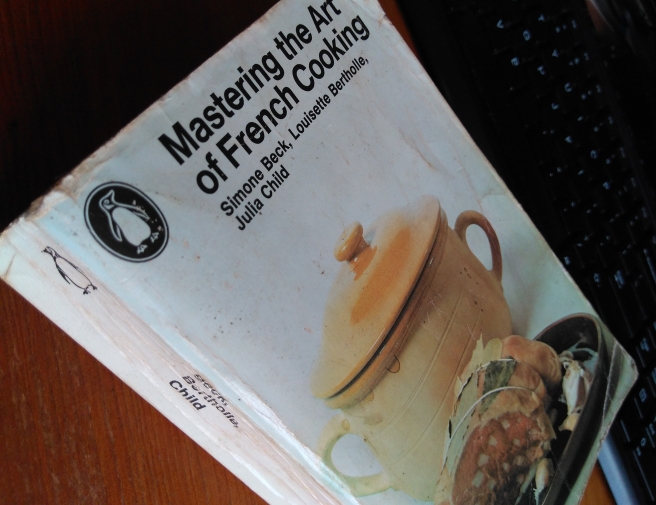
In desperation, where does a person turn? We loved Paolo Petroni’s serious local recipe book, but wanted something less familiar for our customers. Italians scarcely knew even basic French things like quiches, let alone the Antipodean Pavlova (both of which we served). So, I checked out Elizabeth David, Jane Grigson and Mastering the Art.
It was in this last that I found “Croûtes [Toasted Bread Cases]” on page 222 of the Penguin paperback edition. The selected filling became “Fondue au Gruyère [Cream Filling with Swiss Cheese]”, two pages later. I presume that was the original filling – in my head, it’s just a thick, white, cheese sauce. A béchamel, if you will.
To summarise our method: we purchased white, unsliced “supermarket” bread a day or two early (slightly older is easier to handle). Take off the crusts, then cut into approximately 4cm-thick slices, which are divided both ways, to come up with cubes. Next, the tricky bit. After doing this countless times, I became committed to a perfect, little, sharply pointed knife, with which I hollowed the cubes out exceedingly neatly. Brush with melted butter, and crisp a little in the oven until pale gold.
Meanwhile, you will have made a thick white sauce. That is, heat flour and butter in a saucepan to make a golden paste, add milk, slowly at first to stir out even the possibility of lumps. Add grated cheese. Following Beck, Bertholle and Child, we “enriched” with an egg yolk or two. (Did we grate in nutmeg? – not sure.) Fill the cubes, covered with a pinch more cheese, and brown them in the hot oven.
Think that’s right, Jill! It’s many years since we made them. But you now have the source recipe.



 Paris secrets, or at least the dining we’ve enjoyed these past five weeks, with the added test of wanting to return.
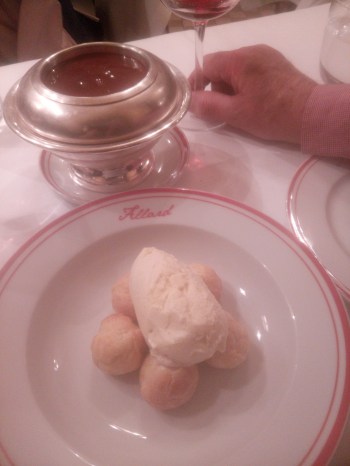 Nearly 40 years ago, I dined Chez Allard, a then one-star bistro founded in 1932. Monsieur Allard (by then, the son, André) recommended sharing the frogs’ legs, because they were the real burgundian ones, and recommended against their famous specialty of duck and olives, because duck and turnips were briefly in season. Just accept our carafe red, he reassured. I probably had profiteroles. And the meal in a then near-empty bistro was magnificent, the duck among the best things I’ve ever eaten.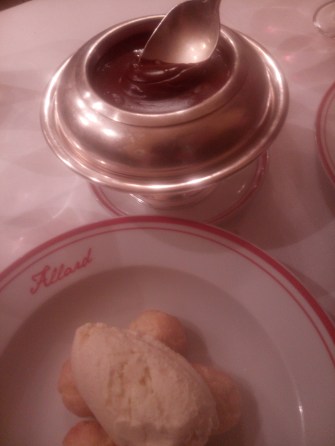
 To engage in some national stereotyping, Italians are “exuberant and spontaneous”, Americans are “enthusiastic and demanding”, and Japanese are “delicate and discreet”.
 Another interesting national difference is meal times. Most nationalities lunch around noon or 1 pm. With a bit more of a spread, breakfast is usually 7:30 – 8:00, but with some expected even earlier. I’m with Germans here, though, because they breakfast seriously, preferably between 8:30 and 10:00.
 My temerity in telling someone the other night about being a “new friend” occasioned further pondering.
 A couple of older women work on laptops, and one is now on a mobile – she has a friend, or maybe it’s work. A young tourist couple come in for double consumption – photographing their breakfast, before touching it. Are these zillion photos as expendable as Zuckerberg’s 75 million followers?
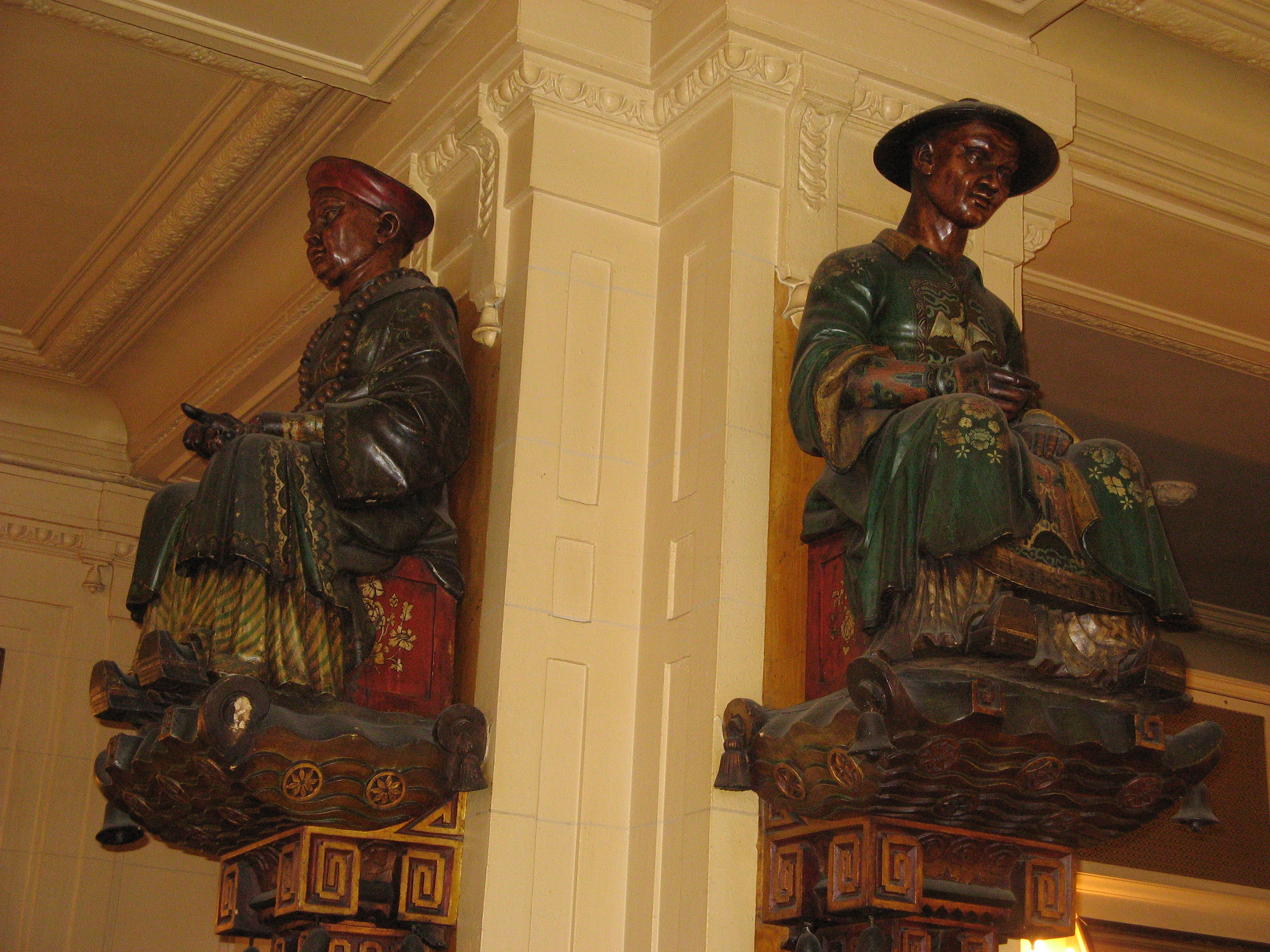 How odd, a tour group files in a side entrance and out through the heavy revolving door (which waiters manage with a packed tray on the arm), photographing the carvings of the two oriental-looking magi, their backs permanently turned on each other. My impression is that tour groups often lead to lasting friendships, people having taken meals together.
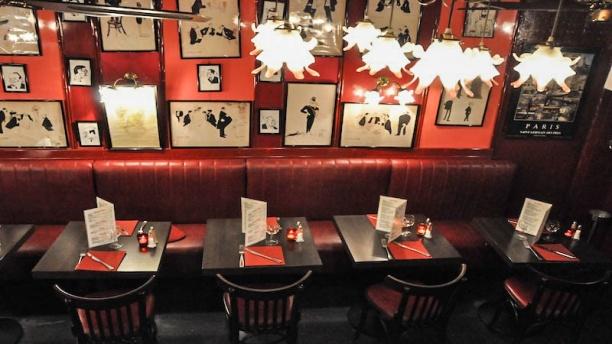 As a restaurateur, I cannot deny having loved our regulars. We had a couple who came fortnightly, for years. They drove quite a distance from a beach suburb, and plainly enjoyed each other’s company. We kept Table 8 for them.
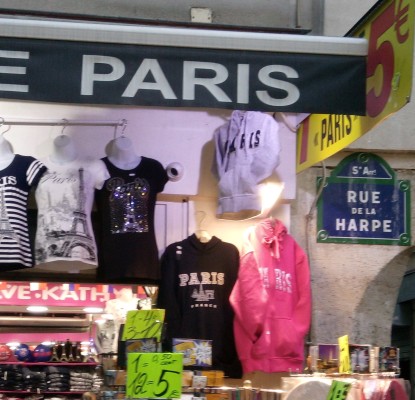 PARIS IS ONE WORD worth more than a thousand pictures.
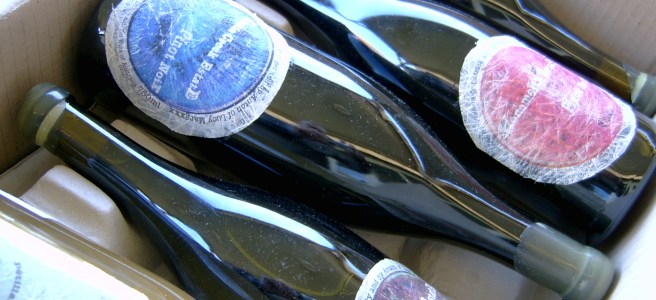
 SOMETHING WAS revealed about my choice of restaurants, or my friend’s, the other day, when he said he was unfamiliar with “natural wines”.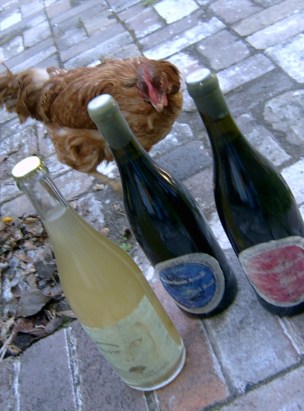
 Meals Matter