THE HEAD CHEF and co-founder of Noma, René Redzepi, resigned yesterday, after 35 former employees had gone public with his workplace abuse from 2009 to 2017.
Everyone seemed unusually friendly when we dined there at the end of May 2007. I even noted Redzepi’s sweet smile, as he worked at a bench overlooking the dining room.
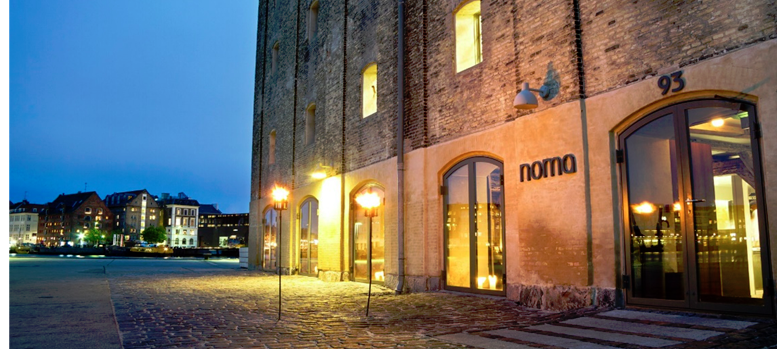
Redzepi had opened Noma with a partner in 2003 in an old Copenhagen warehouse, which was being transformed into “North Atlantic House”, so they were to celebrate ingredients from Denmark, Iceland, Greenland and the Faroe Islands.
I remember numerous snips of this and that by way of found grasses, flowers, etc, before such additions became more common. I particularly recall tiny, cold, dense oysters.
The meal was unforgettable for its completeness, which means not just the food, but also that port location, and more. Our daughter and I sat outside in the late-afternoon sun waiting for Marion to cycle around the docks from her conference. My beautiful German Riesling seemed to be made for gazing at the city centre across the harbour, or back at the spiral church tower that Dorothy had just climbed.
And there was the exemplary kindliness. One notable instance was that, after they had found somewhere to stow Marion’s bike, they let us linger with her beside the water, bringing out an extra round of marvelous crisps of fish and chicken skin.
The thing we could never forget, however, concerned our severely disabled son left back in New Zealand. Marion and Dorothy were keen to phone him. Since this evening was an appropriate time to call, we inquired about a nearby public phone. They insisted on using theirs. But you don’t understand, we said, this is a phone call to New Zealand.
Given Lawrence’s brain damage, “phoning” really meant singing to him. When we were back together, a little emotional, the waiters slipped us small, black, textile handkerchiefs.
Noma proved much “less” – friendlier and more intimate – than might have been imagined from the hype, which, of course, was working up to it being named world No. 1 restaurant for several years (2010, 2011, 2012, 2014 and 2021). In 2007, I witnessed nothing but serious care and concern.
I WAS FORTUNATE TO DINE OUT frequently for nearly six decades with journalist David Dale (27 March 1948-6 August 2025). This was often along with Suzie Anthony.
Our paths crossed early, when he was still a student and I was starting to make a name at the Sydney Morning Herald. He wrote me a long letter arguing that I didn’t understand guitarist Eric Clapton (or something like that).
I was the paper’s first or maybe second deliberate hire of a university graduate (my degree was in maths, and they had a “new maths” education supplement to bring out). When David and Suzie joined, they became “graduate cadets”, who were required to learn shorthand. I always reckoned he had the world’s most useless skill, shorthand slower than his long.
As young journalists at the Sydney Morning Herald, the three of us had lunch and dinner out many times a week for four or five years.
Later, in 1975, after a particularly beautiful lunch at Watson’s Bay, we three sat on a wall above the sand, and swore lifelong allegiance, which we honoured. We kept up meals together with a few unavoidable interruptions, such as living in different countries.
From my perspective, David seemed to lead a compartmentalised life. Early on, he had a girlfriend that Suzie and I never met. Mischievously, we knocked at his address, and were welcomed by a mother desperate to meet some of her boy’s friends, and she laid some of her concerns before us . Never met his father.
He also deliberately shied away from deep thoughts. When we met, he had completed Honours in Psychology, but was keener on Mad magazine, and turning to early Woody Allen movies.
David and my paths crossed more than once in Italy – and he never let me forget about revealing to both him and my father where to find the key to our ancient Tuscan watermill during one of Jennifer Hillier and my absences; David terrified my father in bed asleep, with Christopher demanding: “Do you know Bob Hope?” This was someone (the partner of colleague Julie Rigg’s expatriate mother) whom we all got to know well over there.
By then, he had joined the classy little gang putting out the radical media critic, the New Journalist (which I had co-founded with Leo Chapman and another old colleague who died this year, Paul Brennan).
Without hesitation, David became a third partner (along with Gabriel Gaté) in Duck Press that published my One Continuous Picnic in 1982. He leapt in as its editor.
In the late 1980s, I was invited to lunch in Adelaide, at his suggestion, by a visiting Bulletin journalist, Susan Williams, who grilled me about her editor. They married in Paris, without guests! When I married Marion Maddox in 1995, Suzie was my best person and David her assistant.
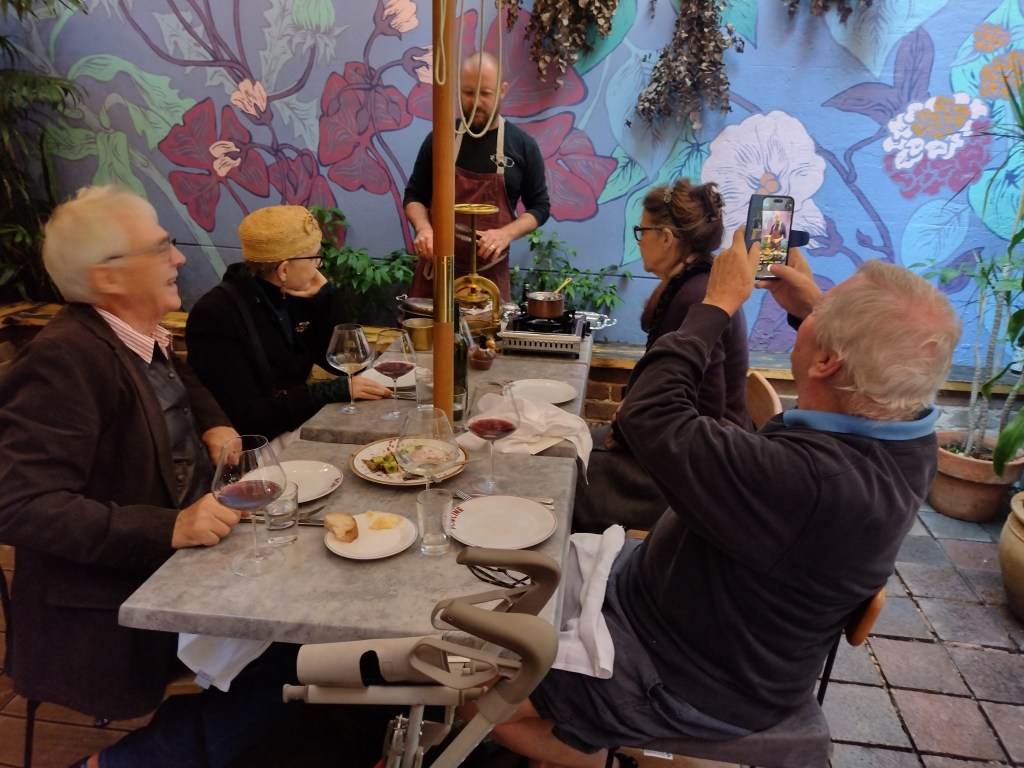
Towards the end, David increasingly talked streaming tv (that I never watch). Suzie and I found him reluctant for Friday lunches, but he was, we now imagine, in considerable pain. Our last get-together at La Riviera, he came with a walking frame.
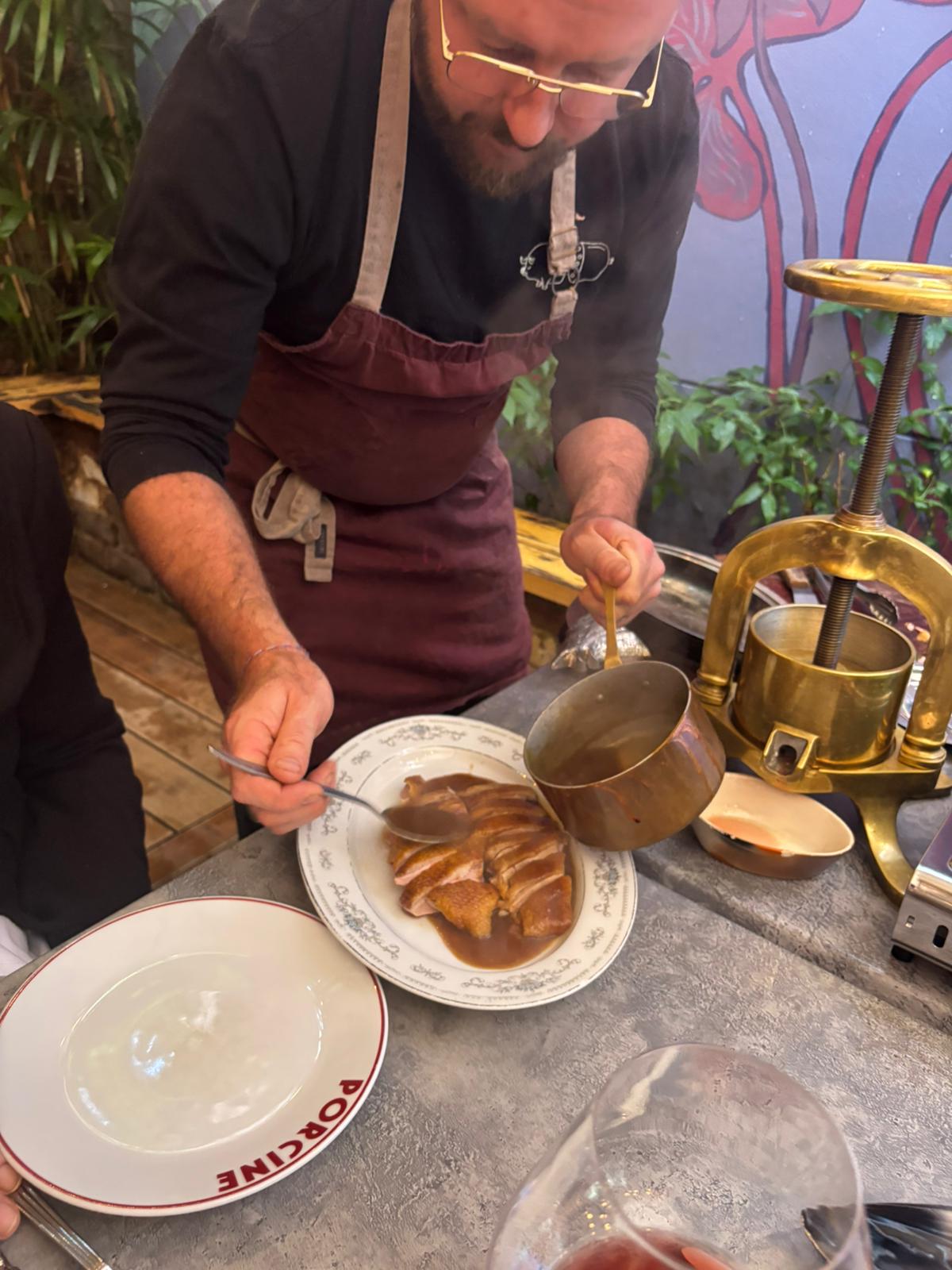
He’d enjoyed sauce from a duck press at Tour D’Argent (I think that was when he secretly got married). Not only the name of our publishing house, it remains my email address, but I hadn’t experienced a duck press.
Accordingly, for our little lunch group’s celebration of my 80th this year, we dined with a duck press at Porcine in Paddington. David needed a walking frame, and my wife a wheelchair; when we discovered the restaurant was up a flight of stairs; the chef generously offered to bring the paraphernalia down to a table set up in the wineshop below.
That was in May. It would be our final meal together. Our paths crossed a last time not many days ago. Marion had two recent stays at the Chris O’Brien Lifehouse. Only on the second, we learned David was in a nearby room all the time. Being a small world, Porcine chef Nik Hill’s wife Milly is a palliative care nurse there. (In an accumulating tragedy, Marion died on 16 September, back there again, two rooms from where David had been.)
When I popped in, he was true to himself, avoiding thoughts of imminent death. On another quick visit, I offered to bring some wine the next night. He was unable to drink, he said, on account of his nausea. He did admit, nevertheless, to wanting the best possible red to be his last mouthful.
That led me to recount how yet another friend with cancer had a few months ago quietly shared an aged burgundy that she happened to “just find in the cellar”. Fortunately, I thanked her profusely for a genuinely amazing experience. Only later, I discovered a bottle online for an equivalently amazing price. Definitely worth a last mouthful and, within days, our friend disappeared forever from our tables.
Time passes in a pair of small country towns 20 minutes from Adelaide centre
Once upon a time (more than forty years ago), Jennifer Hillier and I opened the Uraidla Aristologist in the Adelaide Hills. Still a long time ago (2016), I promised a blog post, reporting on its namesake, the then new Summertown Aristologist, just down the road.
We’ve dined there several times since, which might be all I need to say. But here are a few quick, belated reflections, and a few memories.
Summertown Aristologist (with apologies to Vermeer)
While individual expressions, the two restaurants have also been products of their times. Our dining room had a provincial feel, with linen and white plates and simple cutlery, in an old stone building in a garden. The Summertown version is more hip wine bar with long shared central table, benches, a booth and outdoor tables.
In Uraidla, we went for a three-course, fixed-price menu, opening with a glass of sparkling wine and cheese savouries with around four choices in each course, and closing with coffee. Those cheese savouries lasted from the first meal at our Cantina di Toia in Tuscany until our last meal at Uraidla.
We decided that the fixed price was a “licence to generosity”, and we asked $38 for some years – seemingly little these days.
The cooking was our version of Italian and French – always a pasta, often a soufflé – an eclectic mix that might appeal to foodies hankering after simple meals in those countries back then.
The Summertown Aristologist offers a collection of dishes (sample menu below), usually centred on one ingredient, so that one can snack, share plates or submit to the chefs’ collection, and cooked more professionally. While a series of chefs have taken charge, their food has remained surprisingly consistent.
Both places set out similarly focussed on local ingredients in changing circumstances, given how we ran through the 1980s into the mid-1990s (Jennifer held on a couple of years longer).
We chose a hidden paradise of market gardeners for our location, although the small growers were already then getting big or out. I would go around the district each summer morning extracting zucchini flowers, and also picked up vegetables from one or two remaining old-style market gardeners. The cherry varieties were extraordinary (including from Julie Bishop’s parents). We were able to get English gooseberries from Basket range, sour cherries, quinces, foraged blackberries. A young family started farming Basket Range trout. Basil from a film maker. Avocados from a nearby valley. Locally farmed quail.
We grew plenty in our large garden, including globe artichokes in spring (only cut when ordered), an over-abundance of raspberries through December… and eggs throughout.
Jennifer always baked our bread rolls, and made preserves. We did cure prosciutto and salami, relying on local Italian expertise, but relied mostly on Vari’s deli and then Marino’s in the Central Market..
While strawberry growers have kept up, and orchardists with cherries and apples are somewhere to be found, the Summertown operation could name several prized suppliers the other day, although often at a relative distance, while they boasted growing all their own vegetables. Otherwise, it’s simple ingredients sympathetically considered, the old trick.
Since Jennifer and I were doing a restaurant for its own sake, and eschewing prevalent commercial approaches, we turned out often to have been ahead of our time. Perhaps the simplest example was the grumbles (and thanks) we attracted for “inviting” guests to smoke cigarettes away from the dining-room in a special room or outside. The Summertown A. has no fights on that score.
Perhaps little indicates the changes like wine.
The quick profit from brussels sprouts was ruining land back then. Fortunately, grapes were coming in: Petaluma had planted in 1979, and Ashton Hills would break ground in 1982.
I organised the first Adelaide Hills Wine Show. To get it going, I simply went around to Geoff Trenorden’s – the secretary of the excellent Uraidla Show – and he said “sounds good”, and what section did we want? Since “W” was available, we became Section W: Wine.
Winemakers Brian Croser and Stephen George joined in, and decided that judging should be done by the exhibitors themselves, sitting around in a circle at the Aristologist. The show started with possibly half-dozen wines, including from backyard makers, but within a few years Croser and George were joined by other notables, not least Stephen and Prue Henschke and Geoff Weaver. Those were the days.
While they now have vineyards in all directions, the Summertown restaurant owners are natural winemakers, the restaurant doubling as their cellar doors.
The changed cost of wines is remarkable; fancy wine prices have responded to increased global demand. For example, from a 1985 winelist, we sold Krug champagne for $36 (about $116 in present dollars). By way of comparison, Dan Murphy’s retails the equivalent bottle for $363. It gets worse. Our Petaluma Chardonnay 1981 was on the list for $20. At Rockpool Bar and Grill, an equivalent year is $380. We had the Wendouree Shiraz 1978 for $11, and Rockpool asks $750 for something with a similar age. You’d have to be really in the know to get Mt Mary Cabernets (now called Quintet), which I wasn’t alone in considering the finest Australian red, but we asked $25; Rockpool seeks $390. Chateau Coutet 1980 was $25, whereas $325 now.
To explain (not for the first time) the reason for “Aristologist”, a London writer Thomas Walker coined “aristologist” for “student of dining” in 1835, and the early Australian cookery book author Edward Abbott used it as his nom-de-plume in 1864. The eccentric name provided a warning that the old (and presumably new) restaurant cared about dining, yet did its own thing.
ONCE, WHEN WE WERE DINING OUT in Sydney’s Leichhardt in the late 1960s, the noise became so unbearable that the Italian waiter whistled shrilly, everyone quietened, and then we gradually talked louder to be heard, until he whistled again.
That’s changed, because many restaurateurs now unapologetically drown out conversation. No longer young and silly, and with hearing aids, I have in recent years shied away from at least two restaurants as soon we felt the racket, and I have also put up with the noise in more than one highly-fashionable place where I’m not keen to return.
Discriminating among voices becomes harder with age (too much rock n roll when young). But now speakers thump imperiously beneath the clamour. Managements seemingly welcome the “Lombard effect” (people speaking louder to be heard). They must mistake deafening exuberance for buzz.
Certainly, several waiters have obligingly reduced the volume. Yet in Summer Hill, a young woman turned the sound down, only for the manager to turn it up. When we explained that we’d asked for it down, he said something inaudible about other customers (there were only one or two other tables). He then devoted himself to shifting around paper packages awaiting meal deliverers. Without soliciting our order, he remained unconcerned as we departed, and discovered a cheaper, much friendlier take-away around the corner, with a few tables and wine glasses.
New York Times restaurant critic Pete Wells actually mounted a “ringing defense” of noise. Constantly implored to condemn raucous places, he realised he didn’t find loud restaurants a problem.
The truth is, I love them. Not all of them, not all the time. I enjoy more than a few quiet restaurants, too, where you can concentrate on the food and the conversation without auditory distractions. But so many of the places I enjoy most tend to be at least somewhat noisy.
His illustrator did not seem so keen…
In a study of reviews in the New York Times and San Francisco Chronicle, researcher John Lang found that restaurant noise could affect the critics’ evaluations. Strikingly, the correlation between comments on noise and overall rating was reversed between east and west coasts:
That is, in the Times, as noise increases, restaurant ratings decrease; while in the Chronicle, as noise increases, so do restaurant ratings
The quality of food had double the impact of service on overall rating, followed by “atmosphere”, while noise remained a lesser, but still “significant predictor of the overall restaurant star rating”.
The Zagat “State of American Dining” report in 2016 had already found that, for 25% of customers, noise was the most irritating component of dining out, and the internet abounds with complaints. Various apps – including iHEARu and soundprint – been launched to share information about the noise levels of particular restaurants.
So why raise the volume? Researchers found that tasters rated beer more highly when listening to music by a familiar band.
A pair of professors of marketing, studying restaurant “servicescapes”, have identified the “environmental cues” such as lighting and music that “strongly” influence eating behavior. For example, loud noise and bright lighting increase the quantity eaten, and decrease the pleasure, without an overall effect on the money spent. They also found that “softening the lighting and music led people to eat less, to rate the food as more enjoyable, and to spend just as much”.
Acoustic engineers around the world, including at Flinders University, have advised of how to mitigate the effects of minimalist, hard surfaces.
Noise could become a problem for us at the Uraidla Aristologist in the Adelaide Hills (and so could curmudgeonly customers, but let that pass). A shouty table of six or eight could ruin it for everyone. After we had added a kilim and tapestry to the walls, a further, smart suggestion was to fix egg cartons underneath the long, central serving table. Confession: our notorious cat clawed them down.
Certainly, near-silence could be embarrassing for, say, just two tables of two. But we never succumbed to the increasing pressure to add “atmosphere” with any recorded music. Instead, we often achieved the beautiful hum and clink of contented conversation and dining – one pleasure I still miss.
Surroundings are enormously important to dining. Big money is spent on chairs, walls, bars, benches and lights. Restaurants run from closeted haute cuisine to blaring television echoing around hard surfaces on the other side of the Alps. In recent times, some owners have chosen to deafen customers, and some have chosen to stay away.
With the pandemic, crowding gave way to muffling masks, social distancing, and outdoor tables. But then the clamour came crashing back. Restaurant reviewers ought to include a noise indicator.
SCOTT MORRISON would never make a good waiter. He’s a total “fake”, as certified by recent Australian of the year Grace Tame.
She responded to the Prime Minister’s attempt to effuse sympathetically, when a mother inquired about cuts to NDIS payments for her child with autism.
Scott Morrison and his wife were unable to conceive for the better part of two decades. Nearly giving up on IVF, at the age of 39, Jenny gave birth to the first of the couple’s two daughters.
“She is our miracle child, the answer to a lifetime of prayer and 14 years of painful, invasive, heartbreaking treatment,” Scott wrote in 2009.
So, in a televised leaders’ debate the other night, he replied, concerning the future of the NDIS, “Jenny and I have been blessed, we’ve got two children” – and here he stumbled – “that don’t – that haven’t had to go through that.” He added: “And so for parents, with children who are disabled, I can only try and understand your aspirations for those children.”
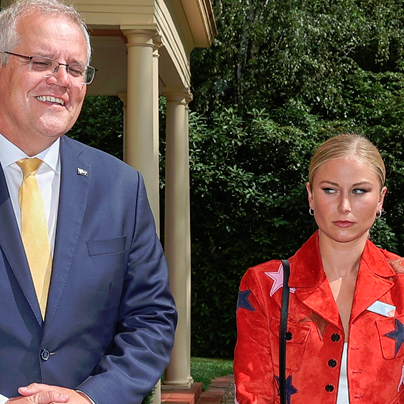
Grace Tame and fake (to her right)
Along with the famous photo of her sideways look at Morrison, Grace Tame tweeted that “autism blesses those of us who have it with the ability to spot fakes from a mile off”.
In a classic non-apology, the Prime Minister later said he was “deeply sorry” about the way his comments were “sought to be represented by our political opponents in the middle of an election,” and that he had intended to “respect the challenges they [?] face, not the opposite”.
He’s a fake leader. He pretends to the role – as a “bully” to some, and “friend” to all the “quiet Australians”, while leaving CEOs, lobbyists and cronies to run the place.
Serious waiters are not fakes. They actually care for people. They help them have a good time, and cope with the full range from angry ignorance to gratitude. They have seen it all – couples in love, couples parting, two-timing spouses, drunken politicians, business wheeler-dealers, tearful families, wedding parties, and new-borns in baskets. They have studied the strangest dietary preferences, and all manner of anxiety.
We have had personal experience. Strangers would try to say the “right thing” when confronting our beautiful son, whose disabilities were in plain evidence. They would say things like: “It’s wonderful what science comes up with”. Or they promised a “miracle” from God.
At restaurants, Lawrence would often cry, and possibly be calmed by listening to the Wiggles. But, truly, the better the restaurant, the happier he was.
Perhaps the noise levels were more comfortable. Perhaps he joined our enjoyment. Perhaps the waiters knew what do. Whatever it was, we confirmed the effect time and again.
There was much that Lawrence couldn’t do (he was blind, never said a word, and remained unable to walk or even grip an object). But, among some wondrous abilities, he could spot fakes.
At good places, waiters would organise clear soup or a mash, so we could feed him. (Ultimately, though, he was happier and healthier just being tube fed.)
And, invariably, good waiters did not carry on about science or God; they just said something sensible.
We can’t exactly remember the best-ever response, but we know it was by a waiter, and where he was – Café di Stasio in St Kilda. His intent was something like: “He will look after you, and you will look after him.”
—
I dedicated my latest book, Meals Matter, to “Marion, Dorothy, and Lawrence Symons Maddox (1999-2009), who together have taught me so much about meals, and thereby everything”.
Words are the aspect of meals that helps their planning, description and acclamation.
Likewise, movies are additions – before, after, or with a glass of wine or popcorn – that can also proclaim dining’s centrality to human existence.
Any good movie is bound to include meals. Charlie Chaplin shares his boiled boot in Gold Rush (1925). Katharine Hepburn and Spencer Tracy play battling barristers in Adam’s Rib (1949), so that George Kukor establishes their happy domestic relationship by them working comfortably together in the kitchen.
It’s not enough just to show pretty food to make a foodie movie – that’s like bringing in stars like Meg Ryan and Billy Crystal without actually establishing their love.
Foodie movies (initial list below) have to bring the whole world together, however fleetingly. As Italian cook Primo reveals in Big Night (1996): “To eat good food is to be close to God.”
Délicieux (Delicious) (2021)
Where does Eric Besnard’s new movie, Delicious, rate on the foodie scale?
Some movie reviewers mustn’t be blessed with the “sacred fire” that Brillat-Savarin described, so that they “regard meals as hours of enforced labour, put on the same level everything that might nourish them, and sit at table like an oyster on its bed”. Accordingly, critics who found Pig merely a trite satire revealed they had missed the central, dramatic point.
In Delicious, another big, obsessive chef has also retreated to the woods, but, whereas Nicolas Cage’s recluse produces one overpowering meal, Grégory Gadeboi’s character ostensibly opens the first restaurant a few days before the French Revolution.
Not that Delicious even tries to be accurate in its details. By 1789, a new kind of dining had already emerged based on restoring broths or “restaurants”, served in private booths. Even more to the point, Antoine Beauvilliers had already brought aristocratic dining to the streets of Paris.
I talk about these developments, and explain why true restaurants are “open domestic households”, in Meals Matter.
Overall, nonetheless, through unashamedly fictional means, Delicious makes bigger statements about the fundamental importance of gastronomic pleasure, and its relationship to French foundation myths.
It is, for example, entirely believable that the French Church decried underground produce as further from God – chef Manceron combines potatoes and truffles in his little pastries that give the movie its title.
In anticipation of you catching Delicious, I won’t give more of the plot, except to disclose that Isabelle Carré, although not so well known outside France, is mesmerising.
Initial list of foodie movies:
Tampopo (1985); Babette’s Feast (1987); Chicken and Duck Talk (1988); Au Petit Marguery (1991); Like Water for Chocolate (1992); Eat, Drink, Man, Woman (1994); Big Night (1996); Chocolat (2000); Mostly Martha (2002); Sideways (2004); Ratatouille (2007); The Trip (2010); The Lunchbox (2013); The Truffle Hunters (2020); Pig (2021); Délicieux (Delicious) (2021)….
Postscript: Lock-down would appear to have unlocked ridiculous numbers of foodie movies. I’ve just noticed (September, 2022) a couple more that don’t in this case sound all that appetising, namely, Flux Gourmet and The Menu.
The movie Pig, starring Nicolas Cage, tells of a recluse who leaves the woods in search of his stolen truffle-hunting pig in Portland, Oregon, where he was once an influential chef.
It mightn’t be everyone’s cup-of-tea; it’s filmed grimly almost entirely in the dark; Cage speaks somewhere between a growl and a mumble; but I thought it great.
It’s a counterpoint to both the Truffle Hunters, about Italian men and their dogs, and SBS’s The Beach, showing Warwick Thornton cooking, and looking, for himself.
An even closer (although less successful) comparison would have to be the recent ABC-TV series, Aftertaste, about an authoritarian chef seeking to redeem himself back in the Adelaide Hills.
Mind you, Pig starts out deceptively as if about a brutal guy – with only a pig to share his meals – fighting the world. But it soon heads elsewhere, although exactly where, as in any decent artwork, can withstand endless interpretation. I won’t reveal too much, in case you intend taking the journey.
While the orthodox movie critics, with few exceptions, praise the movie highly, and especially the performances, the rest of the internet helps answer the big question, which is whether it’s pro- or anti-foodie.
Take this from the New Republic:
Pig cuts straight through foodie hypocrisy
The overwrought film from Michael Sarnoski contains a fundamental truth about a very sick industry.
It’s about time America became disenchanted with foodies. Pig, Michael Sarnoski’s foodie noir about loss, love, and labor in Portland, Oregon’s restaurant scene, doesn’t leave them much room for redemption…
This critic, Jan Dutkiewicz, disapproves of “obnoxious” restaurants and “foodie writing—think Michael Pollan and Mark Bittman and their literary progeny”. He opposes “elitist” fetishizing. And he congratulates the movie, which he didn’t seem to like much, for also exposing the industry’s abuse of workers and animals. (As a scholar, Dutkiewicz works on “improving the treatment of animals through the legal system”.)
The scathing, non-comprehending reviewer in the New Yorker declares the movie’s key moment to be when our martyr apparently learns “the awful truth of the restaurant world and of the world at large”.
What I will say is that this is one of the great modern Food movies, and I would not be surprised to see allusions to it pop up in culinary culture over the next few years … It’s about our authentic relationships to the food we eat and the emotions and memories that come along with any given meal.
Moody, foodie drama with a menacing side serve of parody
… But he’s a foodie not a fighter, and the kind of reverential treatment that might be given to a samurai sword in a Tarantino movie is here more likely to go to a salted baguette.
Hillary Dixler Canavan organised a roundtable for the foodie website, Eater.com, where she’s a restaurant writer, familiar with Portland, and “obsessed” about the movie.
A Heated Discussion About ‘Pig,’ the Movie of the Summer
Eight Eater editors debate and dissect the new Nicolas Cage film about a man’s search for his beloved truffle pig
The foodies’ reactions turn out to be mixed, including Canavan’s:
It would have annoyed me much less if the film’s most important women weren’t dead or in a coma.
Needless to say, the theme of women gone missing is central to the movie. When a sympathetic baker recalls former times, and she finally hugs the grizzled hero, the camera pointedly retains its distance. A woman suddenly revealed in close-up is an intense movie high point.
So, is Pig foodie or anti-foodie? One answer could be that it’s anti-bad-foodie and pro-good-foodie, but I hesitate to divide foodies into, say, “deep” and “shallow”, even when I suspect fetishising.
I’d rather think of Pig as post-foodie in that it treats restaurant dining – and transcendent meals, in particular – with the utmost seriousness, while at the same time satirising ridiculous hype.
It’s not just about sublime tastes either, but very much also about the pleasure of sharing with a loved-one. At the climax, the tragedy turns out to be dining in the absence of not just a pig, but treasured human companions.
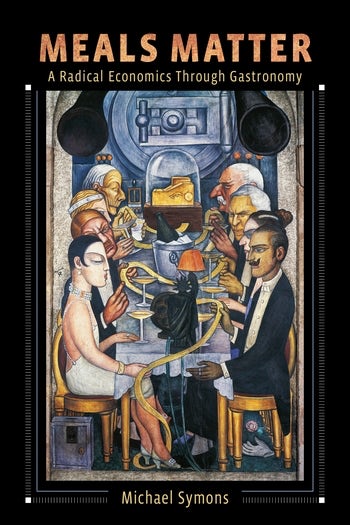
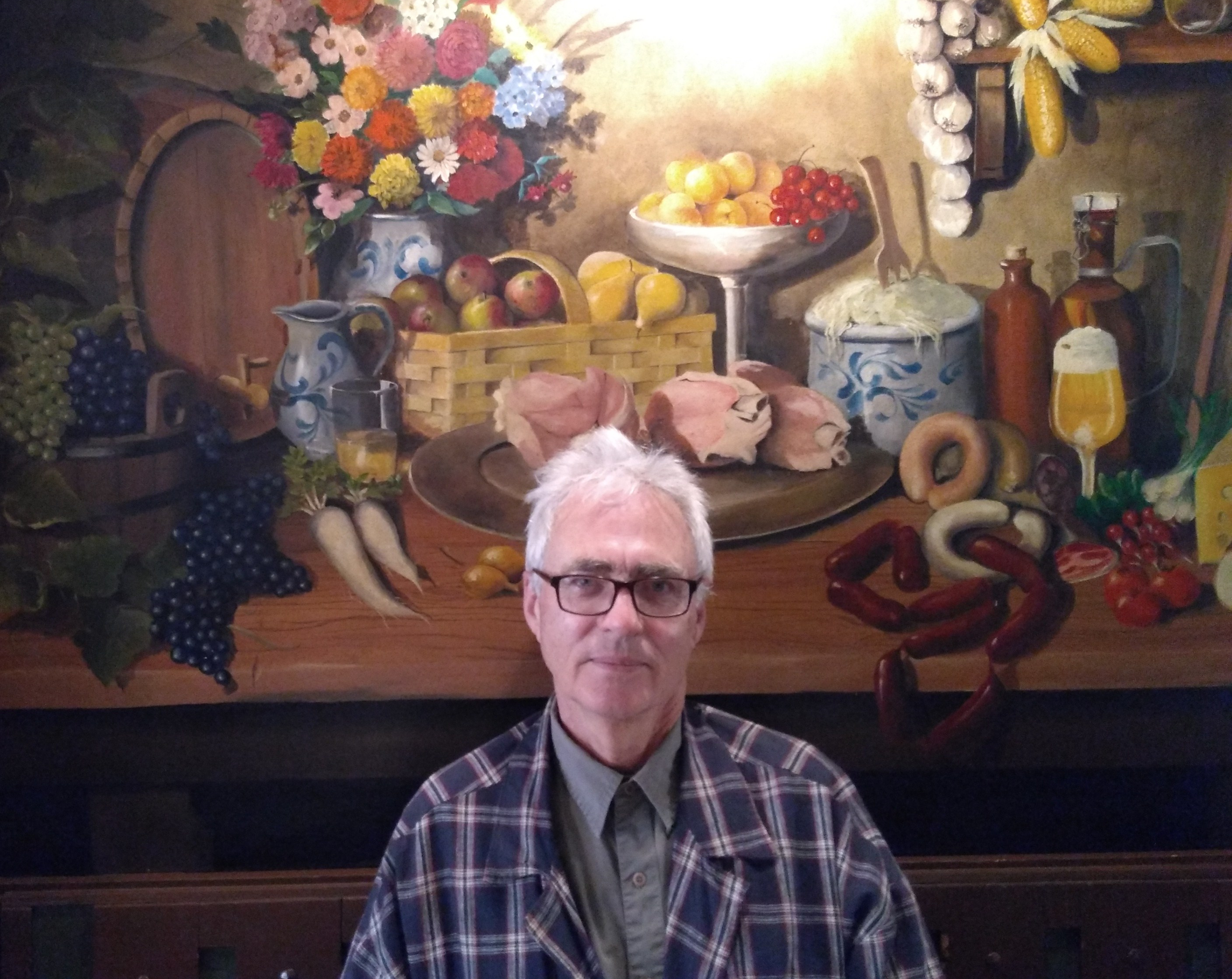
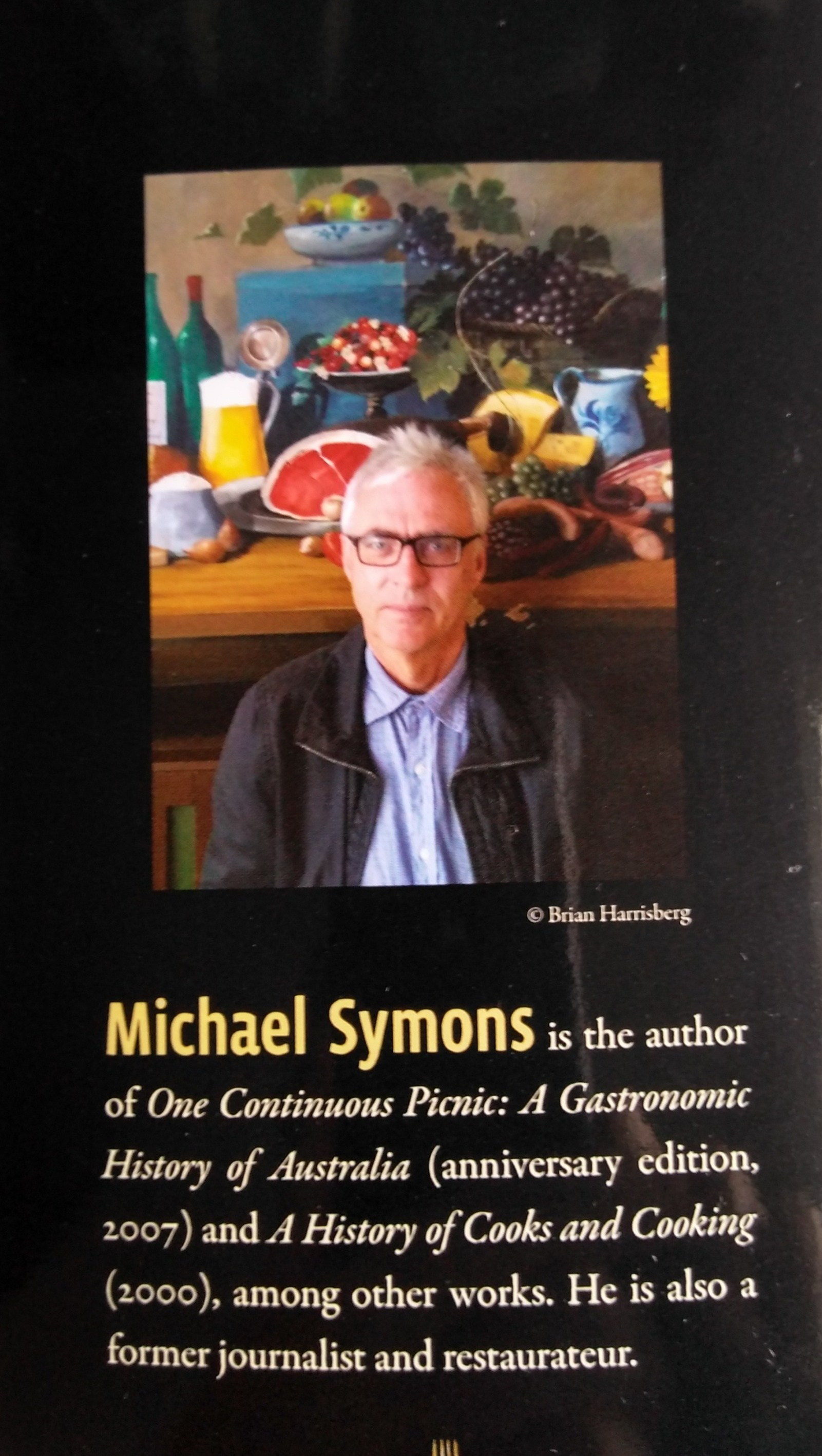
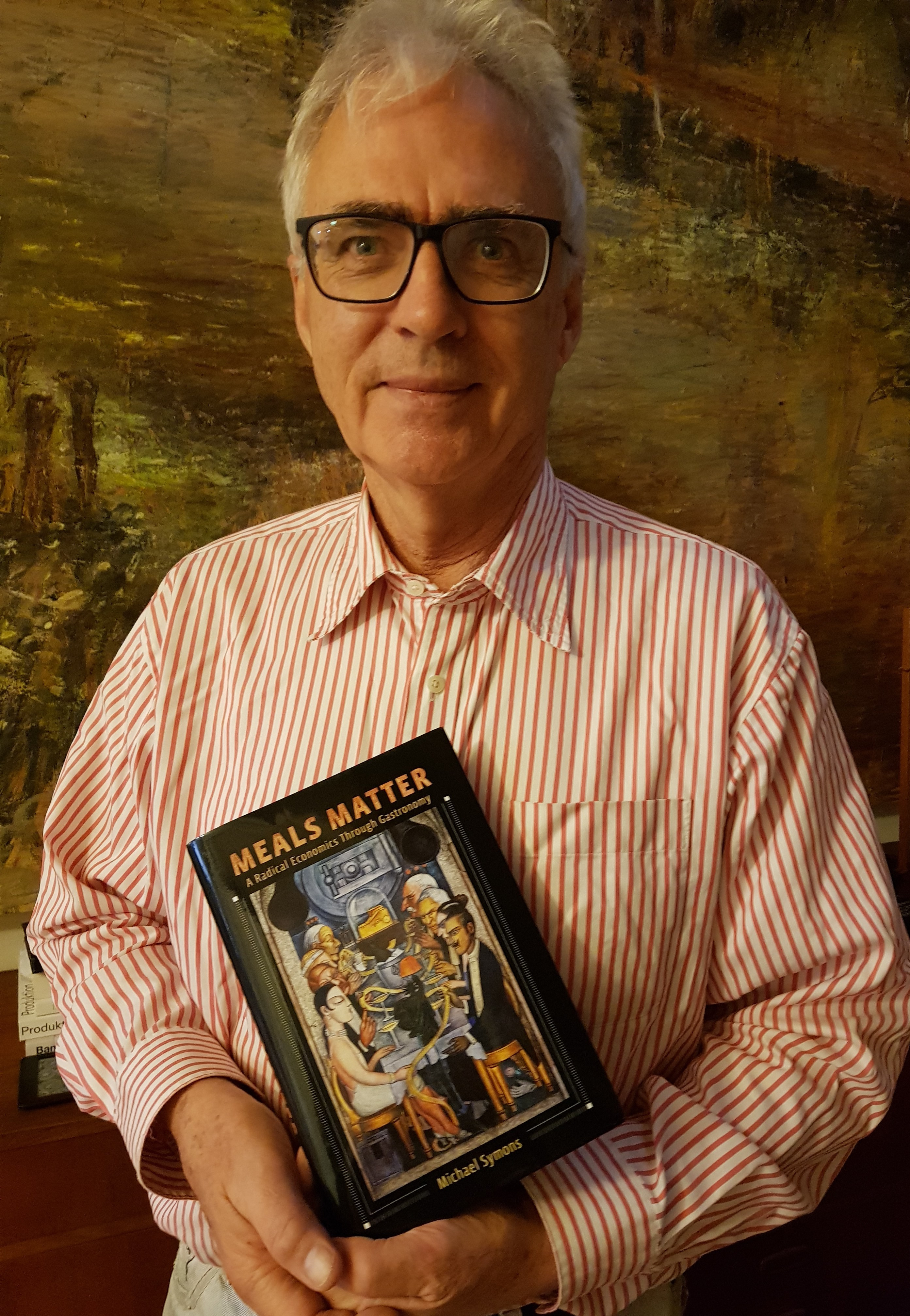
VISUALLY, MY BOOK OPENS and closes with murals. The cover borrows the “Wall Street Banquet” of Mexican muralist, Diego Rivera, and the back flap author photo was taken in a restaurant in Germany. I suppose it’s a coincidence that the book is walled-in, so to speak, although there’s something about murals …
Rivera’s “Banquet” is part of a huge set in Mexico City, covering three floors and staircase of the Ministry of Public Education building, taking Diego and his team six years to finish. That was in 1928-29, as Wall Street crashed.
In this panel, eight diners share champagne, while being served ticker-tape streaming the latest stock market prices from the golden machine under a glass dome. Behind that is a bank vault with megaphones. A Statue of Liberty lamp balances on the table in the foreground.
Rivera, “Dinner of the capitalists”
At least some of the well-dressed guests are historical figures, including a Rockefeller, whose family would commission Rivera, who was an on-and-off-again communist, to work in the U.S. Inevitably, in 1934, the family instructed labourers to scrub out his most ambitious American piece, a huge mural in the foyer of The Rockefeller Centre, New York.
Meals Matter might almost equally have been illustrated by a nearby mural in the Mexico series – “The dinner of the capitalists”, which shows a ruling family served coins, with revolutionaries with abundant food in the background.
Both murals belong to the building’s third level, which illustrates the “Ballad of the proletarian revolution”. Over the Wall St banquet, the banner translates as: “the rich man keeps thinking how to double his money.” The words over the capitalists’ dinner say: “Gold is worth nothing if there is no food”.
I came across Rivera’s murals when idly searching for an illustration of banquets, whose interpretation is important in Meals Matter. (I ended up with a photo of an electric chandelier in Glasgow!) The Wall St version is not strictly a banquet; in this case, “banquet” connotes privilege.
The back flap author photo was taken in mid-2019 by my wife, Marion Maddox, in Hannover, Germany. She took out the phone at the Max Walloschke restaurant, where we went several times. Our revisits explain the two versions (shown here) in different clothes in front of different still lives.
Max Walloschke, who was a weightlifter, professional wrestler and German bowls champion, opened the Kneipe (“pub”) on 19 June, 1952.
In Berlin, I suspected that smart locals crowded old-time Austrian restaurants, because they could not admit to enthusing about what some might call “heavy German kitsch”.
However, Max Walloschke remains unapologetic, calling itself “Das Kultrestaurant am Steintor” – the “cult restaurant at the Steintor”, that is, the place with a dedicated following at the city’s old “stone gate”.
Another of their claims is “Hier gibt es das wahrscheinlich beste Eisbein der Stadt” – “probably the best pork knuckle in town”.
The restaurant’s official slogan, “Gutbürgerliche Küche und gemütliches Ambiente seit 1952“, uses two words that are allegedly untranslatable. “Gutbürgerliche” suggests “homely” in the sense of lots of sausages, potatoes, and beer. And “gemütlich” hints at a “cosy” atmosphere, and more, because: “Cosy captures an element of it but crucially lacks those of friendliness and belonging.”
Max Walloschke postcard
The restaurant also boasts “authenticity” and “tradition”, which we can believe, and “Herzlichkeit” (“warmth”), which we can confirm. (I plan to say more on this.)
As immoveable artworks, genuine murals (rather than wallpapers) have tended to be sponsored for public places, including cafes and restaurants, where they often employ faux architectural elements to give the illusion of grandeur, space or being in the homeland – sometimes all at once, such as a panorama of the Bay of Naples through trompe-l’oeil pillars. The more Gutbürgerlich murals of beer, pork and vegetables encourage Gemütlichkeit.
I must find out the name of the painter, whose food murals contribute so warmly to Max Walloschke’s welcome.
MARION MADDOX AND I have just published a paper, “The consolation of profit”,* in New Formations, a journal of contemporary culture and politics.
Perhaps the quickest introduction is bottled water. Why do people pay for something they can get out of the tap?
At Max Walloschke, Hannover
Certainly, the hefty marketing promises health and status. But to those familiar explanations, we add another: the insistent hawking itself arouses a reasonable expectation that sellers are so desperate for profit that they will risk no other complication. If it’s outside the market economy, can it really be safe?
The “consolation of profit” arose from attempts to understand consumer anxiety when Jennifer Hillier and I ran the Uraidla Aristologist restaurant more according to our own earnest ideas than the Market’s.
Along with a funny name, the Aristologist had no piped music, no Coca-Cola, no smoking (except in a special room or outside), and otherwise signalled more than mere profit-seeking. The precipitating incident was a sweet, young couple looking at the menu, and asking if they might repair instead to a nearby restaurant. Our food would be “too spicy”, they explained, although, in reality, this would have applied more to the other place.
A more likely explanation was that the Aristologist might seem to require savoir-faire, an unfamiliar wine, reflection on the experience, or any number of other interactions.
McDonald’s redoubles the assurances. Their so-called “restaurants” advertise utterly predictable food – “Do you want fries with that?” – and stilted interactions – “Have a nice day”. The hammering of cheapness backs the warranty: no any other demand.
As a religious studies scholar, Marion added the second case-study. Why have megachurches been on the rise, when mainline churches have generally declined? Megachurches have replaced old liturgies with the forms of rock concerts and television tonight shows. Theirs is “Jesus lite”.
The “consolation of profit” thesis adds that, whereas a tight, more traditional congregation might threaten personal, social or deep theological challenges, these “growth churches” preach a simple message, “we want your money.” The merchandising in the foyer, donation buttons on web-pages, repeated onstage appeals shout out the safety of profit-seeking. The upfront demand for money could risk no challenge.
Our third case study asks how could anyone vote for such a shallow charlatan as Donald Trump? Together with lies and racism, his heavily-funded election campaign came with the “consolation of profit”. Trump never pretended to be anything more than a super-salesman with advertising slogans in place of policies.
This self-professed artist of “the deal” grew up in the congregation of prosperity gospel preacher, Dr Norman Vincent Peale, author of a string of business self-help titles, most famously, The Power of Positive Thinking (1952). Peale officiated at Trump’s first wedding.
Voting for the celebrity money-maker guarded against any untoward governmental decisions. Selling himself as the greatest, Trump offered no “deep state” threats. Denouncing elite expertise, he ostentatiously ruled through Fox News tweets.
With the pandemic, the Symons-Maddox thesis sees a hard-selling, anti-intellectual braggart struggling with an unanticipated crisis. “We’re prepared, and we’re doing a great job with it”; “I like this stuff. I really get it,” etc, shows he has nothing to sell but himself.
How enduring the consolation proves against obvious lack of social commitment, we’ll find out in November.
*Michael Symons and Marion Maddox (2020), “The consolation of profit,” New Formations99: 110-126
PURCHASE MEALS MATTER THROUGH YOUR favourite seller, several mail-order firms, or through Columbia University Press with a discount.*** E-books are instant.






 In Berlin, I suspected that smart locals crowded old-time Austrian restaurants, because they could not admit to enthusing about what some might call “heavy German kitsch”.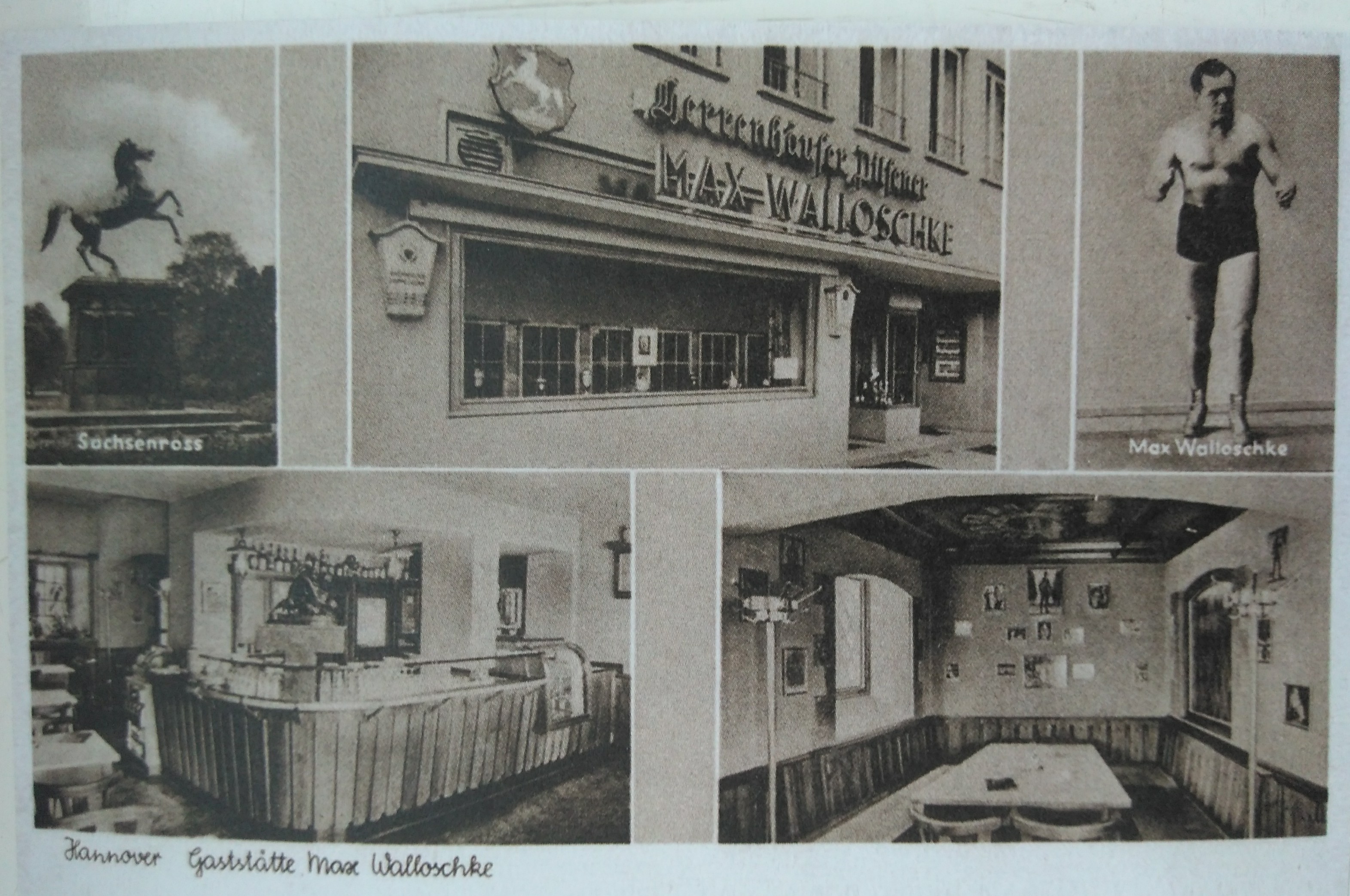


 Meals Matter