David Dale’s last taste

Duck press, Porcine, May 2025

I WAS FORTUNATE TO DINE OUT frequently for nearly six decades with journalist David Dale (27 March 1948-6 August 2025). This was often along with Suzie Anthony.

Our paths crossed early, when he was still a student and I was starting to make a name at the Sydney Morning Herald. He wrote me a long letter arguing that I didn’t understand guitarist Eric Clapton (or something like that).

I was the paper’s first or maybe second deliberate hire of a university graduate (my degree was in maths, and they had a “new maths” education supplement to bring out). When David and Suzie joined, they became “graduate cadets”, who were required to learn shorthand. I always reckoned he had the world’s most useless skill, shorthand slower than his long.

As young journalists at the Sydney Morning Herald, the three of us had lunch and dinner out many times a week for four or five years. 

Later, in 1975, after a particularly beautiful lunch at Watson’s Bay, we three sat on a wall above the sand, and swore lifelong allegiance, which we honoured. We kept up meals together with a few unavoidable interruptions, such as living in different countries.

From my perspective, David seemed to lead a compartmentalised life. Early on, he had a girlfriend that Suzie and I never met. Mischievously, we knocked at his address, and were welcomed by a mother desperate to meet some of her boy’s friends, and she laid some of her concerns before us . Never met his father.

He also deliberately shied away from deep thoughts. When we met, he had completed Honours in Psychology, but was keener on Mad magazine, and turning to early Woody Allen movies.

David and my paths crossed more than once in Italy – and he never let me forget about revealing to both him and my father where to find the key to our ancient Tuscan watermill during one of Jennifer Hillier and my absences; David terrified my father in bed asleep, with Christopher demanding: “Do you know Bob Hope?” This was someone (the partner of colleague Julie Rigg’s expatriate mother) whom we all got to know well over there.

By then, he had joined the classy little gang putting out the radical media critic, the New Journalist (which I had co-founded with Leo Chapman and another old colleague who died this year, Paul Brennan).

Without hesitation, David became a third partner (along with Gabriel Gaté) in Duck Press that published my One Continuous Picnic in 1982. He leapt in as its editor.

In the late 1980s, I was invited to lunch in Adelaide, at his suggestion, by a visiting Bulletin journalist, Susan Williams, who grilled me about her editor. They married in Paris, without guests! When I married Marion Maddox in 1995, Suzie was my best person and David her assistant.

Towards the end, David increasingly talked streaming tv (that I never watch). Suzie and I found him reluctant for Friday lunches, but he was, we now imagine, in considerable pain. Our last get-together at La Riviera, he came with a walking frame.

He’d enjoyed sauce from a duck press at Tour D’Argent (I think that was when he secretly got married). Not only the name of our publishing house, it remains my email address, but I hadn’t experienced a duck press.

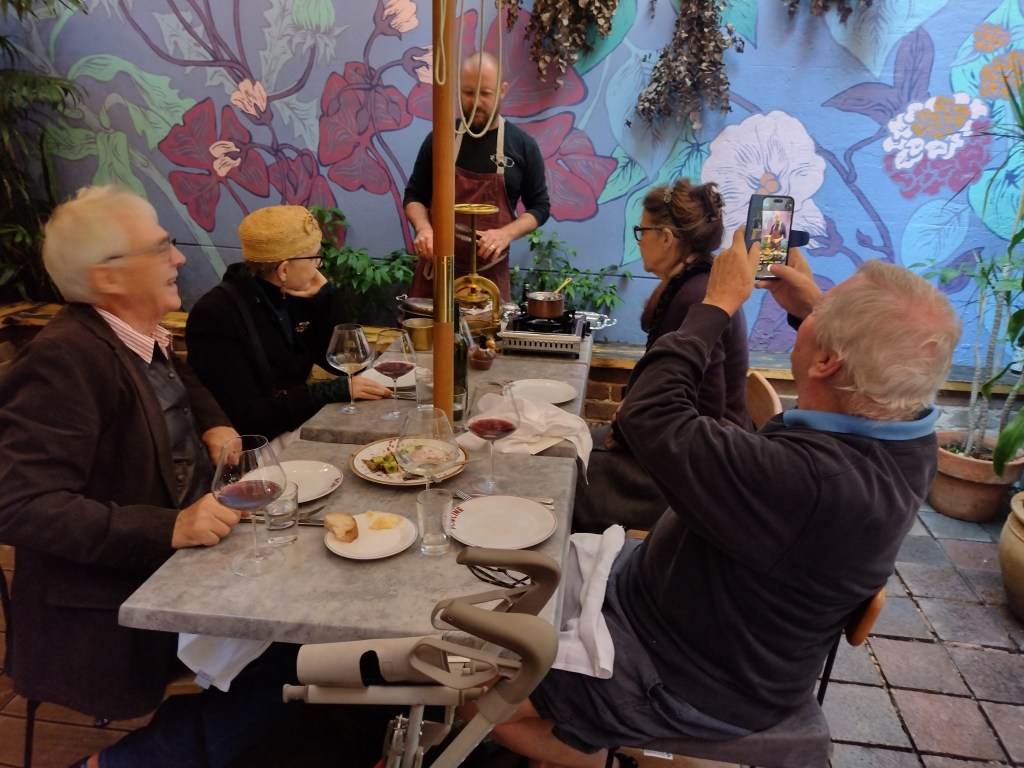
Accordingly, for our little lunch group’s celebration of my 80th this year, we dined with a duck press at Porcine in Paddington. David needed a walking frame, and my wife a wheelchair; when we discovered the restaurant was up a flight of stairs; the chef generously offered to bring the paraphernalia down to a table set up in the wineshop below.

That was in May. It would be our final meal together. Our paths crossed a last time not many days ago. Marion had two recent stays at the Chris O’Brien Lifehouse. Only on the second, we learned David was in a nearby room all the time. Being a small world, Porcine chef Nik Hill’s wife Milly is a palliative care nurse there. (In an accumulating tragedy, Marion died on 16 September, back there again, two rooms from where David had been.)

When I popped in, he was true to himself, avoiding thoughts of imminent death. On another quick visit, I offered to bring some wine the next night. He was unable to drink, he said, on account of his nausea. He did admit, nevertheless, to wanting the best possible red to be his last mouthful.

That led me to recount how yet another friend with cancer had a few months ago quietly shared an aged burgundy that she happened to “just find in the cellar”. Fortunately, I thanked her profusely for a genuinely amazing experience. Only later, I discovered a bottle online for an equivalently amazing price. Definitely worth a last mouthful and, within days, our friend disappeared forever from our tables.

I hope David got his last taste.
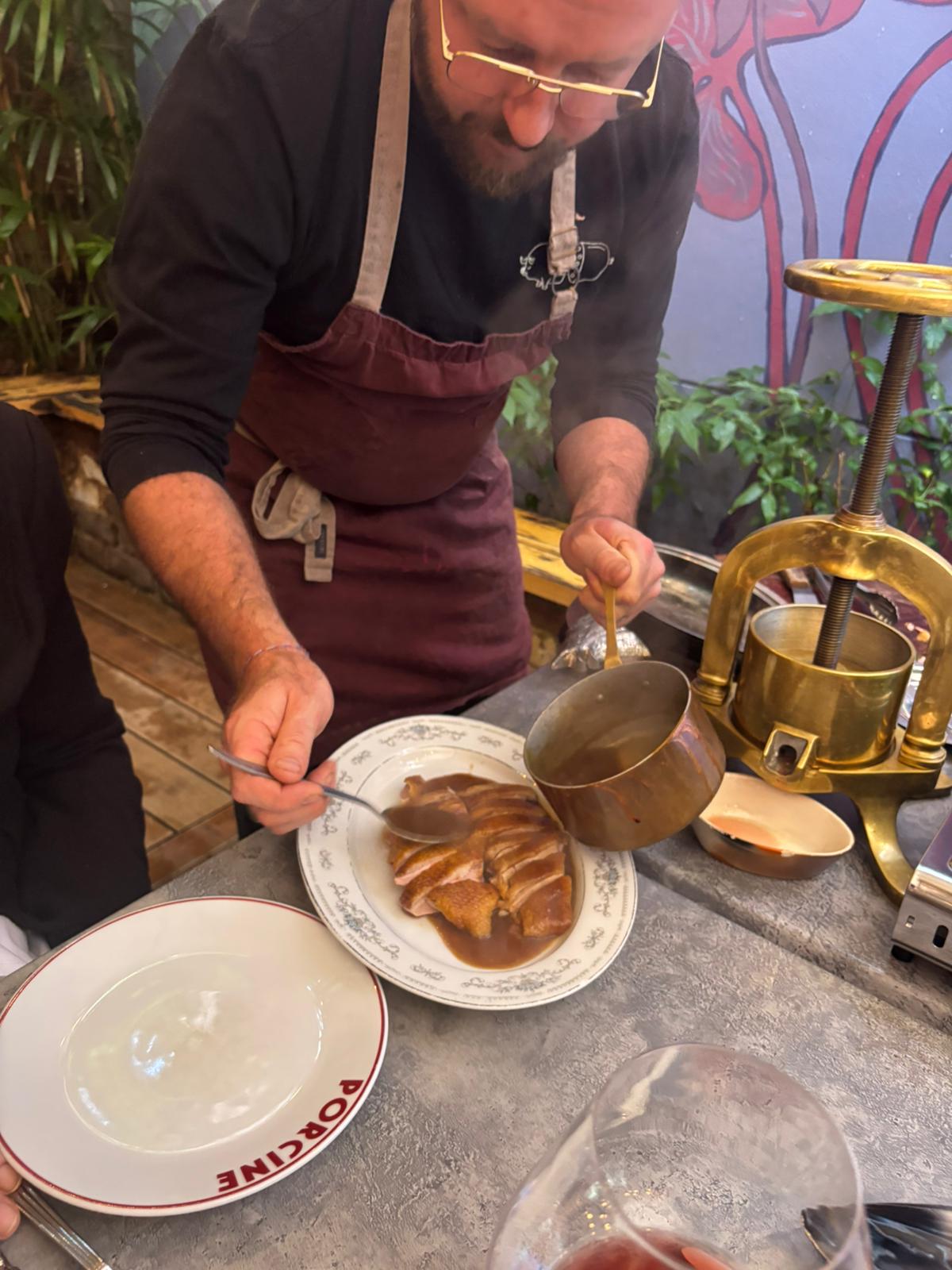
Duck, Porcine. Photo: David Dale
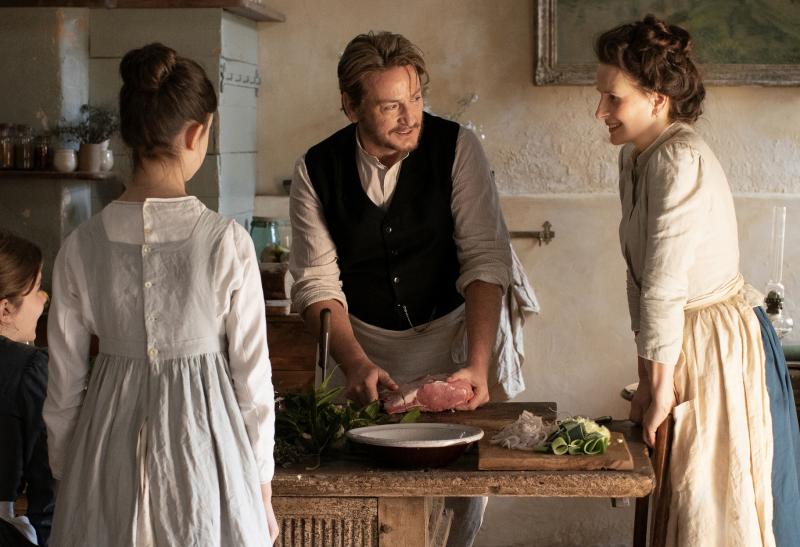
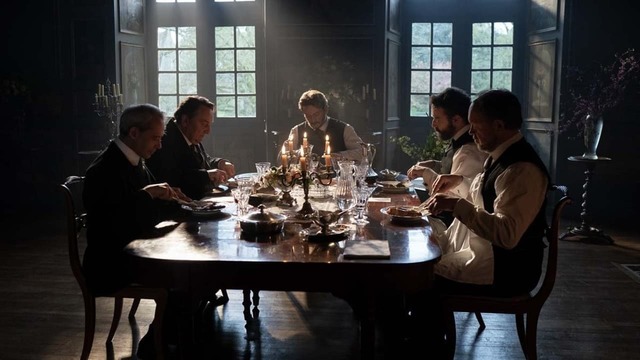
The wondrous materiality of French movie, The Taste of Things

FOR TWO HOURS AND 14 MINUTES, the French movie The Taste of Things observes the preparation and eating of something like nine dishes.

The setting is a provincial chateau in the year 1885, and the focus is gourmet Dodin Bouffant and his cook, Eugenie – played by two considerable actors (and former partners), Benoît Magimel and Juliette Binoche.

Negative reviewers react against privilege and indulgence. The first kitchen scene of 40 minutes introduces an “extremely boring movie showing pots and pans and cooking complicated French recipes” (online comment). Some of the audience walk out.

It’s not perfect – I was mildly irritated by characters informing the audience by telling each other things they would surely already know. Some occurrences seem random – why introduce “electroculture” garden antennae?

Yet the movie is far more than foodie excess or cooking show. The great majority of reviewers are positive. What’s going on?

Musical clue

A clue comes from the absence of music – only used over the credits. Mind you, the Boston Globe reviewer was so seduced, he heard “a romantic score”, though conceding “everything you need to know is conveyed in actors’ eyes.”

The soundtrack relies on clink, clunk, chop, bubble, sizzle, footsteps, birds out the door and window, and occasional words, sometimes among Eugenie, Dodin and helper, as they move between garden, stoves and benches, and among Dodin’s select group of male gourmets, who love the cooking, and the host’s cellar.

“I never before had to direct a film with as much substantiality,” writer/director Trần Anh Hùng answered an interviewer.* “All that material reality is so compellingly expressive, it firmly anchors our characters in daily life. Music would have undermined that.”

Hùng normally likes music, he said, but here it would “bring something that is a little bit fabricated… I wanted it to be very real.”

(Please note, all you restaurateurs who think loud music and noise denote a good time.)

Materialist film-making

Instead of music instructing viewers how to feel, they form their own interpretations. Similarly, Hùng chose long takes, he said, as a way to slow down the pace and give the audience the chance to be a kind of writer, gaining “time to formulate several things” in their mind.

I describe the approach as materialistic, in that the movie carefully shows what’s actually happening at the physical level, among intimates. Emotions arise from mundane cooperation.

“Everything that you see on the screen is real, and everything that we cook for the film, we ate it. Absolutely everything,” Hùng said. He was advised by Parisian chef, Pierre Gagnaire, and the actors were assisted on-set by Gagnaire’s retired colleague, Michel Nave.

“For the crew, it was unusual, because they have done some movies with food. Most of the time it’s fake. To make it very beautiful, you add some different things in it to make it have different texture, color, everything. But here, for this movie, I didn’t want that. Because it’s not about the beauty of the food. But it’s more about showing man and woman at work in that kind of harmony.”

He told the crew the long opening cooking sequence was “my car chase scene”.

Hùng’s wife, Trần Nữ Yên Khê, an actor and this movie’s art director and costume designer, explained the need to just get the setting “right”, and leave the beauty to emerge. “Try to do something beautiful, and it comes across as decorative.”

Happiness

The movie sounds and looks beautiful, allows time for reflection, and so what is it “about”? The Taste of Things gets to the core of cooking and enjoying meals. Hùng extolls Brillat-Savarin, as does my chapter, “Brillat-Savarin’s quest for table-pleasure” in Meals Matter (2020).

Homeliness was suggested by the working title, Pot au Feu (changed in the French to Le Passion de Dodin Bouffant, after the Marcel Rouff novel on which the film is loosely based). Domestic bliss in some present-day kitchen might well have become boring, but French protagonists at the time of Escoffier could believably be immersed in good cooking.

Hùng wanted to “explore something rare in the cinema: conjugality. And even rarer when it works.” With kitchen movements choreographed like a ballet, he sought to show “harmony”.

The 20-year relationship of well-to-do gourmet and cook has confused some movie-goers, particularly since it really doesn’t develop. But the pair are contented with their lives, and Dodin is presumably not surprised when Eugenie refuses proposals of marriage. She only leaves her bedroom door unlocked when she chooses. She gains them the perfect daughter through other means.

The Taste of Things does move steadily towards inevitable sadness, but never with the forced highs and lows of an action movie or even romantic comedy, let alone “reality” tv.

Harmony without drama marks this movie out as beautifully unconventional. Nonetheless, it has a strong motive to show “merely” cooking, eating and companionship, even if that passes. It’s about happiness.

*Interview quotes from Santa Barbara International Film Festival, https://youtu.be/YN5Vy_3a5Ds, and from Gaumont publicity, https://www.perthfestival.com.au/media/h3kd4qcm/the-taste-of-things-press-kit.pdf.)

Dining with a thump

ONCE, WHEN WE WERE DINING OUT in Sydney’s Leichhardt in the late 1960s, the noise became so unbearable that the Italian waiter whistled shrilly, everyone quietened, and then we gradually talked louder to be heard, until he whistled again.

That’s changed, because many restaurateurs now unapologetically drown out conversation. No longer young and silly, and with hearing aids, I have in recent years shied away from at least two restaurants as soon we felt the racket, and I have also put up with the noise in more than one highly-fashionable place where I’m not keen to return.

Discriminating among voices becomes harder with age (too much rock n roll when young). But now speakers thump imperiously beneath the clamour. Managements seemingly welcome the “Lombard effect” (people speaking louder to be heard). They must mistake deafening exuberance for buzz.

Certainly, several waiters have obligingly reduced the volume. Yet in Summer Hill, a young woman turned the sound down, only for the manager to turn it up. When we explained that we’d asked for it down, he said something inaudible about other customers (there were only one or two other tables). He then devoted himself to shifting around paper packages awaiting meal deliverers. Without soliciting our order, he remained unconcerned as we departed, and discovered a cheaper, much friendlier take-away around the corner, with a few tables and wine glasses.

New York Times restaurant critic Pete Wells actually mounted a “ringing defense” of noise. Constantly implored to condemn raucous places, he realised he didn’t find loud restaurants a problem.

The truth is, I love them. Not all of them, not all the time. I enjoy more than a few quiet restaurants, too, where you can concentrate on the food and the conversation without auditory distractions. But so many of the places I enjoy most tend to be at least somewhat noisy.

His illustrator did not seem so keen…


In a study of reviews in the New York Times and San Francisco Chronicle, researcher John Lang found that restaurant noise could affect the critics’ evaluations. Strikingly, the correlation between comments on noise and overall rating was reversed between east and west coasts:

That is, in the Times, as noise increases, restaurant ratings decrease; while in the Chronicle, as noise increases, so do restaurant ratings

The quality of food had double the impact of service on overall rating, followed by “atmosphere”, while noise remained a lesser, but still “significant predictor of the overall restaurant star rating”.

The Zagat “State of American Dining” report in 2016 had already found that, for 25% of customers, noise was the most irritating component of dining out, and the internet abounds with complaints. Various apps – including iHEARu and soundprint – been launched to share information about the noise levels of particular restaurants.

So why raise the volume? Researchers found that tasters rated beer more highly when listening to music by a familiar band.

A pair of professors of marketing, studying restaurant “servicescapes”, have identified the “environmental cues” such as lighting and music that “strongly” influence eating behavior. For example, loud noise and bright lighting increase the quantity eaten, and decrease the pleasure, without an overall effect on the money spent. They also found that “softening the lighting and music led people to eat less, to rate the food as more enjoyable, and to spend just as much”.

Acoustic engineers around the world, including at Flinders University, have advised of how to mitigate the effects of minimalist, hard surfaces.

Noise could become a problem for us at the Uraidla Aristologist in the Adelaide Hills (and so could curmudgeonly customers, but let that pass). A shouty table of six or eight could ruin it for everyone. After we had added a kilim and tapestry to the walls, a further, smart suggestion was to fix egg cartons underneath the long, central serving table. Confession: our notorious cat clawed them down.

Certainly, near-silence could be embarrassing for, say, just two tables of two. But we never succumbed to the increasing pressure to add “atmosphere” with any recorded music. Instead, we often achieved the beautiful hum and clink of contented conversation and dining – one pleasure I still miss.

Surroundings are enormously important to dining. Big money is spent on chairs, walls,  bars, benches and lights. Restaurants run from closeted haute cuisine to blaring television echoing around hard surfaces on the other side of the Alps. In recent times, some owners have chosen to deafen customers, and some have chosen to stay away.

With the pandemic, crowding gave way to muffling masks, social distancing, and outdoor tables. But then the clamour came crashing back. Restaurant reviewers ought to include a noise indicator.

@GoldingCartoons

The sound of music

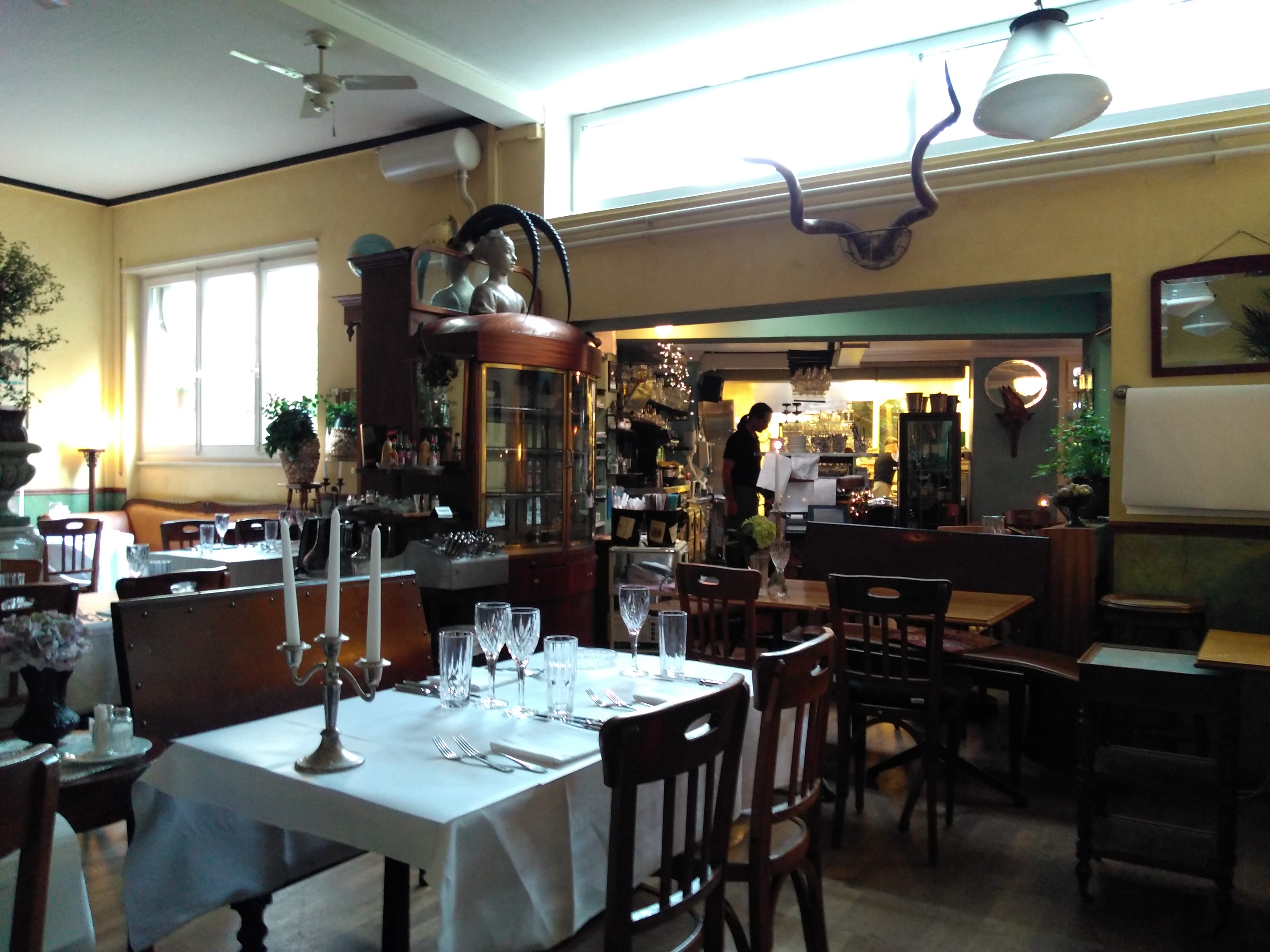
Bern restaurant 2
Zum Blauen Engel, Bern

We arrived here at our apartment in Bern, Switzerland, conveniently across the road from the conference venue, amid crowds celebrating the opening of the World Cup. Our second-floor accommodation is above a bar-restaurant, circled on four sides by huge screens and temporary outdoor seating. Our host apologised that he had hired a dj for the rest of that night. And so the matches have progressed…

The joke is that the thump-thump beat from below that first evening did not stop me getting to sleep. Instead, I was awoken by huge bells chiming 6 am. The nearby Pauluskirche counts each hour, and notes each passing quarter, and there it goes again. Much, much louder than the huge, sixteenth-century Zytglogge in the city centre with its mechanical jester getting in early every hour with his own bells, and the mechanical cock crowing three times. At least the local chimes shut down between 10 pm and 6 am.

The further joke is that I write in praise of Bern’s quiet. This is in the restaurants.

For several weeks we have moved (for Marion’s work) from Fremantle through Glasgow to here, and I have dined to much thumping beat, the seemingly necessary boost to meals these days. (I’m the old fogie in the corner.)

In Fremantle, we seemed lucky to stay adjacent to Bread in Common, to name a name. Quite good food in a vast warehouse conversion, so popular that you can’t hear yourself think. The thump never lets up, except if managing a coffee during the day at an outdoor seat. Fortunately, Fremantle is awash with great spots, albeit mostly also with monotonous mood-lifting.

Much the same in trendy Glasgow, although I must boast that our flat was between the Aragon and Lismore pubs (the video is from the Lismore), both with traditional musicians gathering in varying numbers on selected nights with their fiddles, flutes/whistles, underarm bagpipes, accordions, guitars, and bodhrán (Irish drum). Usually a fiddler starts off, and away they go, the leader mouthing key changes. I kept waiting for a cellist to come back; he’d led them in a wonderfully mournful selection. On another occasion, a tenor came out of the crowd, some notes wobbly, but he knew he had to hit the last one, and did. All determinedly acoustic.

A fellow whisky-drinker (no, I think he had an ale) explained that an Edinburgh conservatorium course in traditional music had generated something of a glut of young professionals.

Heavy “background” music obliterates the clink of cutlery and murmur of conversation. Accordingly, I recommend a couple of old-style places near here (warning: Bern is not cheap).

Being an unusually warm night, filling the outdoor tables, I was the only person inside at Zum Blauen Engel (Blue Angel). With no music whatsoever, I did get a distant exhaust fan. Otherwise, the dull thud of fridge door, clink of bottles, shaking of pans, sizzling from beyond the bench, occasional waiter exchange, old-fashioned clank of heavy glasses and crockery, my own knife and fork … I even heard the chef cut off a tranche of something. All satisfying.

Bern restaurant I
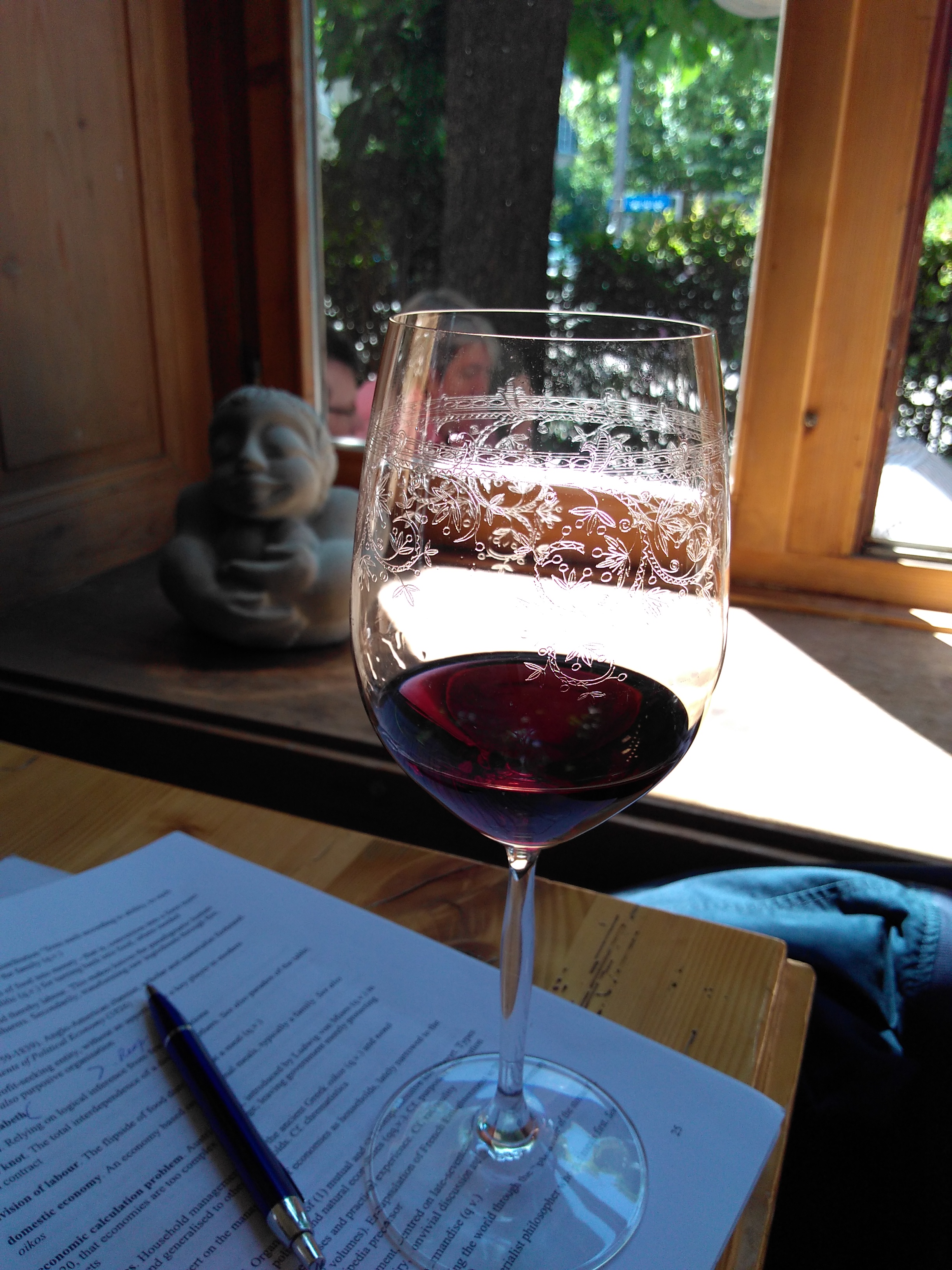
Waldheim

I felt part of the place, belonging to humanity, the world. Not some shouting cosmopolite out for a good time.

Around at the Waldheim, I lunched again almost alone inside, with just another four old fogies at seemingly their regular table, and across an enormous window-sill to those in the garden. The sound of people chatting outdoors, and birds… I could be dreaming (I don’t think so, even about the birds).

Again, a few clinks, waiter exchanges, the espresso being ground and a puck being bashed out, and people enjoying the peak of civilisation. The only odd note was the occasional phone-call announcing itself to a chirrup of Vivaldi.

Please Like Me’s restaurant decadence

We won #AACTA awards! @joshthomas87 won Best Screenplay in Television and Debra Lawrance (Mum) won Best Performance in a TV Comedy. Yeeeaah. Thanks guys. Go team. http://ift.tt/1ycBgmB
Debra Lawrance & Josh Thomas

YOU HAVE BEEN warned: Please Like Me is television brilliance. Perceptive, bold, exquisitely acted, and with a gastronomic thread winding throughout (a domestic comedy has to include meals).

Some movie-goers don’t like Eric Rohmer, and others avoid Woody Allen, so I shouldn’t be surprised that many also seem impervious to Josh Thomas.

If you do not yet know what I’m talking about (despite much praise, including mine a year ago), you could go straight to #PleaseLikeMe Season Four Episode 4 “Dégustation” for a devastating parody of restaurant decadence, the setting for an emotional reunion by Josh and his separated parents. Except for a couple of things.

Firstly, you’d be smarter to treat yourself to the whole six episodes of Season Four, taking them in turn, because the season openers (“Babaganoush”, “Porridge” and “Beluga caviar”) set the scene for “Dégustation” and then … well… watch them through.

Secondly, the “Dégustation” parody was shot in a real restaurant, using its actual parade of 15 dishes (even the culminating “cake”?). The half-hour was filmed over three days at Lûmé restaurant, South Melbourne.

Lûmé is a cheffy fantasy of tweezers, eye-droppers, liquid nitrogen, and, to quote the website:

Artfully deceptive, Lûmé takes a thoughtful and considered approach to dining. It’s a restaurant that doesn’t just serve food, rather, it creates experiences best enjoyed by curious minds. Pronounced loo-May, the word Lûmé evokes a sense of light, elegance and beauty. But its true origin is unknown, and its meaning controversial.

Early reviews of the restaurant mentioned a meal taking 5½ hours, everyone leaving plastered, and some unfortunate misses. After just seven months, two original partners left Shaun Quade to it. Yet, from other comments, the Please Like Me trio’s expressions of delight weren’t entirely acted. Here is a snap of cauliflower “camembert”.

Image result for Lume restaurant Melbourne

The new friend

See original imageMy temerity in telling someone the other night about being a “new friend” occasioned further pondering.

The urgent problem is the explosion of virtual friends produced by the start-up business model: become biggest first. Accordingly, Skype urges: “Tell your friends what you’re up to,” and: “Why not post your own status update?” Rotten Tomatoes, I think it is, “can’t believe” I have no friends, so click here. I can imagine the desperation, loneliness, and paranoia of exclusion with a low friendship count, and the never-ending shower of everyone else’s good-times snaps.

This increasingly heavy parade of prompts, pop-ups, pop-unders and peep-outs cruelly parodies social life. Twitter boasts: “Tweets are the basic atomic building block of all things.” Talk about propaganda, as arrogant as “The real thing” and “To inspire and nurture the human spirit“. The so-called “social” media are essentially marketing vehicles, giving the little people a fantasy of competing in an advertising free-for-all. Perhaps some people keep usefully in touch, if they have the time. But the marketing barrage packs us into silos, where some of my “friends” punctuate with “f—ing” in a desperate quest for attention. Need I remind you that Trump tweets?

I compose these thoughts on pen and paper at breakfast at the Deux Magots at Saint-Germain-des-Prés. They no longer seem to serve fresh orange juice here, but, oh, the tartine and butter.

See original imageA couple of older women work on laptops, and one is now on a mobile – she has a friend, or maybe it’s work. A young tourist couple come in for double consumption – photographing their breakfast, before touching it. Are these zillion photos as expendable as Zuckerberg’s 75 million followers?
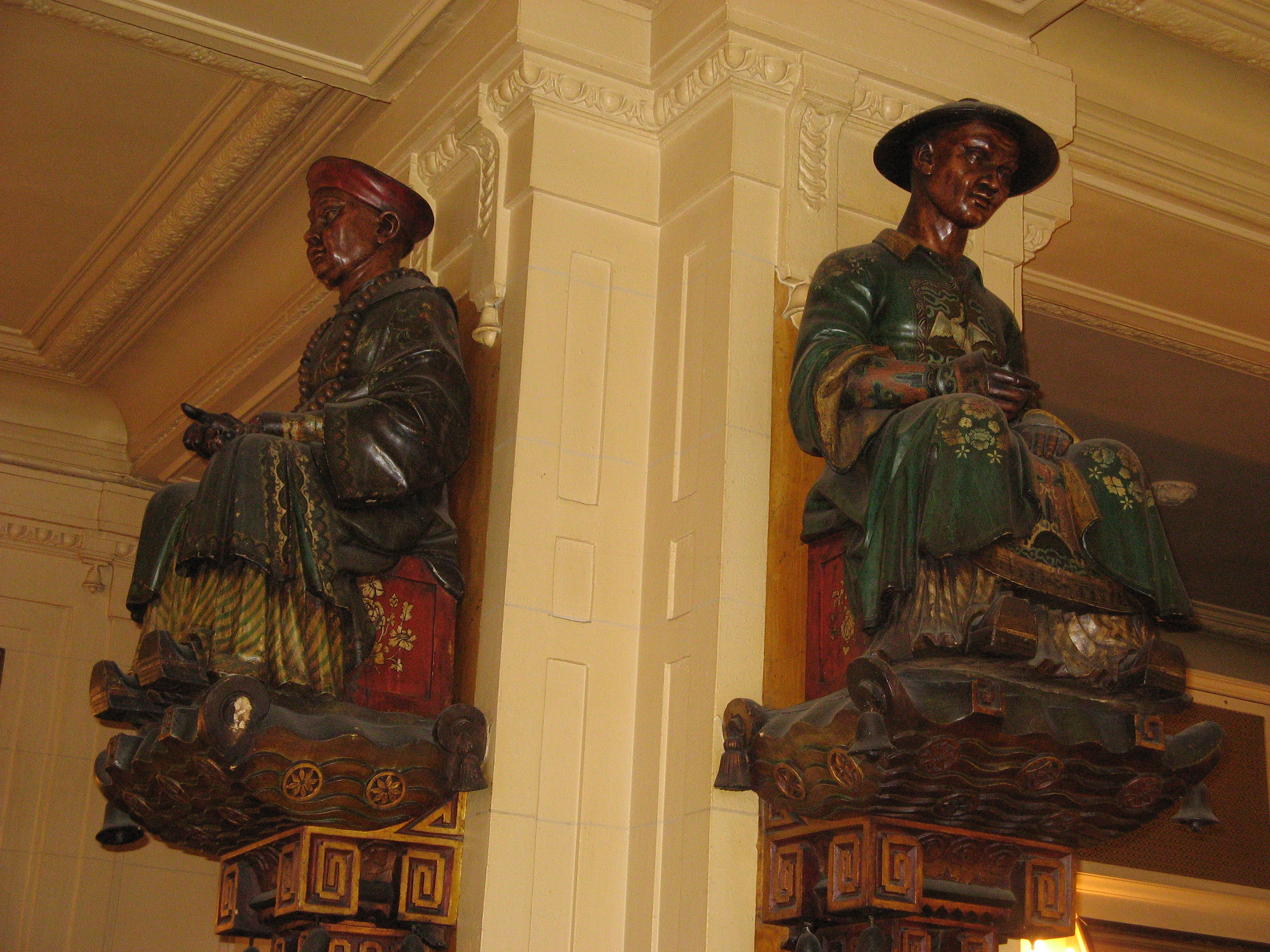
At least momentarily untied from virtuality, a pair of business types are greeted familiarly by a waiter, and enjoy a quick croissant, espresso and each other’s company. An aged gentlemen with a big scarf never takes his eyes off his newspapers throughout the hour or so we’re there. He remains glued to a declining medium that seems both wonderfully curated, and multi-vocal.

Altogether, to the gentle clatter of glass, silver and porcelain, a scattering of café-goers read newspapers, maps, screens, a notebook, and occasionally each other’s faces. Even the digitally-linked seem reasonably contented, presumably because a table across the room feels closer than up to a satellite via mass-monitoring and back.

See original imageHow odd, a tour group files in a side entrance and out through the heavy revolving door (which waiters manage with a packed tray on the arm), photographing the carvings of the two oriental-looking magi, their backs permanently turned on each other. My impression is that tour groups often lead to lasting friendships, people having taken meals together.

I don’t think we’re properly introduced until we’ve dined together. That “new friend” comment was based on two good dinners.

Cultural density clash

See original imageParis has relatively high cultural density. Even modest cafes, bistros and restaurants are meant to be run correctly, I argued the other day.

Crowded, pedestrian-friendly streets and stair-filled buildings help keep people slim. I can add that significant social solidarity – more dining together – protects not only against sugar-snacking, but also against competitive individualism, which provokes mental harm and binge eating.

Such observations provide a contrast with Australia, which might have let more sunlight in when it was the land of the “fair go”,  when lucky country inhabitants would say, “she’ll be right, mate”, when the cuisine was “one continuous picnic”, and when waiters were notoriously slack. But a loose Australia was left comparatively exposed to a hazardous new regime.

Paris is the capital of a relatively tight French republic that demonstrates that any future Australian republic cannot merely banish the monarch, but has to put real power into the hands of the people through a strong state. Here in France, for both good and ill, people gather relatively keenly behind the tricolour, and take seriously “Liberté, égalité, fraternité” (“liberty, equality, conviviality”).

Australians have an embarrassing flag, carrying four Christian crosses that signify colonialism, theocracy and beer-swilling. It’s symbolic of a less committed polity, which has its attractions, but which leaves Australia a wide-open marketing opportunity. In recent decades, we have had insufficient cultural bulk to resist the neoliberal agenda of let-profit-rule. Certainly, French food is being corporatised, too, but less thoroughly than in Australia, where business pressures intensify relatively uncontested just about everywhere – through the internet, on the sport-grounds, in privatised émigré gulags, and across the arts, where the common good is being replaced by the sponsor’s. If audiences don’t flock, then the “market” has spoken.

That is more or less the complaint in an article, “Culture crisis: The arts funding cuts are just a symptom of a broader malaise in Australia”, in the latest Monthly.

Writer and critic Alison Croggon is worried principally by attacks on a more elevated culture – “the yarts” – but she makes a similar comparison.

“The past three years have seen an unremitting ideological war on knowledge, inquiry and, significantly, cultural memory,” she writes, citing cuts to scientific bodies, universities, research programs, museums, archives, galleries, the ABC, National Library’s Trove, and, of her special concern, grants to small arts companies, and individual practitioners.

Right from the start, Prime Minister Turnbull announced a ruthlessly neoliberal agenda, promising “a thoroughly Liberal Government committed to freedom, the individual and the market.” That’s liberty for business, and hostility to égalité and fraternité. He wants a nation “that is agile, that is innovative, that is creative”, which the context makes clear means financially creative, even financially disruptive, as he later added.

While Turnbull’s government might flounder with set-pieces, his Ministers have gone to town using administrative methods to prosecute the culture war against Australia Council recipients and the like.

As Croggon explodes:

The forces of convention have slammed down again. Just as the arts funding debacle is seeing a new conservatism rise on our main stages, so too our critical culture has returned to its default chitchat.

She then reveals: “I’m writing this at La Chartreuse, a former monastery in the south of France… In the 17th century, this room belonged to monks. Now that La Chartreuse is the headquarters of Le centre national des écritures du spectacle (National Centre for Theatre Writers), or CNES, it’s occupied by artists.”

See original imageShe couldn’t imagine a similar institution in Australia – “a centre with comparable resources, devoted solely to the development of writing for theatre … The imagination stops dead. It is simply an impossible thought.”

I have figures to demonstrate France’s more financially assertive collectivity. According to a survey for 2014, general government spending as a proportion of GDP in France was 57.3%, which ranked second highest of 29 OECD countries. Australian expenditure of 36.2% was second lowest. We were even worse than the U.S., also in the bottom bunch, on 38.0%. A huge chunk of the Australian budget goes, through outsourcing, not to socially or culturally useful spending but to corporations.

More specific figures for public funding on the arts are harder to locate, so I gave up after clicking on a Canadian report from 2005, quoting older British data. For what they’re worth, France then spent £37.8 per head on the arts (or 0.26% of GDP), while Australia spent £16.4 per head (or 0.14% of GDP).

Croggon bemoans the collapse of critical, let alone angry, arts in Australia and, along with those, the decline in arts criticism in newspapers and apparently now even in blogs. If that’s the case, we need to protect and enhance serious criticism around the dinner-table. We also need conversations about a republic that puts the people more in charge of their fate through a sizeable, non-capitalist state.

How weird is Andrew Leigh? As exposed by Annabel Crabb, culinary investigator

Kitchen Cabinet - New Season

LABOR FRONTBENCHER and “economics brain box” Andrew Leigh enjoys the same lunch every day in his Parliament House office, Canberra. A staff member, Jennifer Rayner, confirmed “it’s pretty well the only thing I’ve seen him eat.”

Training an average hour daily for marathons – he has run three so far this year – Leigh told television journalist Annabel Crabb: “I run a lot, so I can basically eat what I like.”

And so what is his “usual”? His daily indulgence is peanut butter. Every lunchtime, Andrew Leigh spreads his canola margarine and peanut butter on a white bread roll.

Why smooth rather than crunchy peanut butter? inquired Crabb. “I can eat it more quickly.”

The former economics professor organises his life according to cost-benefit analysis, he explained, and peanut butter “tastes good, and doesn’t take long to prepare”.

Why then devote so much time to running marathons? Crabb countered. He must get pleasure from them, he decided.

AKL_with_KBL_photo.jpg

The senior politician said his grandfather, Methodist minister Keith Leigh, had celebrated his 50th birthday by running 50 miles, which is almost two marathons, back-to-back. He died shortly after, running up Mount Wellington in the snow, a route that Andrew Leigh repeated in his grandfather’s honour on 17 November.

Leigh’s lunchtime interview is Episode 13 of Annabel Crabb’s Canberra Al Desko, which is an online companion to her Kitchen Cabinet, a series in which a politician cooks the main course, Crabb brings a dessert, and they chat.

Her culinary reports have been condemned as “fluff” that “humanises” politicians. But such a reading certainly does not work for de-humanised Leigh. He must come near the top of the list of politicians Crabb showed to be manifestly uncomfortable in the kitchen.

Under the heading, “Junk food journalism: Why Annabel Crabb’s Kitchen Cabinet is toxic”, Amy McQuire expressed her “disgust” (New Matilda, 29 October 2015). This was not my main complaint that Crabb’s vegetarianism unfairly narrows the menu. Rather, McQuire reported that the show was “about as nutrient rich as the majority of her desserts”.

For McQuire, the show represents the “insidious spread of propaganda, soft interviews with hard-line politicians”. The interviews coat “with sugar frosting” the “numerous acts of structural violence” by some of the most powerful Australians.

Agreed, her kitchen visit with former hardline border protector, now Treasurer, Scott Morrison, showed him to be not quite as freaky as I had originally thought, but that was pretty freaky. As usual, Crabb was much sharper than “fluffy”, leaving my companion fuming at Morrison’s shallow, self-satisfied theology. In her defence, Crabb does not over-grill her cooks in the manner of the 7:30 Report, but brings out their natural flavour. The politicians’ openness in the informal setting is Crabb’s own defence.

Incidentally, if we believe in “structural” forces, then Morrison surely showed himself to be victim of capitalism, authoritarianism and chauvinism, all wrapped up in the Shirelive church’s prosperity gospel.

Furthermore, Crabb’s “humanising” is indiscriminate, revealing Greens leader Richard di Natale to be a culinary star, reaching back into his Italian roots to make salami and pizze. Sharing Ricky Muir’s beloved campfire showed the four-wheel-drive and wheelie enthusiast to be an unusually earnest politician (for whom fellow Senator di Natale also admitted admiration).

Fairfax television critic Ben Pobjie found it “easy to be nauseated by last week’s KC [Kitchen Cabinet] episode, wherein Annabel had a spiffing old time cooking with Scott Morrison, trading amiable banter while carefully avoiding the topic of irredeemable evil. Crabb is generously acting as a bonus PR arm for Australia’s parliamentarians.” I go along with Crabb’s belief that she’s helping democracy, rather than joining in its typical trashing.

Law academic Sarah Keenan discovered that the show “reproduces a culture of white Australian entitlement to master and consume any and every cultural product, regardless of who it belongs to”. She went on: “As Crabb and Morrison joyfully prepare and eat the food [samosas] of the very people Morrison prevented from entering Australia, they perform their white Australian entitlement to own and consume what does not belong to them.”

Anticipating the bush tucker of Indigenous politician Nova Peris, Keenan predicted: “Crabb will devour the food hungrily, remark upon its delicious flavour and allow the nation to keep unsavoury topics like structural racist violence off the table.”

Like many of the show’s politicians, these critics reveal frighteningly little appreciation of the gastronomic basis of life. They have fallen victim to the same dehumanising institutions and inhospitable policies as the ascetic Andrew Leigh, spreading his peanut butter, not offering any to his guest, and then even refusing to eat in front of the camera because eating would not look “attractive”.

Mercury_Front_Page.jpg

Comedians at dinner, or, Why I love Brydon, Coogan (and Winterbottom’s) Trip and Trip to Italy

A FRIEND SAW THE MOVIE version of the Trip to Italy, together with some of Sydney’s top Italian restaurateurs, and all were disappointed. New Yorker reviewer David Denby joined an audience “apparently expecting a beach-and-mountain travelogue. For a hundred and ten minutes, watching some of the funniest comedy in years, they maintained a puzzled silence.” Not everyone loves The Trip (2010) and The Trip to Italy (2014), so I promised over dinner the other night to explain my delight.
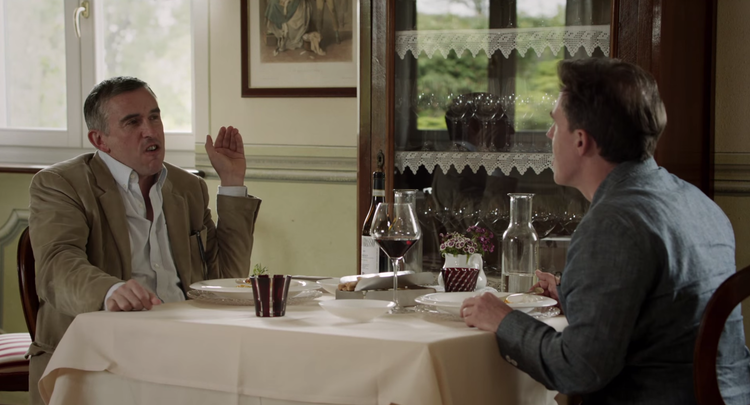
These are the adventures of comedians Rob Brydon (Welsh) and Steve Coogan (northern English), as they chat in the car during a scenic drive, compete in mimicking movie stars over a restaurant meal, pose for a snap in front of a plaque for a poet whose lines they recite, get shown to their hotel room by a young woman, sometimes have a brief encounter, and talk on the phone to a partner, child or agent or themselves in a mirror.

Without having seen the movies, I suspect the six-part series, upon which the movies are based, are preferable not only because they are longer but also because, accented with music, the same ritual every episode lends a melancholy predictability. dark-knight-rises-characters-hilariously-impersonated-by-steve-coogan-and-rob-brydon

My wife happily tolerates my enthusiasm, but wonders if our divergent opinions might invite gender analysis. True, David Denby of the New Yorker asserts: “Both movies, in fact, are about the impossibility—and the necessity—of male friendship.” However definitive that might sound, he also applauds several other basic themes. The men reveal their attraction to younger women – receptionists or at a nearby cafe table – and agree that glances are now not so usually reciprocated. I also wonder whether two female comedians might yet be allowed to retain the same dignity, while being so frequently silly, and mean, but will wisely leave further such conjectures to others.

Both series show some of the world’s loveliest scenery (the Lakes District and nearby parts of England, and the west coast of Italy), finest restaurant food and smartest comic impersonations (Michael Caine, Sean Connery, Woody Allen and Hugh Grant being ones I recognise), but the series are not particularly about any of these, nor quotations from Wordsworth and Coleridge in England and Byron and Shelley in Italy, nor celebrations of the craft of comedy, nor conversations about fading professional careers, about aging and death. Amalgamating such components, the Trips are classics of apparent simplicity, exemplified by the addictive rhythm.

The viewer accepts immediately that Brydon and Coogan play clever caricatures of themselves (Coogan more on top – including longer hair – in the first series, and Brydon winning in the second), and that they are not really reviewing the restaurants for the Observer, but a third, highly creative force is also hiding behind them. Using the same actors, director Michael Winterbottom developed some of the same techniques in Tristram Shandy: A cock and bull story (2005), and he had already done a road movie, In This World (2002), depicting the harrowing “smuggling” of two Afghan refugees from Pakistan across the Middle East and Europe to Britain.

Presumably also contributing to the minimal plots, Winterbottom has spent much of his adult life making movies far from home, probably getting used to luxurious accommodation, so that his former wife, Sabrina Broadbent, wrote Descent: An irresistible tragicomedy of everyday life (2004) about a movie director, always away, having affairs with his female actors. The shows revel in ambiguity, with the glamour constantly subverted. The beautiful food, places and people are haunted by insults and interruptions, quarrels about driving, agents sounding hopeful, relationship troubles, and time passing. As Denby reports: “Both films pursue the high and the low: a complicated deep-running sadness courses through the cynical, sybaritic adventures.” Winterbottom has captured the Nigella Lawson lesson – behind every façade lies pain (the “domestic goddess” had everything, including a nasty, public split with wealthy advertising entrepreneur husband Charles Saatchi).

A dear friend used to finish her emails with the tagline: “Be kind, for everyone you meet is fighting a great battle”, probably the invention of Scottish pastor, Rev. John Watson (1850-1907). The shows’ downers might seem casual and never worse than hit-and-miss communication, rivalry, nagging doubts and work pressures, but time is always fleeing. The implicit lesson is: “Eat, drink and be merry, … ” and I plan to write further in defence of that philosophy. For the moment, my argument is that the Trips witness the fundamental distinction between food and meals, and, at the risk of repetition, meals matter. Two or three brief shots from each kitchen show the cooks paying considerably more attention to the dishes than the two diners ever do. It is as if to say that celebrity chefs and photogenic plates have been accorded too much prominence of late.

As Brillat-Savarin wrote, table-pleasure depends not on fancy fare, but on four essentials: at least adequate setting, food and drink, companionship, and time. I’ll expand on this important point on another occasion, even if Brillat-Savarin gave two, differing lists of the four necessities (reconciled here). Nevertheless, Winterbottom has won me over by making the food and wine plainly important, but only one part of the picture. He has wondrously illustrated the peaks of all four necessary elements – glorious settings, fine comestibles, exceedingly witty and caring conversations, and apparently (only apparently) all the time in the world.