Dining with aphantasia

TO THINK I reached the age of 30 without knowing this.” I was considerably older than that incredulous online author when I learned about “aphantasia”, just a few days ago.

Aphantasia is the experience of “reduced or absent voluntary imagery”, that is, we aphantasics are not bothered by a “mind’s eye”, nor its equivalents for the other senses.

We are amazed to learn that, when “counting sheep”, many people actually watch imaginary sheep!

It’s a surprisingly late discovery for us aphantasics, and also for science. Psychologists wrote about it more than a century ago, including Fechner (1860), Galton (1880), Bentley (1899) and John Watson (1913). But then the topic disappeared.

Watson himself might have to take some blame by launching behaviourism’s avoidance of subjective experience in favour of external psychological observation, which would be ironic given how he was a non-imaginer.

This last is suggested by Bill Faw (2009), who arguably led the return to studies of “non-imagers”, the name he prefers for himself and others. In 2015, a neurologist came up with the seemingly catchier, “aphantasia”. Under whatever the name, the research remains rudimentary, especially in relation to the phenomenon’s fascination. For instance, published estimates of the proportion of aphantasics in the population range from 0.7% to 2 – 5%.

Many have discovered the condition when a therapist asks them to visualise. They remain puzzled when asked to, perhaps, put an intrusive thought on a floating leaf and watch it drift away. We recognise the condition immediately it’s described.

If I am asked: “Imagine the sun rising,” I get a glimpse, vanishing instantly, like keying in a password. An imagined apple might have some details, and at least seem red, but then I’ve seen standard depictions of apples since learning “A is for Apple”.

Given imagery’s presumed role in memory, non-imagers generally don’t have such strong recall of even recent events, people’s faces or the narrative of their own lives.

Recent research also shows, for example, that we non-imagers might draw a simpler version of a room from memory, but often with more spatial accuracy. Spatial memory follows separate brain pathways from object memory, and aphantasics would generally seem better at it.

No question but that human minds are varied.

My wife Marion and I discovered complementary experiences early in our relationship, but never pinpointed the underlying explanation. From the start, we knew that she’s much better with people’s names, and recall of events.

Whereas I could scarcely remember one line of poetry, she can recite not 10,000 lines, but 10,000 poems (only a slight exaggeration).

She enjoys novels, whereas I can’t arouse much enthusiasm (although maybe for Pride and Prejudice, which she supposes comes from Austen’s relative disregard for description).

We both enjoy movies – they don’t rely on visualisation. Mind you, I often get greater enjoyment than she does from movies based on her favourite novels – they are rarely quite as she imagined.

On the instruction “think of the colour red”, I get a fleeting impression, and move on. When I try to recall the smell of nutmeg, say, nothing happens. Marion has no such trouble.

Researchers referring to “visualisation, “imagination” and the “mind’s eye” betray a cultural priority for vision. Those with a vivid “mind’s eye” usually also have a strong “mind’s nose”, “mind’s ear”, “mind’s touch”, etc.

Reporting in 1880, the early researcher Francis Galton asked respondents to imagine “your breakfast-table as you sat down to it this morning – and consider carefully the picture that rises before your mind’s eye”. Some respondents saw the breakfast table “as well in all particulars as I can do if the reality is before me”. At the other end of the scale: “I recollect the breakfast table, but do not see it.” Galton did not report on other sensory recall, nor pleasures.

Delving into the absence of visual, auditory and other impressions raises questions about meals.

I’ve long been puzzled by the deluge of cookery pages. Why do we need yet another pavlova recipe? It turns out that where I might think “that’s a long list of ingredients”, Marion puts the ingredients together in her head, and decides if she’d enjoy eating the result.

Seemingly following my lack of olfactory recall, I have relative difficulty naming flavours, so that with wine, for instance, I struggle to find “vanilla notes”, “cedar” and “violets”. Instead of identifying particulars, I become immersed in compound sensations, starting with the wine’s “structure”.

That’s like meals as a whole. They are immediate. At a good meal, I am absorbed – engaged with the here-and-now of dishes, places, conversations and their connections. A good meal is complex, and hums. Existential.

Without intricate recall, I enjoy talking (yet again) about past stand-outs, and also look forward to the next experience. I always like to know something is planned.

I am now wondering about the act of writing. Just as some visual artists turn out not to visualise, but set images out in front of them, I love words on paper.

My books on cooking and economies contain numerous details, but these are meant to point to bigger concepts. Some readers might become preoccupied by descriptions, just as so-called “economists” might promote the simple mathematics of price, rather than absorb the full wonder of sharing the world.

Footnote: Research and writing on aphantasia has often been expressed in the negative – it is a “lack” or “disorder”. To quote a recent scientific paper, “visual imagery is absent or markedly impaired.” Even when protesting it’s not a disease, and citing examples of highly successful non-imagers, these same writers still focus on deficits. The very name aphantasia is pathologising.

That’s surprisingly easily turned around, so that one might say, for example, that many people – known as “phantasics” – suffer an overload of imagined sights, sounds, bodily states, and more.

George Herbert Betts reported on visual, auditory, gustatory, olfactory and other imagery in his 1909 study, and declared: “Very much of memory is accomplished without the use of imagery, and much of the imagery which accompanies memory is of no advantage to it.”

Questioning imagination’s importance for reading literature, he worried: “if a flood of profuse imagery should accompany the words as we read, interpretation and appreciation would be seriously interfered with.”

Without impediment, non-imagers engage with the factual and here-and-now, and think clearly.

Furthermore, aphantasia might be somewhat protective against PTSD, major depressive disorder, social phobia, and bipolar disorder (e.g., Cavedon-Taylor, 2022), given how these can be reinforced by visualising – flashbacks, or too vividly imagined dangers.

And yet, without leaping sheep, floating leaves or the sweet scent of vanilla, aphantasics might be exposed to other anxieties.

I am just beginning, and so is research generally.

For a sample:

Galton, Francis (1880), “Statistics of mental imagery”, Mind: A quarterly review, No. 19 (July 1880): 302-318

Betts, George Herbert (1909). Distribution and Functions of Mental Imagery (Columbia Univ. Contr. to Educ. No. 26.), New York: Teachers College, Columbia University

Cavedon-Taylor, Dan (2022), “Aphantasia and psychological disorder: Current connections, defining the imagery deficit and future directions,” Frontiers in Psychology, Published online 14 October 2022

Faw, Bill (2009), “Conflicting intuitions may be based on differing abilities: Evidence from
mental imaging research,” Journal of Consciousness Studies, 16(4), 45–68

Fox-Muraton, Mélissa (2021), “Aphantasia and the language of imagination: A Wittgensteinian exploration,” Analiza i Egzystencja 55 (2021)

Cavedon-Taylor, Dan (2022), “Aphantasia and psychological disorder: Current connections, defining the imagery deficit and future directions,” Frontiers in Psychology, Published online 14 October 2022

Bonkers billionaires

AMONG THEIR HAZARDS, billionaires get to believe that they are farsighted geniuses.

Take Elon Musk, who’s so clever that h­­e’s now not only planting his prodigious DNA (the number of Musk children is a question), but also preparing a Mars colony on the way to populating the Milky Way with mind-boggling numbers of artificial geniuses.

He’s is nothing if not inconsistent, and warns against Artificial Intelligence, while developing it, co-founding Neuralink in 2016 to merge brains with machines.

Adding Twitter to his portfolio through 2022, Musk is far from the only bonkers billionaire, whose fortunes back such right-wing troops as Trump Republicans, Christian gun-toters, mainstream economists, and rocketeers.

The common thread is a vision that takes eyes off everyday reality to promote money’s interests, whether through populist conspiracies, American myths, the price mechanism or some glorious science-driven future of digital rationality.

Musk is attracted to particularly arrogant beliefs about longtermism and transhumanism (with links to the get-rich Effective Altruism network).

Environmentalists, liberals and republicans care about future generations, but the longtermists ask us to care even more for a hypothetical future of computer-simulated “persons”, who will colonise the stars.

The director of the Future of Humanity Institute, Nick Bostrom, anticipates at least 1058 such digital brains, so that, on simplistic utilitarian logic, the claims of these posthumans vastly outweigh present worries.

Bostrom also introduced the prevalent idea of existential risk, referring to potential catastrophes that get in the way of enormous numbers of “people” radiating out into space. It’ll happen, if we just leave everything to our superiors, the tech billionaires.

Even a recent, semi-respectable airing of longtermism in the New York Times calls on our brainiacs to plan in some unspecified way on behalf of future generations of “sentient life”. The article is by William MacAskill to promote his book, What we Owe the Future.

The latest issue of the Guardian Weekly both reviews MacAskill’s “thrilling” book, and editorially backs the Artemis space project for no reasons other than Russia and China’s similar ambitions, and the admittedly significant “earthrise” photograph of 1968.

While we are wise to attend to the science, we need to shield ourselves from science fiction, especially when it so obviously serves massive investments. Besides, we should never forget that scientists have already brought eugenics, plastics and nuclear weapons.

The well-funded thinking-machine capitalists, blowing us out of the sky, are of particular gastronomic concern because their ideology is alienated from the metabolic universe. That’s our world of eating, drinking and cooperating on our apparently (for them) expendable little planet.

Their adulation of some detached “intelligence” is especially delusional because our cerebra are essentially tools for eating better – coordinating sensory inputs and movements, and reaching the sophistication of good restaurants. As suggested by (other) recent science, the mind is subservient through the “gut-brain axis” to the “first brain” or stomach.

Tech billionaires planning to populate space with incredible numbers of thinking machines leave behind nature, farms, kitchens and restaurants. Bonkers!

Promoting some supposedly superior race is a treason against humans radically grounded on Earth, thank you very much.

Elon Musk’s prototype space-populating rocket

Aristologist in the Hills

Time passes in a pair of small country towns 20 minutes from Adelaide centre

Once upon a time (more than forty years ago), Jennifer Hillier and I opened the Uraidla Aristologist in the Adelaide Hills. Still a long time ago (2016), I promised a blog post, reporting on its namesake, the then new Summertown Aristologist, just down the road.

We’ve dined there several times since, which might be all I need to say. But here are a few quick, belated reflections, and a few memories.

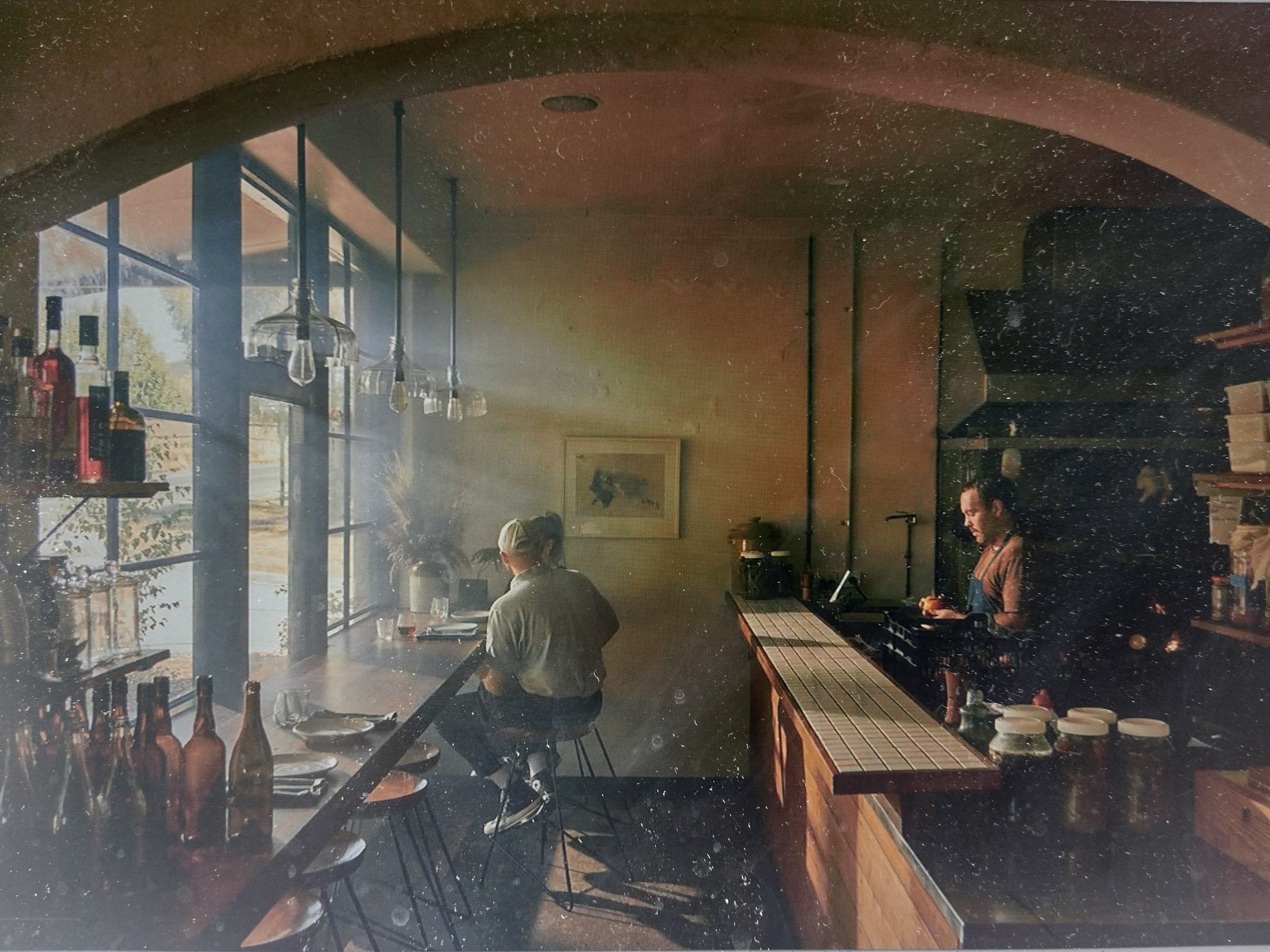
Summertown Aristologist (with apologies to Vermeer)

While individual expressions, the two restaurants have also been products of their times. Our dining room had a provincial feel, with linen and white plates and simple cutlery, in an old stone building in a garden. The Summertown version is more hip wine bar with long shared central table, benches, a booth and outdoor tables.

In Uraidla, we went for a three-course, fixed-price menu, opening with a glass of sparkling wine and cheese savouries with around four choices in each course, and closing with coffee. Those cheese savouries lasted from the first meal at our Cantina di Toia in Tuscany until our last meal at Uraidla.

We decided that the fixed price was a “licence to generosity”, and we asked $38 for some years – seemingly little these days.

The cooking was our version of Italian and French – always a pasta, often a soufflé – an eclectic mix that might appeal to foodies hankering after simple meals in those countries back then.

The Summertown Aristologist offers a collection of dishes (sample menu below), usually centred on one ingredient, so that one can snack, share plates or submit to the chefs’ collection, and cooked more professionally. While a series of chefs have taken charge, their food has remained surprisingly consistent.

Both places set out similarly focussed on local ingredients in changing circumstances, given how we ran through the 1980s into the mid-1990s (Jennifer held on a couple of years longer).

We chose a hidden paradise of market gardeners for our location, although the small growers were already then getting big or out. I would go around the district each summer morning extracting zucchini flowers, and also picked up vegetables from one or two remaining old-style market gardeners. The cherry varieties were extraordinary (including from Julie Bishop’s parents). We were able to get English gooseberries from Basket range, sour cherries, quinces, foraged blackberries. A young family started farming Basket Range trout. Basil from a film maker. Avocados from a nearby valley. Locally farmed quail.

We grew plenty in our large garden, including globe artichokes in spring (only cut when ordered), an over-abundance of raspberries through December… and eggs throughout.

Jennifer always baked our bread rolls, and made preserves. We did cure prosciutto and salami, relying on local Italian expertise, but relied mostly on Vari’s deli and then Marino’s in the Central Market..

While strawberry growers have kept up, and orchardists with cherries and apples are somewhere to be found, the Summertown operation could name several prized suppliers the other day, although often at a relative distance, while they boasted growing all their own vegetables. Otherwise, it’s simple ingredients sympathetically considered, the old trick.

Since Jennifer and I were doing a restaurant for its own sake, and eschewing prevalent commercial approaches, we turned out often to have been ahead of our time. Perhaps the simplest example was the grumbles (and thanks) we attracted for “inviting” guests to smoke cigarettes away from the dining-room in a special room or outside. The Summertown A. has no fights on that score.

Perhaps little indicates the changes like wine.

The quick profit from brussels sprouts was ruining land back then. Fortunately, grapes were coming in: Petaluma had planted in 1979, and Ashton Hills would break ground in 1982.

I organised the first Adelaide Hills Wine Show. To get it going, I simply went around to Geoff Trenorden’s – the secretary of the excellent Uraidla Show – and he said “sounds good”, and what section did we want? Since “W” was available, we became Section W: Wine.

Winemakers Brian Croser and Stephen George joined in, and decided that judging should be done by the exhibitors themselves, sitting around in a circle at the Aristologist. The show started with possibly half-dozen wines, including from backyard makers, but within a few years Croser and George were joined by other notables, not least Stephen and Prue Henschke and Geoff Weaver. Those were the days.

While they now have vineyards in all directions, the Summertown restaurant owners are natural winemakers, the restaurant doubling as their cellar doors.

The changed cost of wines is remarkable; fancy wine prices have responded to increased global demand. For example, from a 1985 winelist, we sold Krug champagne for $36 (about $116 in present dollars). By way of comparison, Dan Murphy’s retails the equivalent bottle for $363. It gets worse. Our Petaluma Chardonnay 1981 was on the list for $20. At Rockpool Bar and Grill, an equivalent year is $380. We had the Wendouree Shiraz 1978 for $11, and Rockpool asks $750 for something with a similar age. You’d have to be really in the know to get Mt Mary Cabernets (now called Quintet), which I wasn’t alone in considering the finest Australian red, but we asked $25; Rockpool seeks $390. Chateau Coutet 1980 was $25, whereas $325 now.

To explain (not for the first time) the reason for “Aristologist”, a London writer Thomas Walker coined “aristologist” for “student of dining” in 1835, and the early Australian cookery book author Edward Abbott used it as his nom-de-plume in 1864. The eccentric name provided a warning that the old (and presumably new) restaurant cared about dining, yet did its own thing.

The Niagara has reopened in Gundagai

GREAT POLITICAL excitement! After years of neglect, a new team has taken over. That’s not just in Canberra, but also, not that far away, in the town of Gundagai.

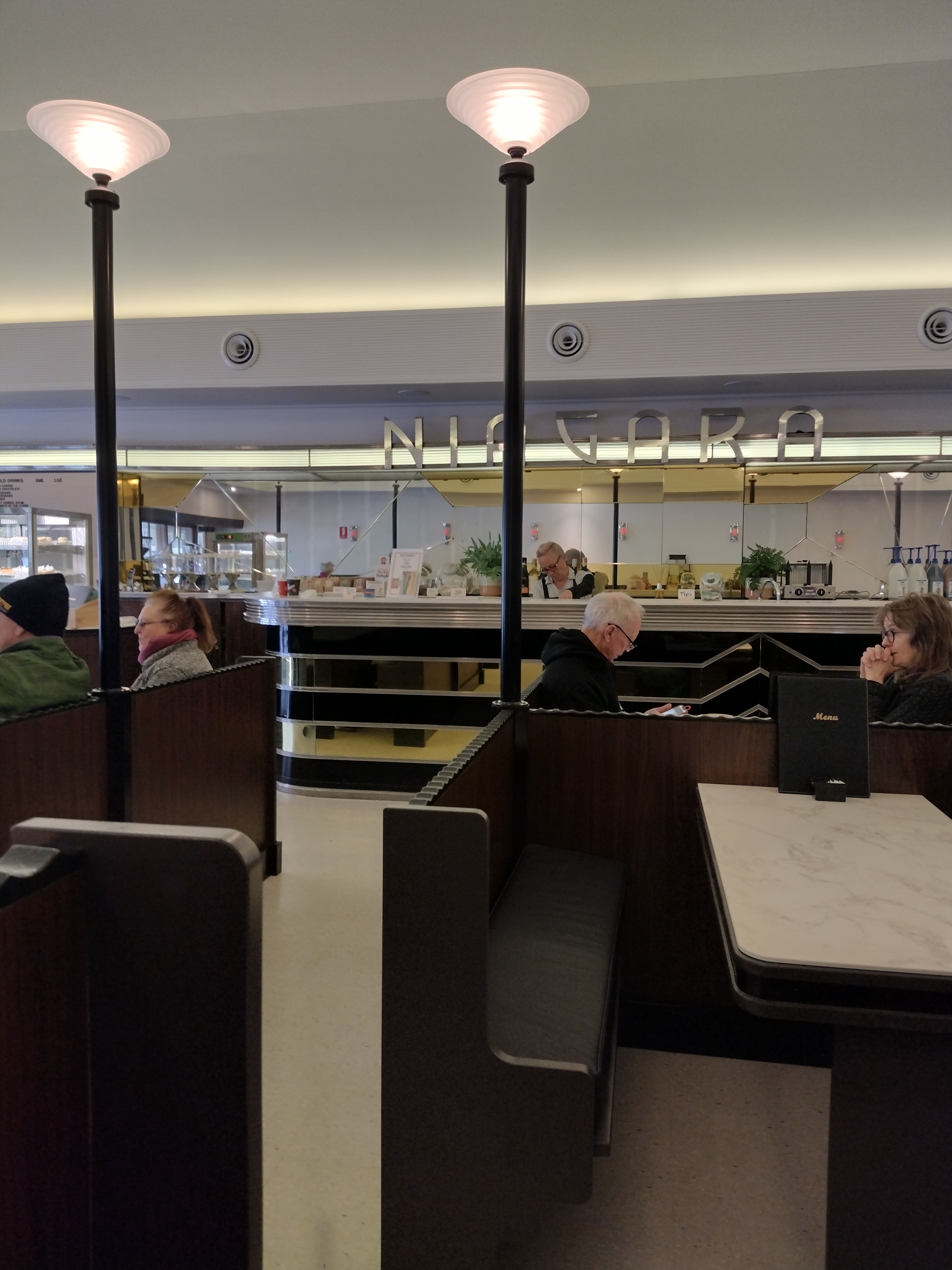
We chanced to breakfast at the renowned Niagara cafe in the first week of the art deco gem’s reopening. The new owners have done a great job, restoring the booths and all.

Suddenly, Luke and Kym have gone from paying tradespeople to paying customers.

Families with Greek heritage got early into refrigerated foods in Australia, and specialised in fish, icecream (including Peter’s and Paul’s) and milkbars.

And so, successively, the Notara, Castrission and Loukissas families owned and ran the place from 1902, through the wondrous art deco modernisation in 1938, until it became too much a few years ago.

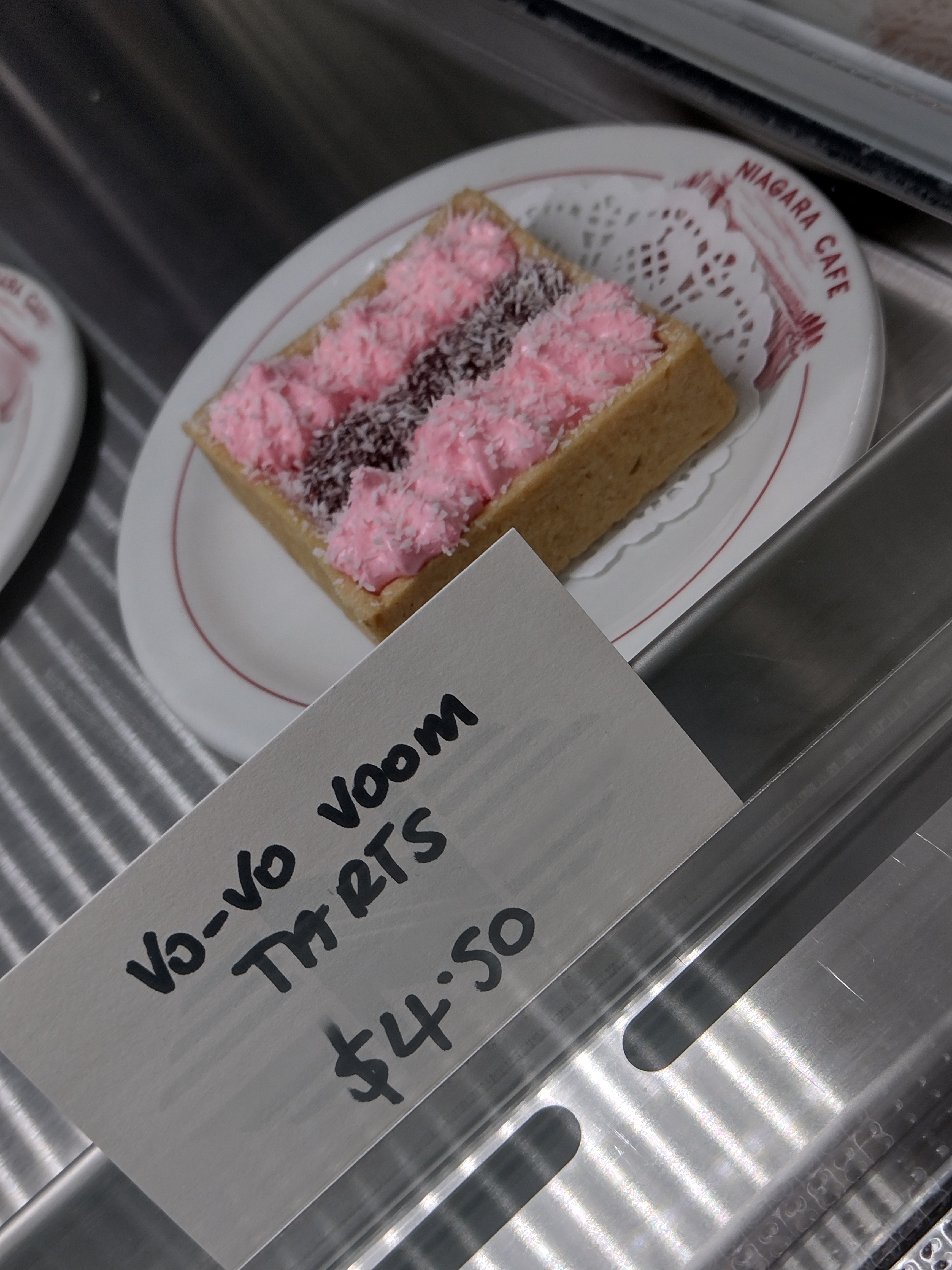
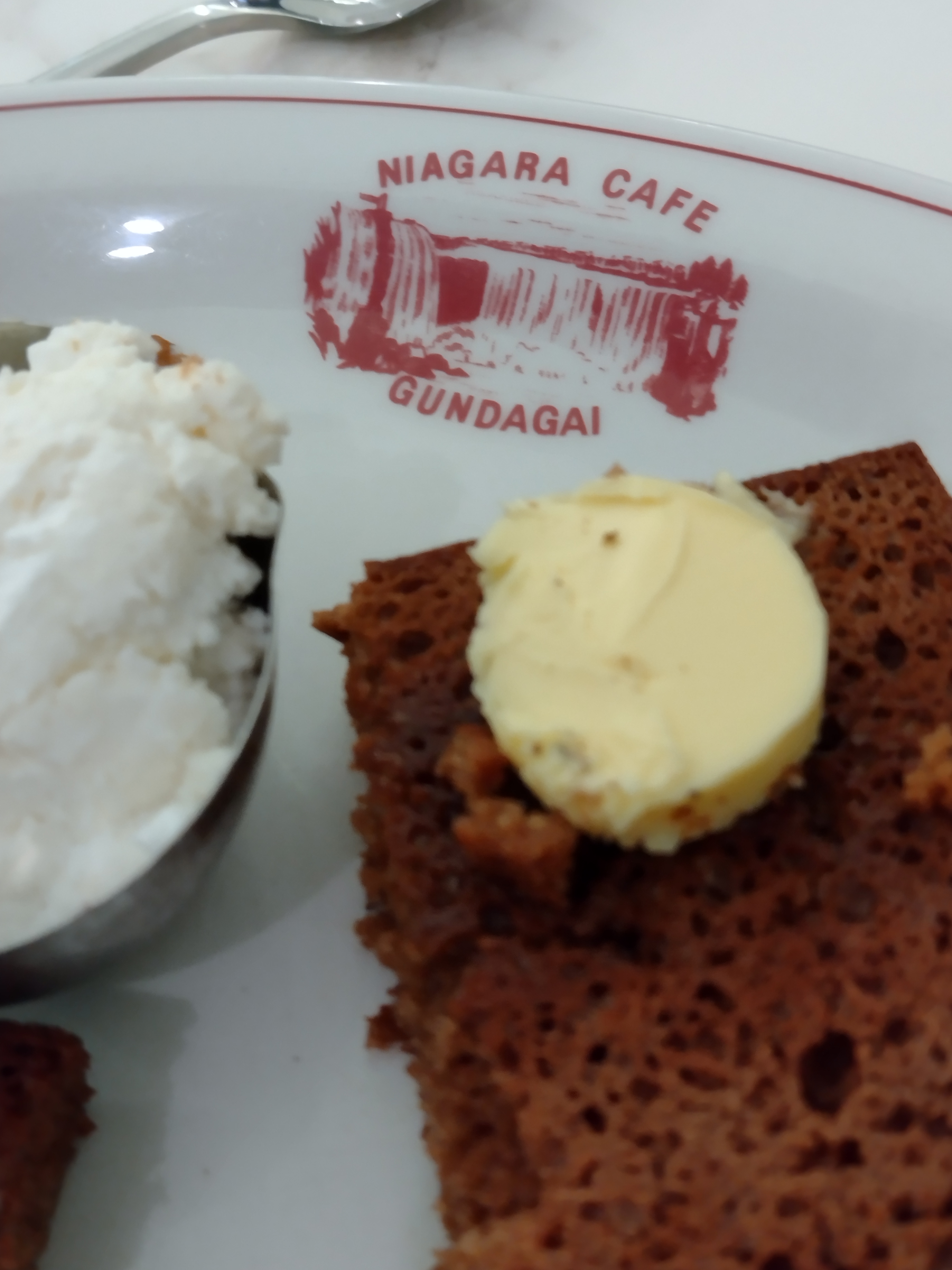
After opening up for a midnight meal for Prime Minister John Curtin and team in 1942, the place became a Labor Party shrine, accumulating signed photos commemorating the visit, and showing off the crockery used.

The new owners have stored the memorabilia, and promise to soon return it to display.

Postscript: Two years later, and the new owners are still to show the old Labor crockery and other memorabilia. Perhaps a metaphor?

@NiagaraCafeGundagai 

The centre can be radical. Look what happened at the recent Australian election

THE POLITICALLY COMMITTED often decry the “centre” as wishy-washy, and as cosying up to the other side. But, being less ideological, the centre can be more radical.

Just one piece of evidence is the recent electoral success of “community independents”, whose pronounced liberalism produced policies more radical than either main party, left or right.

Liberalism? Corporate capitalism has rewritten our political language (chronicled in Meals Matter), and that necessitates being more open to rethinking liberalism.

The liberalism of its often-acknowledged founder, John Locke, tends to live on with so-called “small-l” or “left-” or “social-” liberals, who have multiplied over recent decades.

They eschew extremes, and yet have become such a threat that the right’s “culture warriors” have ridiculed them variously as “chardonnay socialists”, “latte liberals”, “smoked salmon socialists”, “gauche caviar”, “Toskana-Fraktion”,  “Salonsozialist”, “yuppies”, “politically correct”, “chattering classes”, “bobos”, “educated classes”, “liberal elite”, “inner-city greenies”, “mad left”, and on and on.

These liberals are committed to everyday, kitchen-table reality, which is perceived through practical experiences and face-to-face conversations, and informed by learning, with a consequent embrace of equality, tolerance, and democracy. Combined with the rejection of high authority and ideology and other extremes, these liberals are definitively radical in the sense of getting back to material basics.

The recent rise of so-called “teal” independents has been explained as “professional women” rejecting “merely” climate inaction, political corruption, and mistreatment of women.

They are better identified as genuine liberals, unimpressed by the Coalition’s obfuscations on global warming and women. Disturbed by political corruption and capture, they are determinedly “community” candidates, and I have already described their “kitchen table conversations” – grassroots exercises in interpersonal respect and participatory democracy.

Community independents belong to a centre that’s definitely not a weak compromise, not at least in terms of climate action, political integrity and gender equality.

Their policies are reliant on facts and expertise, not ideology, suggesting radicalism that’s not extreme, but literally getting to the root of the matter (deriving from Latin radix radicis).

Max Chandler-Mather

Likewise, the Greens would appear to have somewhat furled their wilderness and class war wings, and boosted their liberal radicalism. “People have lost faith in a political system that puts the interests of a few big corporations ahead of the rest of us,” according to Max Chandler-Mather. So, he ran “the biggest grassroots campaign in Greens’ history”, and won the Brisbane seat of Griffith.

Unusually for an Australian campaign, they established themselves as community carers by, for example, building a community garden on Defence land being disposed of to a developer. Their volunteer teams used some of the garden’s produce when helping out during covid lockdowns and after floods.

Historically, the major Australian parties – Labor and Liberal – represented the interests of the working class and bosses, respectively, although both always contained liberal elements.

Labor outgrew the class war with the Whitlam revolution of 1972, although its liberal leadership then fell in with neoliberalism. Labor’s agenda remains hypnotised by “jobs, jobs, jobs”, which is sunny way to support corporate capitalism.

We might be lucky, and the new Labor government might get behind the common-wealth of health, social justice, infrastructure, environment, education, research and the arts. But that means standing up to capitalist rule by profit.

Perhaps Labor needs to become the Labourer/Worker/Housekeeper/Carer/Professional/ Artisan/Farmer/Small businessperson/LGBTIQA+/Immigrant/Aged/Disabled/Indigenous/Abused/Student/Etc Party. A new name is not easy to come up with… Perhaps “Commonwealth Party”?

The “Liberal” name is already taken by the occasionally liberal party of Robert Menzies, but whose main demand is “freedom” for money, and which now has to choose between becoming a “broad church” or a reality-inventing, fact-denying, cynical rump.

Likewise, the National Party has to decide between being a Country Party, concerned with increasingly perilous bread-and-butter rural issues, or Trumpian authoritarians.

Perhaps the party system is doomed, anyway, as a relic of hierarchies with “party discipline” under the Leader, announcing policy, allocating ministries, and making “captain’s picks”.

Rather than rely on backroom deals, sloganised messaging and last-minute hi-vis pageantry, Members and Senators might deliberate on the floor of parliament. Now that’s an idea.

The community independents have shown the way. And let’s not forget that a thriving democracy in a complex society requires a highly informed citizenry, and therefore strong public education, responsible media, and a committed and open public service.

With determination, it’s possible that a new centre might hold, and a radical centre at that.

To repeat, by “centre”, I do not speak of midway between two extremes, but caring, honest, informed and pragmatic “liberalism”.

Dining with a thump

ONCE, WHEN WE WERE DINING OUT in Sydney’s Leichhardt in the late 1960s, the noise became so unbearable that the Italian waiter whistled shrilly, everyone quietened, and then we gradually talked louder to be heard, until he whistled again.

That’s changed, because many restaurateurs now unapologetically drown out conversation. No longer young and silly, and with hearing aids, I have in recent years shied away from at least two restaurants as soon we felt the racket, and I have also put up with the noise in more than one highly-fashionable place where I’m not keen to return.

Discriminating among voices becomes harder with age (too much rock n roll when young). But now speakers thump imperiously beneath the clamour. Managements seemingly welcome the “Lombard effect” (people speaking louder to be heard). They must mistake deafening exuberance for buzz.

Certainly, several waiters have obligingly reduced the volume. Yet in Summer Hill, a young woman turned the sound down, only for the manager to turn it up. When we explained that we’d asked for it down, he said something inaudible about other customers (there were only one or two other tables). He then devoted himself to shifting around paper packages awaiting meal deliverers. Without soliciting our order, he remained unconcerned as we departed, and discovered a cheaper, much friendlier take-away around the corner, with a few tables and wine glasses.

New York Times restaurant critic Pete Wells actually mounted a “ringing defense” of noise. Constantly implored to condemn raucous places, he realised he didn’t find loud restaurants a problem.

The truth is, I love them. Not all of them, not all the time. I enjoy more than a few quiet restaurants, too, where you can concentrate on the food and the conversation without auditory distractions. But so many of the places I enjoy most tend to be at least somewhat noisy.

His illustrator did not seem so keen…


In a study of reviews in the New York Times and San Francisco Chronicle, researcher John Lang found that restaurant noise could affect the critics’ evaluations. Strikingly, the correlation between comments on noise and overall rating was reversed between east and west coasts:

That is, in the Times, as noise increases, restaurant ratings decrease; while in the Chronicle, as noise increases, so do restaurant ratings

The quality of food had double the impact of service on overall rating, followed by “atmosphere”, while noise remained a lesser, but still “significant predictor of the overall restaurant star rating”.

The Zagat “State of American Dining” report in 2016 had already found that, for 25% of customers, noise was the most irritating component of dining out, and the internet abounds with complaints. Various apps – including iHEARu and soundprint – been launched to share information about the noise levels of particular restaurants.

So why raise the volume? Researchers found that tasters rated beer more highly when listening to music by a familiar band.

A pair of professors of marketing, studying restaurant “servicescapes”, have identified the “environmental cues” such as lighting and music that “strongly” influence eating behavior. For example, loud noise and bright lighting increase the quantity eaten, and decrease the pleasure, without an overall effect on the money spent. They also found that “softening the lighting and music led people to eat less, to rate the food as more enjoyable, and to spend just as much”.

Acoustic engineers around the world, including at Flinders University, have advised of how to mitigate the effects of minimalist, hard surfaces.

Noise could become a problem for us at the Uraidla Aristologist in the Adelaide Hills (and so could curmudgeonly customers, but let that pass). A shouty table of six or eight could ruin it for everyone. After we had added a kilim and tapestry to the walls, a further, smart suggestion was to fix egg cartons underneath the long, central serving table. Confession: our notorious cat clawed them down.

Certainly, near-silence could be embarrassing for, say, just two tables of two. But we never succumbed to the increasing pressure to add “atmosphere” with any recorded music. Instead, we often achieved the beautiful hum and clink of contented conversation and dining – one pleasure I still miss.

Surroundings are enormously important to dining. Big money is spent on chairs, walls,  bars, benches and lights. Restaurants run from closeted haute cuisine to blaring television echoing around hard surfaces on the other side of the Alps. In recent times, some owners have chosen to deafen customers, and some have chosen to stay away.

With the pandemic, crowding gave way to muffling masks, social distancing, and outdoor tables. But then the clamour came crashing back. Restaurant reviewers ought to include a noise indicator.

@GoldingCartoons

Welcome to our kitchen table election

This Federal election is powered by Kitchen Table Conversations, a technique developed in Melbourne in the late 1990s and which has mobilised the constant political chatter around tables, in cafés and over drinks

THE “CLIMATE” INDEPENDENTS expected to win an increased number of seats on 21 May, and conceivably the balance of power, are propelled by KTC.

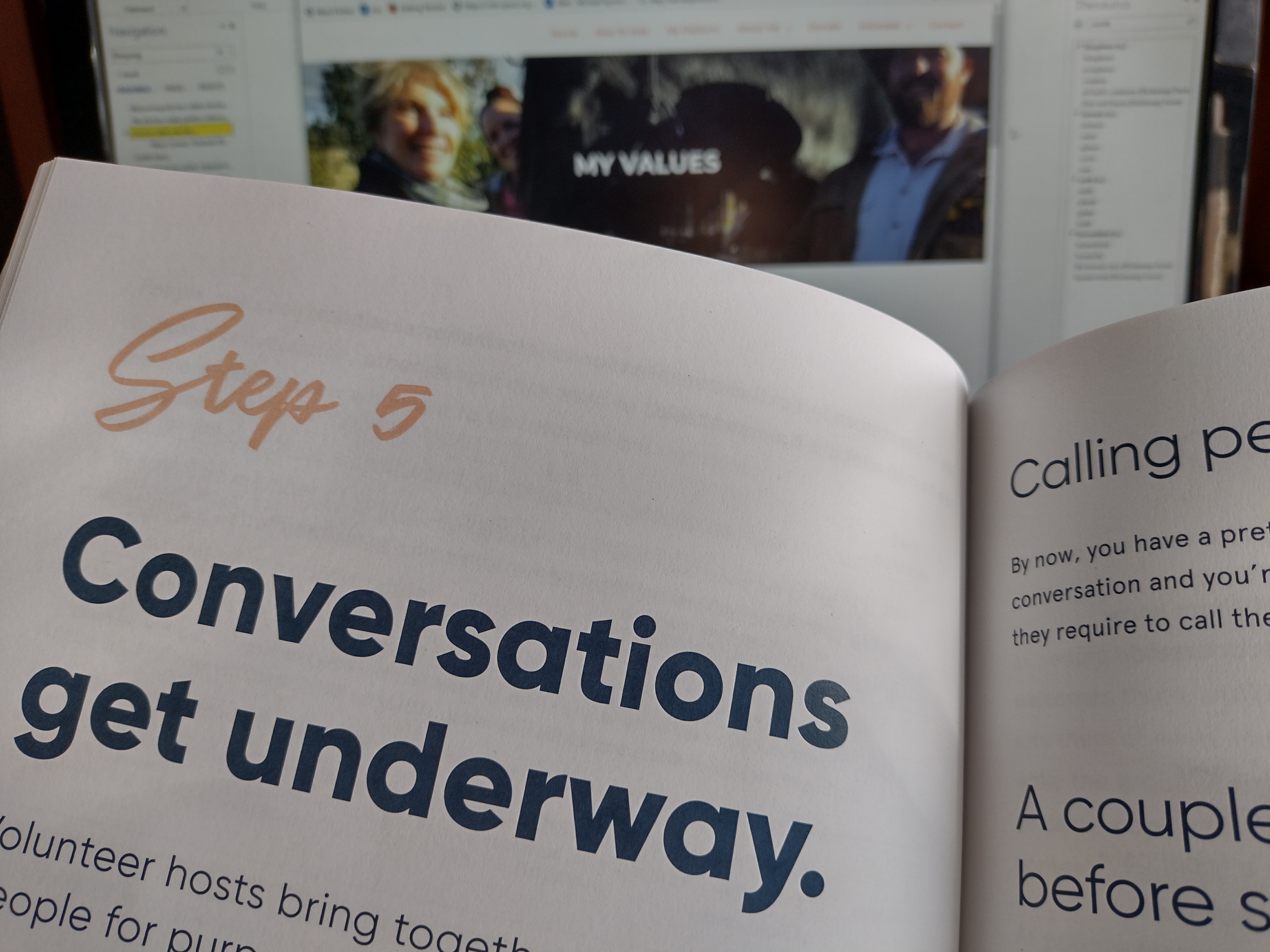
This is the mobilising technique of “Kitchen Table Conversations”. Self-selected hosts invite perhaps nine others around to discuss the political issues they find important, and to plan possible actions. A coordinating group collate reports from the kitchens to help find and inform a local candidate.

A relatively spontaneous, and still quite loose, movement is now significant in Australian politics (and I would like to learn about similar techniques elsewhere in the world).

Various “Voices 4”, “climate”, “teal” or “community” independents have sprung up in Coalition electorates, with voters disgruntled principally about lack of action on the climate emergency, and on an independent commission on corruption.

Behind that, kitchen-table activists respond to perceptions that political parties have failed participatory democracy.

While progressive on some core issues, participants thus far tend to be relatively comfortable, financially, so that campaigns lack neither professional access, nor funds.

Compiling a definitive list of KTC-propelled candidates proves tricky, initially because I have not checked through all possibilities. Climate 200 has published a list of those it supports, but others remain sufficiently independent as to refuse all outside funding. Other estimates suggest more than two dozen “teal” candidates. My attempted list (below) contains four up for re-election, plus eleven newcomers in city seats held by Liberals, and six rural candidates mainly challenging Nationals.

From Kitchen Table Conversations: A guide for sustaining our democratic culture, by Mary Crooks and Leah McPherson (2021)

The mechanism was adopted famously in the rural Victorian seat of Indi in 2013, when Cathy McGowan replaced Sophie Mirabella (and was succeeded by fellow independent Helen Haines). In like manner, in 2019, Zali Steggall spectacularly beat former Prime Minister Tony Abbott in Warringah.

KTC had originated even earlier, among women worried by the aggressive neoliberalism of Premier of Victoria Jeff Kennett as he closed schools, privatised government activities, and dismantled democracy.

Introducing a new booklet on the topic, Mary Crooks relates how, in 1996, she lunched with two friends (Sandra Hart and Angela Munro) at the Red Sage Café in Clifton Hill (Melbourne). “Despite the Kennett government being re-elected for a second term, we sensed a groundswell of community unease across Victoria,” Crooks recalls.

At a second meeting, Crooks took along an ad for the position of executive director of the Victoria Women’s Trust. She got the job, and developed the grassroots mechanism. The initial name of the “Red Sage Project” (after the café) was soon changed to Purple Sage to avoid political confusion (and setting off a palette of colours, often teal). Working with other respected community groups, the project engaged as many as 6000 women and men across the state “in a thoughtful deliberation of the key issues and the actions they could think about taking”.

The model very much belongs to the (traditionally womanly) domain of the kitchen table, and the treatment of women has remained prominent.

In the new booklet, Mary Crooks and Leah McPherson advise: “Hosts will need to provide some drinks and light snacks. This may be as simple as tea, coffee, and a packet of biscuits.” This contrasts with political candidates drinking a beer at the traditionally male pub (although photo-ops have lately included sipping tea in workplaces).

Crooks and McPherson accept that “Core Group” organisers might enjoy a proper meal for a post-mortem: “You may wish to organise a lunch or dinner together, share a drink at the pub or café, or enjoy a peaceful walk to decompress.”

These domestic get-togethers should be viewed as a deliberate alternative to the presently dominant conversations at board tables, business lunches and cocktail parties among politicians, billionaires and lobbyists, titillating each other with coal mines, highways, new airports, outsourcing opportunities, and cuts to public education. (For more on “state capture”, read this recent report.)

In pursuit of the “delicious revolution” in Meals Matter, I recognise meal conversations as the essential ground of democracy, because table chat covers not only regular meals past, future and present, but also the wider meals of schools, hospitals and aged care, and all that surrounds them – table talk naturally encompasses life’s essentials.

Political theorist Janet Flammang has written how everyday meals generate popular political consciousness.Even slightly more formality can be powerful. Like-minded experts and enthusiasts typically “socialise” at drinks and restaurant tables.

Courtly banquets were centres of political proposals and intrigue. Regicide has been plotted at aristocratic feasts, and so, too, revolutions have been planned in coffee-houses, and people’s victories celebrated in street banquets.

Some might defend digital media as furthering political discourse, but online chat drifts too far from social foundations in food sharing.

Politics emerges from the pleasure of the stomach, “especially through participatory democracy, in which everybody labors at everyday meals and converses, so that knowledge collects up and distributes”. The political economy is to be “rewritten by living well” (Symons, Meals Matter, 2020: 272-273).

Long live table politics!


The “community”, “climate”, “Voices 4” and “teal” independents seeking lower-house re-election are: Helen Haines in Victoria, Rebekha Sharkie in South Australia, Zali Steggall in NSW, and Andrew Wilkie in Tasmania.

As to newcomers in Liberal city seats, we’re speaking of at least: Nicolette Boele in Bradfield; Jo Dyer in Boothby; Kate Chaney in Curtin; Zoe Daniel in Goldstein; Claire Miles in Casey; Despi O’Connor in Flinders; Monique Ryan in Kooyong; Sophie Scamps in Mackellar; Allegra Spender in Wentworth; Georgia Steele in Hughes; and Kylea Tink in North Sydney.

Taking a swing at rural, mainly National seats, similar candidates include: Penny Ackery (Hume), Kate Hook (Calare), Suzie Holt (Groom), Hanabeth Luke (Page), Caz Heise (Cowper), and Rob Priestly (Nicholls).

The campaigns are unique to each electorate, but all wanting to “do politics differently”, and they generally feature climate action, and integrity in parliament, and they listen at kitchen table, fireside and pub get-togethers.

Mary Crooks

Morrison, “fake”

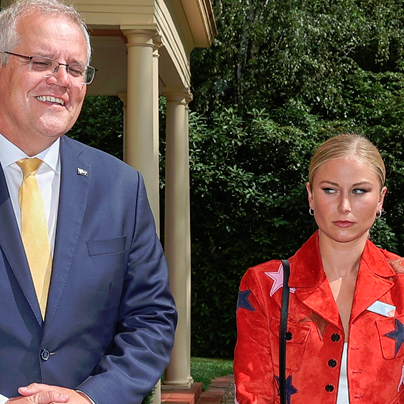
SCOTT MORRISON would never make a good waiter. He’s a total “fake”, as certified by recent Australian of the year Grace Tame.

She responded to the Prime Minister’s attempt to effuse sympathetically, when a mother inquired about cuts to NDIS payments for her child with autism.

Scott Morrison and his wife were unable to conceive for the better part of two decades. Nearly giving up on IVF, at the age of 39, Jenny gave birth to the first of the couple’s two daughters.

“She is our miracle child, the answer to a lifetime of prayer and 14 years of painful, invasive, heartbreaking treatment,” Scott wrote in 2009.

So, in a televised leaders’ debate the other night, he replied, concerning the future of the NDIS, “Jenny and I have been blessed, we’ve got two children” – and here he stumbled – “that don’t – that haven’t had to go through that.” He added: “And so for parents, with children who are disabled, I can only try and understand your aspirations for those children.”

Grace Tame and fake (to her right)

Along with the famous photo of her sideways look at Morrison, Grace Tame tweeted that “autism blesses those of us who have it with the ability to spot fakes from a mile off”.

In a classic non-apology, the Prime Minister later said he was “deeply sorry” about the way his comments were “sought to be represented by our political opponents in the middle of an election,” and that he had intended to “respect the challenges they [?] face, not the opposite”.

He’s a fake leader. He pretends to the role – as a “bully” to some, and “friend” to all the “quiet Australians”, while leaving CEOs, lobbyists and cronies to run the place.

Serious waiters are not fakes. They actually care for people. They help them have a good time, and cope with the full range from angry ignorance to gratitude. They have seen it all – couples in love, couples parting, two-timing spouses, drunken politicians, business wheeler-dealers, tearful families, wedding parties, and new-borns in baskets. They have studied the strangest dietary preferences, and all manner of anxiety.

We have had personal experience. Strangers would try to say the “right thing” when confronting our beautiful son, whose disabilities were in plain evidence. They would say things like: “It’s wonderful what science comes up with”. Or they promised a “miracle” from God.

At restaurants, Lawrence would often cry, and possibly be calmed by listening to the Wiggles. But, truly, the better the restaurant, the happier he was.

Perhaps the noise levels were more comfortable. Perhaps he joined our enjoyment. Perhaps the waiters knew what do. Whatever it was, we confirmed the effect time and again.

There was much that Lawrence couldn’t do (he was blind, never said a word, and remained unable to walk or even grip an object). But, among some wondrous abilities, he could spot fakes.

At good places, waiters would organise clear soup or a mash, so we could feed him. (Ultimately, though, he was happier and healthier just being tube fed.)

And, invariably, good waiters did not carry on about science or God; they just said something sensible.

We can’t exactly remember the best-ever response, but we know it was by a waiter, and where he was – Café di Stasio in St Kilda. His intent was something like: “He will look after you, and you will look after him.”

I dedicated my latest book, Meals Matter, to “Marion, Dorothy, and Lawrence Symons Maddox (1999-2009), who together have taught me so much about meals, and thereby everything”.

Tom Uren and me

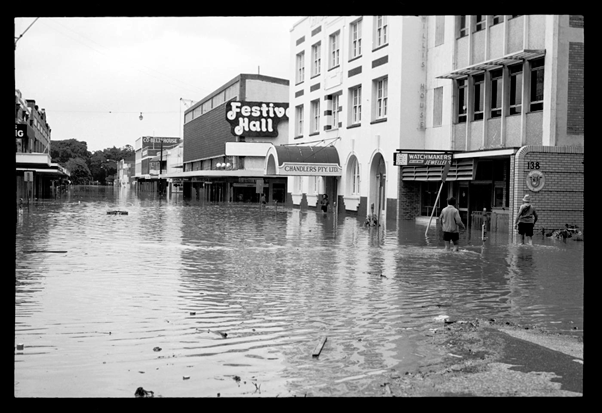
AT THE TIME OF THE DISASTROUS BRISBANE FLOODS of January 1974, I was acting for some months as Whitlam minister Tom Uren’s media officer in Canberra.

Planners in his new Department of Urban and Regional Development explained to me that the flooding was exacerbated by laissez-faire development, whether chopping down trees upstream that hastened run-off, further speeding up rivers as flood “mitigation” or, incredibly, subdividing housing blocks on flood plains.

Brisbane, January 1974 (Qld Archives)

I suggested to Uren that he issue a media statement about the environmentally-destructive policies. Tom refused. He believed it wrong to score political points when people were losing their lives and property.

While humbled by Tom Uren’s decency, I’ve never been sure that he chose, at least in this case, the better way to practise his unchallenged love for humanity and nature.

Back then, the Queensland Premier, Joh Bjelke-Petersen, was famously pro-development, and never let up as a ferocious and ignorant detractor of the Whitlam Labor Government.

The pattern has continued until now, nearly five decades later, and with incontestably worsening floods.

With storms continuing, immoral N.S.W. Premier Dominic Perrottet demanded more housing, whether on flood plains or not (“NSW Planning Minister scraps order to consider flood, fire risks before building”, Sydney Morning Herald, 22 March 2022).

One difference now is the featuring of climate change. Back then, the more generalised fear was that too many people were sold too much technology, destroying biodiversity and unleashing harmful chemicals in a race to disaster.

This broader concern about resource depletion, loss of species, pollution, etc, might yet prove more realistic. For example, with pandemic lockdowns, investigators found that the rate of heart attacks dropped, in synch with the clearer skies.

That health improvement was detected in the U.S., and much of the air there is cleaner than other parts of the world.

A WHO report recently recognised air pollution as the “the single biggest environmental threat to human health”. That’s illnesses and deaths from the same fossil fuels that produce the greenhouse effect.

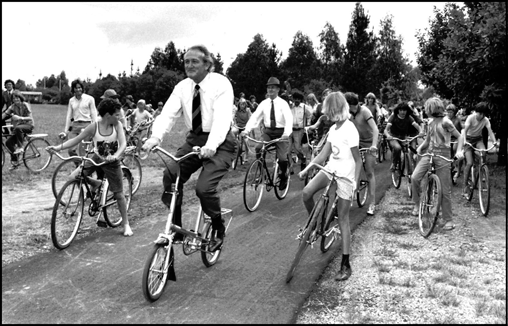
I did successfully organise photo-ops for Tom Uren opening bike paths (ACT Archives)

Recycling world tour

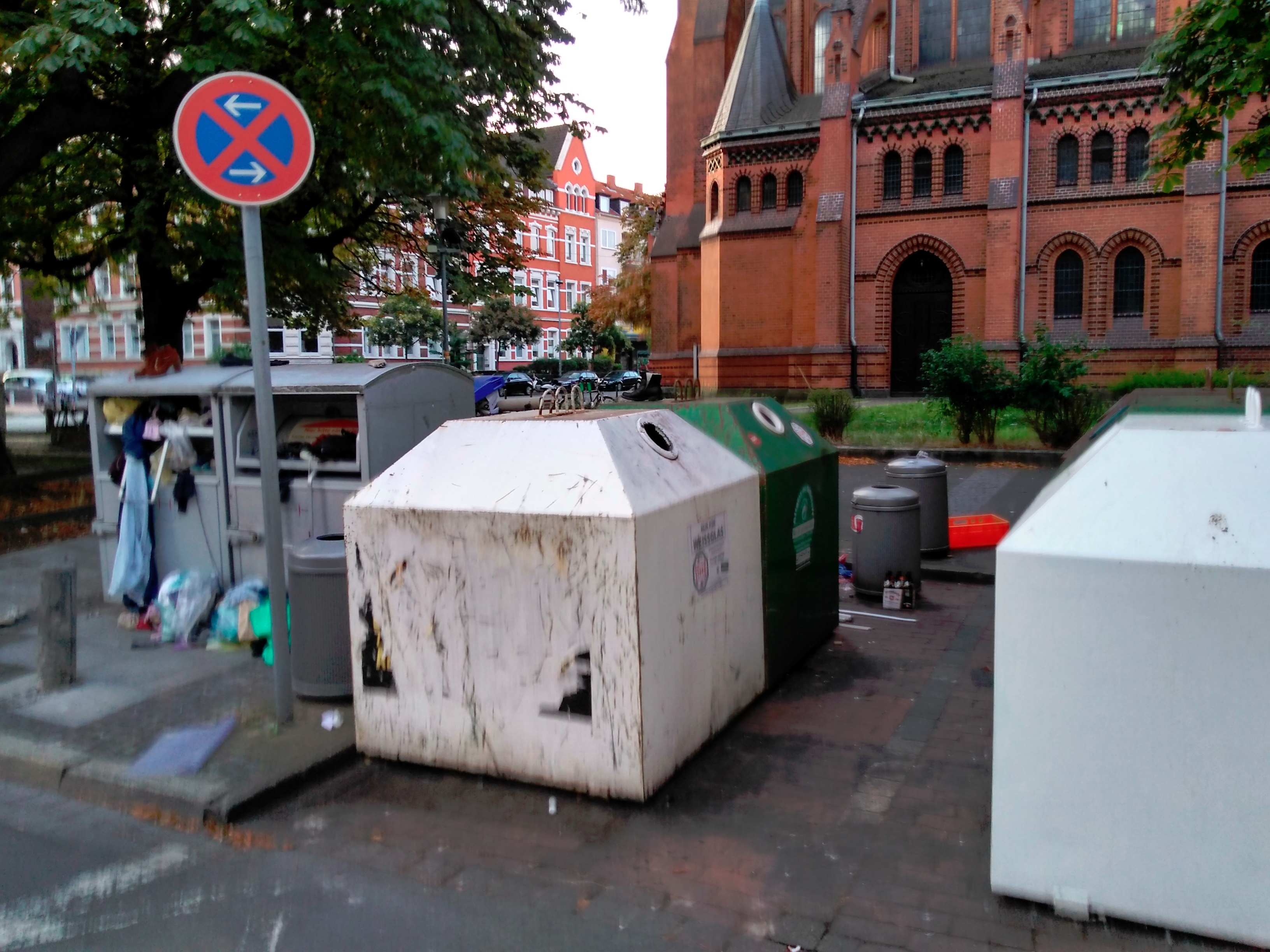
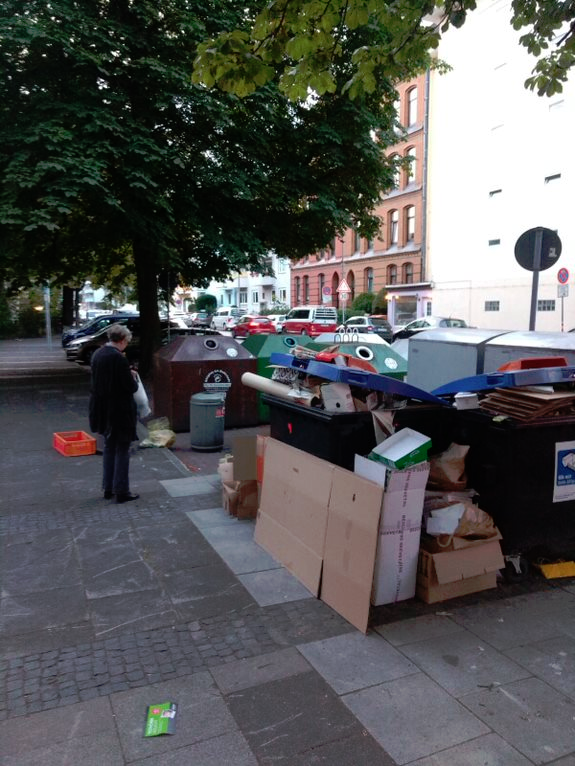
Recycling bottles (clear, green and brown, separately), also clothing, and various, Hannover, Germany

MY EARLIEST school years taught me, before crossing a road, to “look right, look left and look right again.” Or was it the other way around … ? And does any rule apply world-wide? I must have learned to cycle on the left, because keeping to the “wrong” side of the road still bewilders me. High concentrations of silent-cyclists-from-nowhere on criss-crossing lanes add to the hazards. That’s Germany.

Lately, I’ve been wishing school taught me another life skill, namely, how to recycle. What goes in what colour bin? What about mixed materials? What happens to other stuff?

I try my best, but what precisely are “soft plastics”? If I collect aluminium foil, where does it go? Am I just keeping wine-bottle corks to make another cork-board? I hear that an electric toothbrush divides in two directions.

On what will perhaps prove our last global trip, we stayed in several different houses in a few different countries, and (confession) I’ve basically given up.

Different nations, different parts of cities, and even different households make confusingly different demands.

I would like to suggest more global action. Where’s world government when we need it? Business already relies on considerable international coordination. Why can’t it standardise recycling?

Recycling makes the streets of Spain, Germany, China and elsewhere in Australia look, and also sound, gloriously exotic, given the different systems, so I eventually started taking photographs.

In Barcelona, for example, the green bin took “glass” (here, green is for garden organics);  blue meant “paper” (going into our yellow general recycling; and I haven’t noticed blue bins in Sydney); and grey was for “non-recyclable” (red for us; and I haven’t noticed grey here either). The only possible match might be brown, for “organic” in Barcelona, and I think being used for a kitchen scraps trial in Sydney.

In Hannover, the church bells across the road would stop after 10 pm and resume at the same ungodly hour as builders. But bottles never stopped clinking into large recycling containers alongside the church. Fascinatingly for us, designated bins took different glass colours: green, brown, and clear. A huge, suitably compartmentalised truck hoisted the bins and dropped the bottles out the bottom with a massive, weekly clatter. That’s the bottles the supermarket – across from the front of the church – wouldn’t take .

More street furniture, Hannover

For, at the supermarket, you inserted empty bottles singly into a roller to read the bar code. The reverse automat might then send some back out, but accept others for a redeemable deposit at the check-out.

Automatic refund detection in supermarket, Hannover

Blocks of apartments in Hannover often seemed to share a locked cage for garbage bins, sometimes on the front of the building or on the footpath. It wasn’t the neatest or quietest solution. In Shanghai, recycling could seem much slicker, and more padlocks presumably restricted these bins to nearby households.

Shanghai, China

I’m trying to recall where garbage collection was paid for by requiring official plastic bags, sold through supermarkets. Such “pay-as-you-waste” schemes ostensibly encourage waste reduction (although sometimes dumping). Inevitably, the schemes have a confusing number of names, including Pay as you throw (PAYT), variable rate pricing, trash metering, unit pricing, and user-pays.

If we travelled less, the confusion could just remain a cute distraction. Still, it’s telling that we can’t standardise recycling.

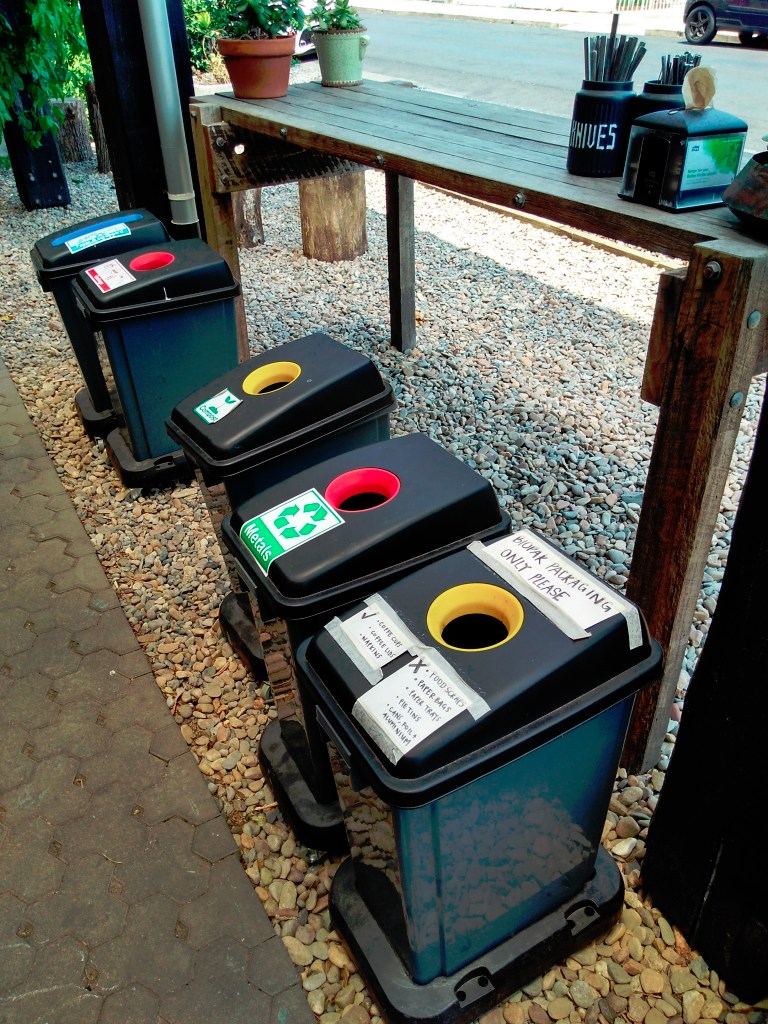
A cafe in Newcastle, NSW, seemed to have invented yet another colour scheme.