What are we doing with a King?

OUR RECENT PUBLIC holiday to celebrate the King’s birthday reminded yet again that Australia needs to move to a democratic Commonwealth with a grown-up Constitution. The existing arrangements merely sign up Australian colonies under the Crown, rather than make a careful social contract between citizens.

AS a suggestion, a preamble might begin: Finding ourselves in an industrial civilisation, imposed violently on Indigenous nations, we each agree to cooperate in this Commonwealth. Obedient to ourselves, we remain wary of rule from above, whether by kings, ideologies, autocrats or big money. We, the People, organise ourselves. The Constitution inspires, while it sets out formal principles.

As citizens of the Commonwealth, we submit to the rule of law, democratically established by an informed citizenship, and managed by the state (government and bureaucracy), overlooked by a mindful judiciary. And there’s more.

But, before getting too far, a quick note that our King’s Birthday weekend is being followed immediately by the U.S. “No Kings” day. And this leads to an admission that conservatives make a reasonable point about a king or queen possibly providing stability, unlike what’s happening in a famous republic.

Neither a poet, nor a honed legal mind, but a meal-centred scholar, let me propose some essentials for our forthcoming Constitution.

As individuals and social beings, we respect the laws of nature, notably the ecological requirements of generation and preservation. We also obey laws, democratically achieved. That more or less paraphrases seventeenth-century English political philosopher John Locke’s arguments against paternalism, particularly monarchical, and for democracy.

Thinkers in his day understood a Commonwealth as a political economy, with, traditionally, a monarch organising food-centred infrastructure and services, such as irrigation, roads, art, science and welfare.

Replacing kings and queens, Locke envisaged a Commonwealth enhancing citizens’ “natural rights”, which were to life, liberty and property. We achieve well-being through access to food and water, gardens and seashores, to housing and livable towns, to health through good medical care, knowledge gained through schools and research, and all embellished and reinforced through the arts.

The world has changed since Locke, and not only because powerful forces have abstracted “Bills of Rights” from natural realities.

The big problem now – worse than being subject to a king and queen – is Corporations. They rule more intricately, and more ideologically, than ever any monarch.

As explained in Meals Matter (2020), for-profit corporations essentially emerged after the modern republican pattern had been set. Lacking Constitutional legitimacy, corporations nonetheless gained legal support through such devices as “limited liability” and “corporate personhood”. They then appropriated rights, especially “liberty”, which supported “laissez-faire”, “free enterprise”, “neoliberalism” and lately “disruption”.

Corporate capitalist theory reassigned sovereignty to money. The system has now remodeled all in the corporate image, turning universities into businesses, and people into buying-and-selling machines.

Corporations supply our cars, and build the roads. Their advertising funds news dissemination. Their factories supply food, and armaments. This means having to engage closely with government through lobbying, consultation, outsourcing, and two-way personnel exchange. Who “understands” war better than military suppliers?

Invidiously, I mention just one of numerous experts now running the place: former SA Senator and Cabinet Minister, Christopher Pyne. To quote Wikipedia:

Lacking Constitutional status, corporations have captured government. They push politicians to the fringes, where they take photo opportunities. The frustrated electorate are expected to blame … “the government”!

In our serious Constitution, corporations lose “rights” and gain licences or something of the kind.

The loss of the Voice Referendum in Australia a year ago pointed to an uninspiring, irrelevant-seeming Constitution. Additionally, the perceived need for a consultative body highlighted the lack of power of actual citizens, in this case Indigenous people.

In the new Republic, I reckon the democratically-elected parliament might elect a President, who forms a Cabinet and outer Ministry from both elected members and from representatives of registered consultative bodies.

As recognised economic tools with government oversight, corporations might provide recommendations this way. All lobbying would be public through recorded debates and publications of registered representative assemblies.

Likewise, a wide collection of interests make their case. Trade unions make useful representations. And so on, through various advocacy groups, all overseen by a commission.

This commission is appointed by the parliament with reference to the bodies themselves. As well as collating submissions, the commission would support consultative bodies. The commission provides financial and logistical support, where appropriate.

Think of it as like a royal court of old, whose lively gossip, intelligence, opinion, and learning advised the ruler. In ridding ourselves of kings and queens in favour of parliaments, we need to replace not only monarchs, but also their clever courtiers.
The missing analysis: How money trumps people

STEALING FREEDOM, CAPITALISM trounces liberals.

In the recent U.S. Presidential election, whichever side you voted for, money won.

One party was aligned to neoliberal rationality and the other, the victors, represented maverick disruption. Either way, corporations won.

For more than two centuries, money stole liberty from the people. Corporate apologists eroded individual integrity in favour of laissez-faire, free enterprise, and neoliberal capitalism.

After the Cold War, promoting “liberty” for money world-wide, corporations gained neoliberal outsourcing, de-regulation and tax reduction. As a quid pro quo, newly-educated worker/consumers sought various forms of social and cultural liberation.

However, with states captured, rule by supposed rational “elites” has been giving way to rampant oligarchy.

The Democrats and similar parties need to “get back to the grassroots”. More than that, left- and social-liberals must rediscover the Enlightenment understanding of liberty belonging not to corporations but to the “preservation” of all individuals through meal-sharing.

Let the global banquet begin!

For more, read Meals Matter: A radical economics (Columbia University Press, 2020).

Doomed to disruption

Capitalism has abandoned neoliberalism and gone disruptive

FOLLOWING perestroika and glasnost and the collapse of the Soviet Union in 1991, capitalism’s boosters trumpeted “liberty” worldwide. Demanding liberation for all, a new Pax Americana would make everywhere safe for corporations.

Under big money’s global message of freedom, such left-liberal political leaders as David Lange, Paul Keating, Bill Clinton, Tony Blair, Helen Clark, Kevin Rudd and Barack Obama pushed progressive cultural reforms with particular support for racial, women’s, gay and other rights.

The trap was that the “rights revolution” in such areas as feminism and multiculturalism provided cover for the corporate capture of government. Under the banner of neoliberalism, the same leaders pushed through deregulation, fiscal “rectitude”, lower corporate taxes, “flexible” job markets, outsourcing, lower trade “barriers”, individual responsibility, etc.

In the flurry of freedom, cultural liberation was outmatched by the bolstering of corporate power.

With governments now firmly in its grip, capitalism moved from neoliberalism to “disruption”. Facebook boss Mark Zuckerberg instructed: “Move fast and break things”. Powerful corporate leaders from Zuckerberg, Musk and down asserted their sacred right to do what they wanted – AI, rockets to Mars, armaments, opioids, drill, baby, drill…

Writing about the “disruption machine” in the New Yorker in 2014, Jill Lepore observed that innovation had become “the idea of progress stripped of the aspirations of the Enlightenment, scrubbed clean of the horrors of the twentieth century, and relieved of its critics”.

Long-time Silicon Valley reporter Kara Swisher (Washington Post, 15/02/24) had “watched founders transform from young, idealistic strivers in a scrappy upstart industry into leaders of some of America’s largest and most influential businesses.” With few exceptions, “the richer and more powerful people grew, the more compromised they became.”

Upon Trump’s election as President, digital CEOs rushed for an audience, Swisher reported:

“There was a heap of money at stake, and they wanted to avoid a lot of damage the incoming Trump administration could do to the tech sector. … they also wanted contracts with the new government, especially the military. … More than anything, they wanted to be shielded from regulation, which they had neatly and completely avoided.”

The “invisible hand” of money unleashed disruption (and corruption), and broke pay parity, democracy and civility (not forgetting nature). Along with that, fewer and fewer billionaires supported left-liberal causes, preferring to boost their own fortunes by backing think-tanks and increasingly authoritarian ideologies.

Right-wing populists blamed the “politically correct”, the “woke”, university-educated “elites”, and mysterious liberals who controlled the “deep state”. Raising the “cloud of confusion”, Murdoch opinion-leaders baited their opponents until seeming actually to believe environmental degradation was an esoteric belief, and supporting women of colour impoverished white men.

Historian Ellen Schrecker has charted how the unprecedented invigoration of American universities during the Sixties eventually rebounded, when the right both attacked universities’ “liberalism” and corporatised them (in her studies of universities’ Lost Promise (2021) and Lost Soul (2010)).

Those endeavouring to save the welfare state, worker rights, universities, democracy and the environment have been tempted to display militancy. Israel’s brutality has now prompted campus protests in the Sixties manner.

Caution is warranted, nonetheless. Given how abusive politics suits aspiring demagogues, supporters of left/progressive/Green politics should prefer exposing the sin of over-commitment over indulging in it. Rather than shout back, the liberal left could usefully resort to honesty and openness, and appreciate complexity.

Arguing the benefits of civilised society also means understanding politics more deeply than as just warfare (“class struggle” already proved insufficient).

Contesting the authoritarian appeal of “the strong always win” means re-discovering lost principles. Countering disruption requires a return to something more like Enlightenment political philosophy, seized and shattered by capitalism.

The pre-capitalist basis of radicalism is described in Meals Matter: A radical economics through gastronomy (Columbia UP, 2020). The book also shows how money’s polemicists borrowed selectively from liberal-democratic arguments, and trampled on them.

Grassroots change comes from care and conversation at and about meals (at their different levels)

Australian Blak activist Natalie Cromb has just advocated, with “violence all around us”, for “reimagining our communities to be as they should be – caring, nurturing, healthy, happy and with enough”.

The centre can be radical. Look what happened at the recent Australian election

THE POLITICALLY COMMITTED often decry the “centre” as wishy-washy, and as cosying up to the other side. But, being less ideological, the centre can be more radical.

Just one piece of evidence is the recent electoral success of “community independents”, whose pronounced liberalism produced policies more radical than either main party, left or right.

Liberalism? Corporate capitalism has rewritten our political language (chronicled in Meals Matter), and that necessitates being more open to rethinking liberalism.

The liberalism of its often-acknowledged founder, John Locke, tends to live on with so-called “small-l” or “left-” or “social-” liberals, who have multiplied over recent decades.

They eschew extremes, and yet have become such a threat that the right’s “culture warriors” have ridiculed them variously as “chardonnay socialists”, “latte liberals”, “smoked salmon socialists”, “gauche caviar”, “Toskana-Fraktion”,  “Salonsozialist”, “yuppies”, “politically correct”, “chattering classes”, “bobos”, “educated classes”, “liberal elite”, “inner-city greenies”, “mad left”, and on and on.

These liberals are committed to everyday, kitchen-table reality, which is perceived through practical experiences and face-to-face conversations, and informed by learning, with a consequent embrace of equality, tolerance, and democracy. Combined with the rejection of high authority and ideology and other extremes, these liberals are definitively radical in the sense of getting back to material basics.

The recent rise of so-called “teal” independents has been explained as “professional women” rejecting “merely” climate inaction, political corruption, and mistreatment of women.

They are better identified as genuine liberals, unimpressed by the Coalition’s obfuscations on global warming and women. Disturbed by political corruption and capture, they are determinedly “community” candidates, and I have already described their “kitchen table conversations” – grassroots exercises in interpersonal respect and participatory democracy.

Community independents belong to a centre that’s definitely not a weak compromise, not at least in terms of climate action, political integrity and gender equality.

Their policies are reliant on facts and expertise, not ideology, suggesting radicalism that’s not extreme, but literally getting to the root of the matter (deriving from Latin radix radicis).

Max Chandler-Mather

Likewise, the Greens would appear to have somewhat furled their wilderness and class war wings, and boosted their liberal radicalism. “People have lost faith in a political system that puts the interests of a few big corporations ahead of the rest of us,” according to Max Chandler-Mather. So, he ran “the biggest grassroots campaign in Greens’ history”, and won the Brisbane seat of Griffith.

Unusually for an Australian campaign, they established themselves as community carers by, for example, building a community garden on Defence land being disposed of to a developer. Their volunteer teams used some of the garden’s produce when helping out during covid lockdowns and after floods.

Historically, the major Australian parties – Labor and Liberal – represented the interests of the working class and bosses, respectively, although both always contained liberal elements.

Labor outgrew the class war with the Whitlam revolution of 1972, although its liberal leadership then fell in with neoliberalism. Labor’s agenda remains hypnotised by “jobs, jobs, jobs”, which is sunny way to support corporate capitalism.

We might be lucky, and the new Labor government might get behind the common-wealth of health, social justice, infrastructure, environment, education, research and the arts. But that means standing up to capitalist rule by profit.

Perhaps Labor needs to become the Labourer/Worker/Housekeeper/Carer/Professional/ Artisan/Farmer/Small businessperson/LGBTIQA+/Immigrant/Aged/Disabled/Indigenous/Abused/Student/Etc Party. A new name is not easy to come up with… Perhaps “Commonwealth Party”?

The “Liberal” name is already taken by the occasionally liberal party of Robert Menzies, but whose main demand is “freedom” for money, and which now has to choose between becoming a “broad church” or a reality-inventing, fact-denying, cynical rump.

Likewise, the National Party has to decide between being a Country Party, concerned with increasingly perilous bread-and-butter rural issues, or Trumpian authoritarians.

Perhaps the party system is doomed, anyway, as a relic of hierarchies with “party discipline” under the Leader, announcing policy, allocating ministries, and making “captain’s picks”.

Rather than rely on backroom deals, sloganised messaging and last-minute hi-vis pageantry, Members and Senators might deliberate on the floor of parliament. Now that’s an idea.

The community independents have shown the way. And let’s not forget that a thriving democracy in a complex society requires a highly informed citizenry, and therefore strong public education, responsible media, and a committed and open public service.

With determination, it’s possible that a new centre might hold, and a radical centre at that.

To repeat, by “centre”, I do not speak of midway between two extremes, but caring, honest, informed and pragmatic “liberalism”.

“Don’t Look Up” stole my ending

The story so far:

  • Writer/director Adam McKay attracted big names (Jennifer Lawrence, Leonardo DiCaprio, Cate Blanchett, Meryl Streep, Ariana Grande, Timothée Chalamet, Rob Morgan, Mark Rylance, etc) to depict the apocalypse.
  • Movie critics are luke-warm – Don’t Look Up rates only 55% on Rotten Tomatoes (“slapdash, scattershot sendup”).
  • But some scientists say, “Please watch – this is just what it feels like.”

Both sides have a point. As a movie, Don’t Look Up falls short of the artistic clout of, say, Invasion of the Body Snatchers (1956) or Dr Strangelove (1964) – and both rate 98% on RT. But the new movies is breaking streaming records, and gets a 78% audience rating.

As to the scientists’ pleas, the movie might demonstrate the benefits of following “the science” in terms of peer-reviewed facts. The discovery of the fatal asteroid by astronomy postgraduate (Jennifer Lawrence) should have benefitted humanity.

But the movie also reveals reasons to be sceptical of “the scientists” – with teams of them aiding and abetting capitalism, personified here by a tech billionaire with a life-long dream of shooting himself into space.

The final flourishes of capitalism deserve greater movies, and Don’t Look Up’s audience success will surely stimulate more.

The immediate question here, nonetheless, is whether Don’t Look Up goes on my list of best foodie movies. Okay, it’s more about the distractions, vividly capturing Guy Debord’s “Society of the Spectacle” of political illusion, tv chat, TikTok, bottled water and packet snacks.

Eventually, the movie also turns to the only serious contender for human grounding, where? – to a simple meal.

However, the care and consideration of sharing food and conversation is what we need right now, not when it’s too late!

Don’t Look Up is compulsory viewing – it illustrates what happens when greed trumps appetite. Nevertheless, to get a real grip on the issues, I recommend Meals Matter: A Radical Economics through Gastronomy (2020). The endings are similar, but the paths are different.

Jennifer Lawrence

Talking meals

CHECK OUT my online chat with senior Economist journalist Dominic Ziegler, organised by Brisbane bookshop @avidreader4101 here.

This image has an empty alt attribute; its file name is image-1.png

I had a writerly go – extending beyond 100,000 words – to demonstrate that Meals Matter, but here I try to persuade you that the book’s not just a pretty cover.

Yes, meals matter, as you might accept. But do you really appreciate how much meals shape our politics, economics, and social analyses?

Two centuries of laissez-faire, then free enterprise ideology, and, lately, neoliberalism belittled meals. Our lives were meant to centre on money instead.

But read the book, and catch up with the conversation.

Online event!

Talking Meals Matter

CHECK OUT my online chat with senior Economist journalist Dominic Ziegler, organised by Brisbane’s Avid Reader Bookshop here.

Leading Brisbane bookshop @avidreader4101 hosts a conversation between senior journalist for the Economist magazine DOMINIC ZIEGLER, and Meals Matter author MICHAEL SYMONS

I’ve had a writerly go – extending beyond 100,000 words – to demonstrate that Meals Matter, but now I persuade you on Zoom that the book’s not just a pretty cover.

It’s one thing to agree, yes, meals matter, but another to recognise just how much that shapes our politics, economics, and social analyses.

Two centuries of laissez-faire, then free enterprise ideology, and, lately, neoliberalism belittled meals. Our lives had to centre on money instead.

The book demonstrates the upending of economics – once the management of households, with meals at their heart, it became the mathematical depiction of competitive money-making. Once associated with wellness and well-being, “wealth” became financial. Concern for appetite became glorified greed. And so on.

But read the book, and catch up with the conversation from 18 January.

Not just a pretty cover

The magic of money

Human need vs capitalist greed: A gastronomic rebuttal of mainstream economics

By Michael Symons

[This essay, summarising some main themes of Meals Matter: A Radical Economics through Gastronomy, was published in Economic Sociology & Political Economy, 10 November 2020, now with minor corrections]

“A TAP OF MY MAGIC WAND … and all you see is money!” With this, the conjurer distracts attention from healthy bodies, happy households, wise governments, and nature. Even the actual market of bread, apples and beer disappears behind the price mechanism.

For more than two centuries, capitalism has rewritten economics.

The ancient Greek oikonomia – “household management” – concerned the satisfaction of basic human needs. Economics remained that way until the rise of for-profit corporations in the late-eighteenth/early-nineteenth century. To suit capitalism, modern economists concentrated everyone’s attention on the powerful tool, money.

PIG TODAY-Dollar gains further traction on Trump tax talk

Mainstream economists celebrated financial rule, and relegated human needs to, at best, incidental beneficiaries. Instead of appetite, the motive became greed. Instead of well-being, wealth meant bullion. Instead of natural growth, it became money’s eternal expansion. Instead of every individual counting, it became each for himself.

Success was measured by market indices, inflation, deficits, GDP, bottom lines, and tax cuts.  Money gained such a hold that it shrank a person to a buyer-seller, merging human-beings with for-profit corporations. The relentless push for profit culminated in crises in health, equity, democracy and nature.

My latest book, Meals Matter: A Radical Economics Through Gastronomy, explores how actual economies put food on the table, and how capitalism up-ended that, neglecting human needs, with unhappy results.

Dedicated to gastronomy as the “diner’s sense of the world”, the book rereads Epicurus, Hobbes, Locke, Quesnay, Brillat-Savarin, Marx, Jevons, Weber, Mises, Polanyi, Fisher, and Friedman, among the mix. Taking meals seriously upsets political and economic orthodoxies, as I sketch here.

By “radical” economics, I don’t mean extreme, just getting back to basics – true to the word’s derivation from the Latin radix for “root” (as in “radish”).

Such grounded activities as gardening, cooking, drinking, and talking politics might seem “trivial” from some superior vantage-point. However, the “little things” are highly significant at the grass roots, and multiply across humanity. The deterioration of trade relations with China or some militant action might claim “importance”, but only from its links to everyday experience.

Meals Matter shows how such Enlightenment thinkers as Thomas Hobbes, John Locke and Jean-Jacques Rousseau still based their arguments on the fundamental need to eat and drink. For them, the natural law of “self-preservation” called for “subsistence”, “comforts” and “conveniencies”.

Locke’s core right to “life” meant to a living or livelihood, that is, to “food and raiment, and other conveniencies”. Locke quoted Richard Hooker’s statement that, to obtain necessities, “we are naturally induced to seek communion and fellowship with others… in politic societies”.

For Locke, in the Second Treatise chapter, “On property”, the plain fact was that people, “once born, have a right to their preservation, and consequently to meat and drink, and such other things as nature affords for their subsistence”. He raised questions about when an apple becomes “one’s own” (that is, property) – is it when digested, chewed, cooked, brought home or picked? The individual also had to be permitted to labour on their self-preservation, within bodily, social and natural limits.

Enlightenment theorists knew several types of household or economy, each based on a different mode of distribution. Only two types used money, and even then it was not essential.

The original oikos or family economy circulates nutriments through communism. Although sometimes distorted through paternalism, the family follows the guideline, “from each according to ability, to each according to need”.

Finding parallels with the domestic household, Enlightenment thinkers knew the human body as the “animal economy”, employing digestive and circulatory systems.

In like manner, the “political economy” was a “body politic”. Depicting the head, heart and arms in the frontispiece to his Leviathan, Hobbes saw money coursing around the body politic as preserved food, kept for another time or place.

In Chapter 24 of Leviathan, Hobbes explained:

By Concoction, I understand the reducing of all commodities, which are not presently consumed, but reserved for Nourishment in time to come, to some thing of equall value, and withall so portable, as not to hinder the motion of men from place to place; to the end a man maye have in what place soever, such Nourishment as the place affordeth. And this is nothing else but Gold, and Silver, and Mony.

The body politic’s “head” – in charge of collecting and redistributing food (or its substitute) – could be an autocrat or group of people. (My book discusses the political banquet in more detail.)

Thinkers back then spoke of the confining, “natural economy”. Charles Darwin still used the Linnean phrases, “economy of nature” and “polity of nature”, in Origin of Species in 1959; Ernst Haeckel coined “ecology” in 1866.

As well as these economies, a separate market economy, based on exchange, became more visible in the mid-eighteenth century. The French économistes, led by Madame de Pompadour’s physician François Quesnay, found parallels of the œconomie animale in the distribution of grain, hampered by the interventions of the “baker-king”.

Visiting France through 1764-1766, during an experiment in grain-trade liberalization, Adam Smith picked up économiste ideas about leaving the market to its own devices. Nonetheless, Smith still introduced Wealth of Nations in 1776, with the recognition that, through the “co-operation and assistance of great multitudes”, such as the butcher, brewer, and baker, “we expect our dinner”.

Radical ideas supported American, French, and subsequent republics. However, just when the people were successfully contesting autocracy, corporate capitalism muscled in.

Jean-Baptiste Say’s interpretation of Smith as a free marketeer influenced a new generation of business-linked political economists (no longer physicians and philosophers), among them David Ricardo, who found importance in the arithmetical relationships between workers’ wages, business operators’ profits and property-owners’ rents.

Along with that, capitalist authority relentlessly undercut and also, where convenient, appropriated Lockean guidelines. In particular, the confusingly-named “classical” liberalism handed the human right of self-preserving liberty to money, thereby backing “laissez-faire”, then “free enterprise” and eventually “neoliberal” campaigns.

With capitalism picking up pace, radical arguments from below returned with Karl Marx, for whom the “first premise” of society remained “eating and drinking, housing, clothing and various other things”. He found importance in the class struggle over the ownership of the means of production.

With the “marginal revolution” of the 1860s, Stanley Jevons, Carl Menger and other economic theorists elevated market exchanges of actual meat, beer and bread into differential equations.

“Political economists” dropped the modifier through the nineteenth century, becoming, imperialistically, “economists”. Self-styled “economists” presented “the economy” as little more than profits and prices, and so tasteless, colourless, unequal, and not alive. For decades, the financial superstructure suppressed radical insights.

The Sixties brought some relief, when the technological sophistication of capitalist industry required a more highly educated workforce, and slicker marketing formed desirous consumers. The counterculture gained gastronomic appetites, with concerns for unprocessed foods, co-ops, communes, “dropping out”, the environment, and, in 1969, the Black Panther free breakfast program for school children.

The now abstract notions of “liberty” and “equality before the law” were employed to free up aspects of society and culture, among the most notable being women’s liberation. Centre-left governments of Bill Clinton, Tony Blair, Paul Keating and others found common cause with neoliberalism’s libertarian tendencies, while remaining ensnared in money’s insistent logic.

With a resurgence of conservative reaction, money resorted again to culture wars, with liberals now the dangerous “other”.

Recommending a considerably more intricate, life-centred economics, Meals Matter looks to the everyday activism of growers, cooks, and meal-lovers through a bewildering array of grassroots movements for urban farms, alternative economies, Slow Food, food justice, food sovereignty, agroecology, and more.

Radical economists must call money’s bluff, and prosecute a full agenda, including the freeing of “free” markets, held hostage to corporations.

Fundamentally, hope lies in the joyful rediscovery of the “little things” for which all individuals have equal rights, pursuing life, liberty, and happiness in harmony with the rest of nature.

“Mesmerising” descriptions of food

Weekend Australian 2
Weekend Australian, Books, 8-9 August 2020

YOU MIGHT NOT expect to read a scholarly tome about economics for pleasure. But this is gastronomic economics. As the Weekend Australian reviewer announces:

Revelling in the history, preparation and philosophy of food, he weaves its poetry into the text. Along with mesmerising descriptions of food …

For gastronomic works, such as Meals Matter, hedonism is not only a topic, but also a method, which is one reason why, unlike standard economics texts, I open each chapter not with a graph or financial table, but with a meal description.

Weekend Australian 1

Another reason is that the book challenges orthodoxies across economic theory, legal theory, political philosophy, food studies, and more. In the face of such transgressions, the hope is that the opening meals start out from a shared need to eat.

Hearteningly, academic readers for successive publishers gave strong support. The back-cover endorsements come from professors in disciplines as varied as politics, economics, anthropology, and European history.

In the 1980s, the “gastronomy” label put off academics, but this has plainly changed.

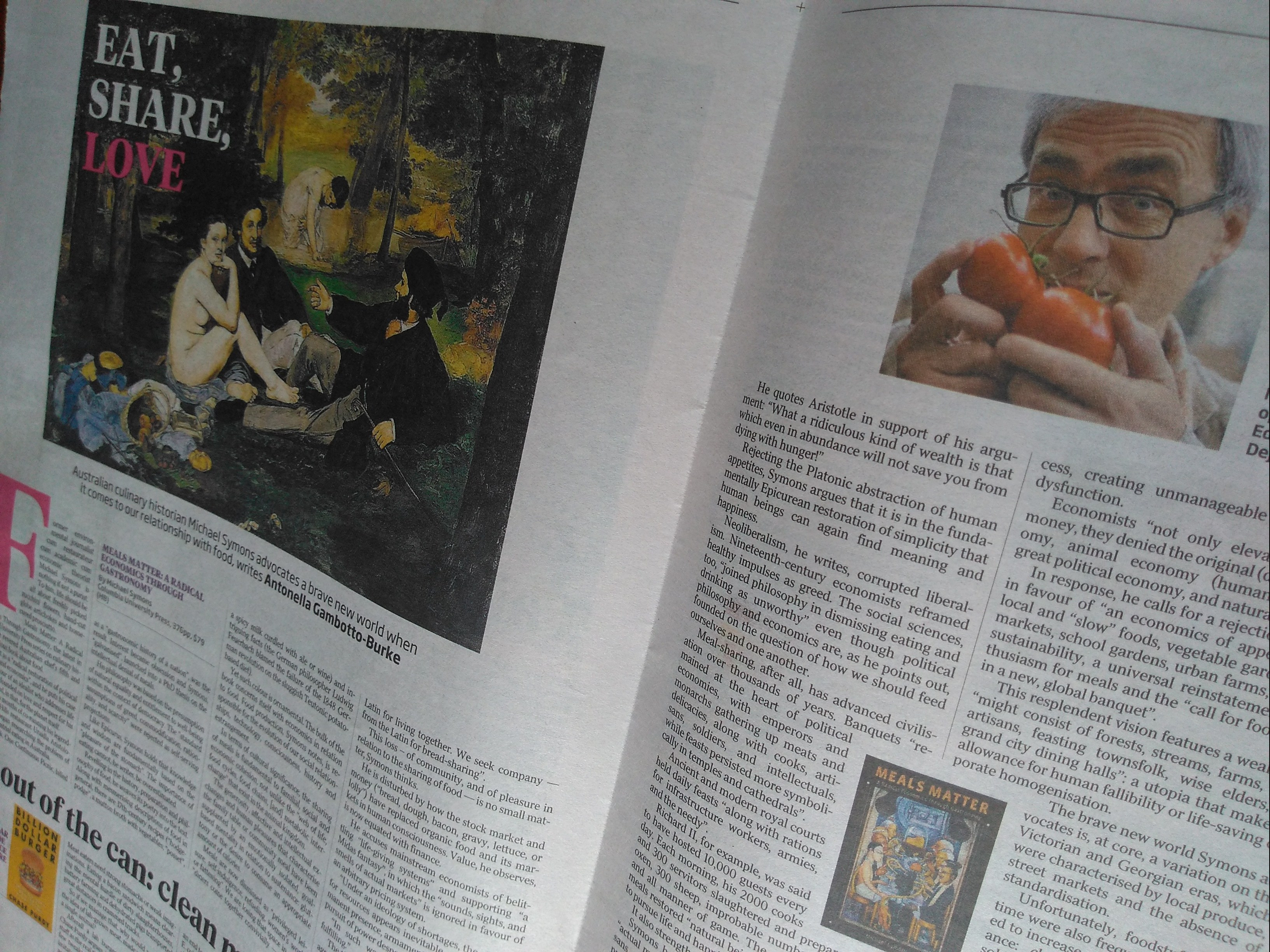
Eating and drinking brings in everyone, or almost everyone, and so what about the general or “trade” audience? At least in the book’s first extended review, Antonella Gambotto-Burke finds it enjoyable, with “mesmerising descriptions” (Weekend Australian Review, 8-9 August 2020, pp. 14-15).


Unlike the usual, more scholarly review, Gambotto-Burke does not attempt to set out the argument. Rather, she picks out key points, and joins the radical celebration, recommending:

Meals Matter is a passionate and inspiring proposal for change.

Upskirting shows how porn culture has caused a breakdown in ...
Antonella Gambotto-Burke

Antonella @gambottoburke is a seasoned reviewer and author (her next book is Apple: Sex, Motherhood and the Recovery of the Feminine). Inevitably, in close to 1300 words, she gets a couple of things wrong. I’m no “naive” idealist (that’s the self-proclaimed economists); I have thought of myself as a restaurateur but never as a chef – that was Jennifer Hillier at the Uraidla Aristologist (maybe I should?); and life generally improved after Dickensian England, because that was an exceptional low point, whose miserable conditions and food adulterations were brought on by laissez-faire capitalism.

For the full review, try clicking on Gambotto-Burke’s twitter link.

But since the Murdochs keep their gems behind a paywall, I’d better give some more, fairly random snippets, firstly, about present disasters:

Meals are now dismissed as “privileged leisure, self-indulgence, refueling, women’s work, or fattening”.

He is disturbed by how the stock market and money (“bread, dough, bacon, gravy, lettuce, or lolly”) have replaced organic food and its markets in human consciousness. Value, he observes, is now equated with finance.

He accuses mainstream economists of belittling “life-giving systems” and supporting “a Midas fantasy”, in which the “sounds, sights, and smells of actual markets” is ignored in favour of an arbitrary pricing system.

Neoliberalism, he writes, corrupted liberalism. Nineteenth-century economists reframed healthy impulses as greed.

And, secondly, about doing better:

He sees it as a “radical restoration of political philosophy and economics”, and he puts his case with the fervor of an idealist who addresses life as a pleasure founded on love and respect for his fellow man and, in that, for the planet itself.

This resplendent vision features a wealth that “might consist of forests, streams, farms, clever artisans, feasting townsfolk, wise elders, and grand city dining halls”: a utopia that makes no allowance for human fallibility or life-saving corporate homogenisation.

Meals Matter is a passionate and inspiring proposal for change. Symons’s suggestion that the “festal core” of democracy needs to be resurrected is certainly correct. Pleasure, in our culture, has come to be synonymous with stress relief rather than passion or joy.

Similarly, there is no question that sustainability and compensatory materialism must be addressed on a global level. We desperately need more love and idealism, if tempered by the recognition that the future cannot be found in the past.


Murals matter

9780231196024
Diego Rivera, “Wall St Banquet”

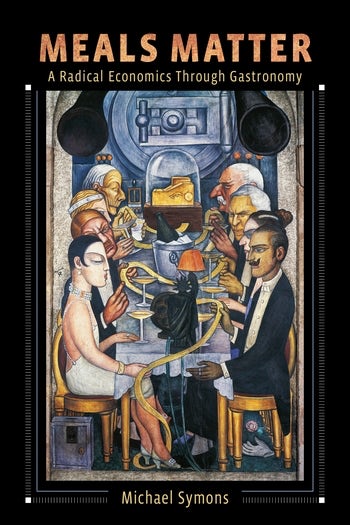
VISUALLY, MY BOOK OPENS and closes with murals. The cover borrows the “Wall Street Banquet” of Mexican muralist, Diego Rivera, and the back flap author photo was taken in a restaurant in Germany. I suppose it’s a coincidence that the book is walled-in, so to speak, although there’s something about murals …

Rivera’s “Banquet” is part of a huge set in Mexico City, covering three floors and staircase of the Ministry of Public Education building, taking Diego and his team six years to finish. That was in 1928-29, as Wall Street crashed.

In this panel, eight diners share champagne, while being served ticker-tape streaming the latest stock market prices from the golden machine under a glass dome. Behind that is a bank vault with megaphones. A Statue of Liberty lamp balances on the table in the foreground.

Rivera, “Dinner of the capitalists”

At least some of the well-dressed guests are historical figures, including a Rockefeller, whose family would commission Rivera, who was an on-and-off-again communist, to work in the U.S. Inevitably, in 1934, the family instructed labourers to scrub out his most ambitious American piece, a huge mural in the foyer of The Rockefeller Centre, New York.

Meals Matter might almost equally have been illustrated by a nearby  mural in the Mexico series – “The dinner of the capitalists”, which shows a ruling family served coins, with revolutionaries with abundant food in the background.

Both murals belong to the building’s third level, which illustrates the “Ballad of the proletarian revolution”. Over the Wall St banquet, the banner translates as: “the rich man keeps thinking how to double his money.” The words over the capitalists’ dinner say: “Gold is worth nothing if there is no food”.

I came across Rivera’s murals when idly searching for an illustration of banquets, whose interpretation is important in Meals Matter. (I ended up with a photo of an electric chandelier in Glasgow!) The Wall St version is not strictly a banquet; in this case, “banquet” connotes privilege.

Symons portrait Max 7

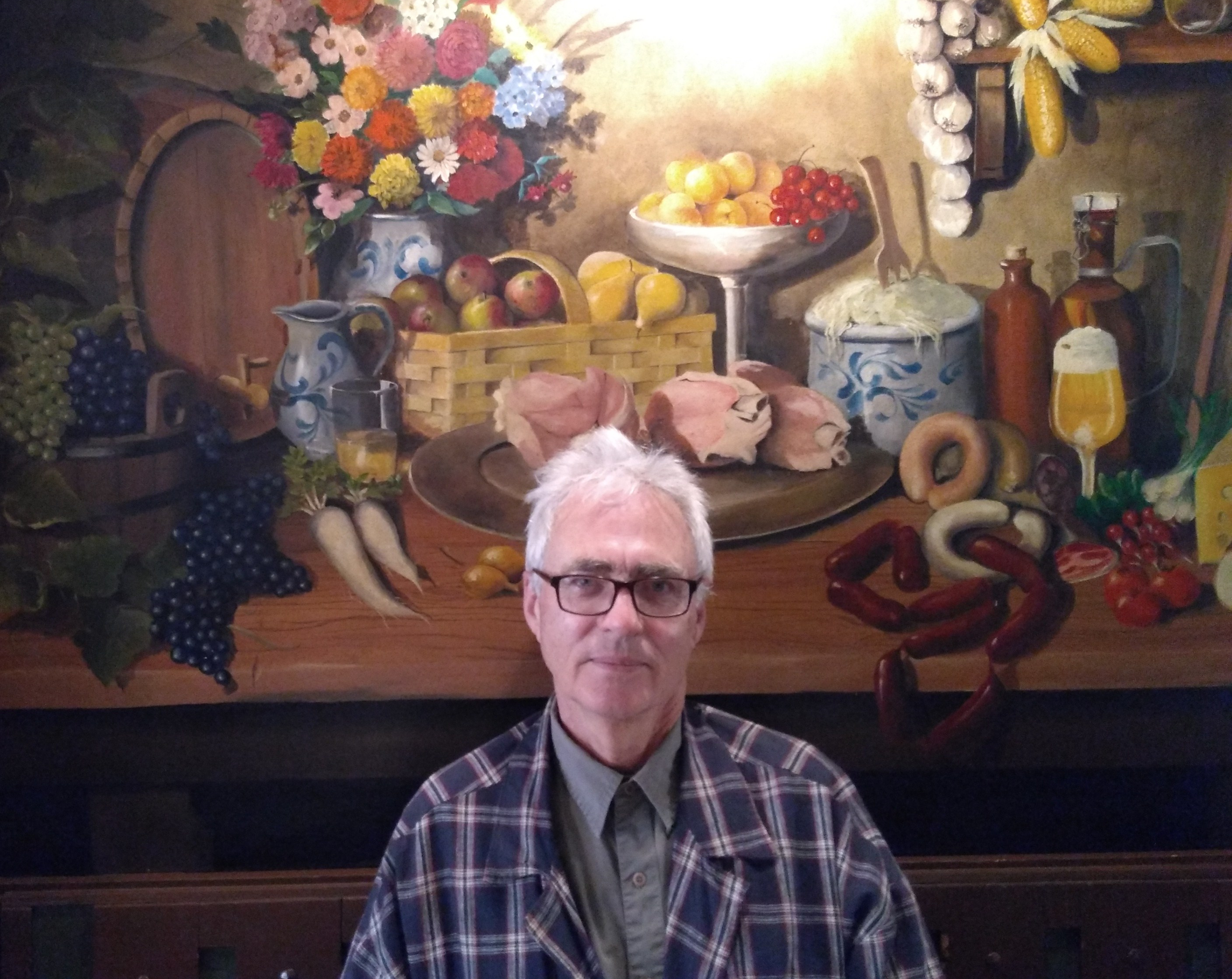
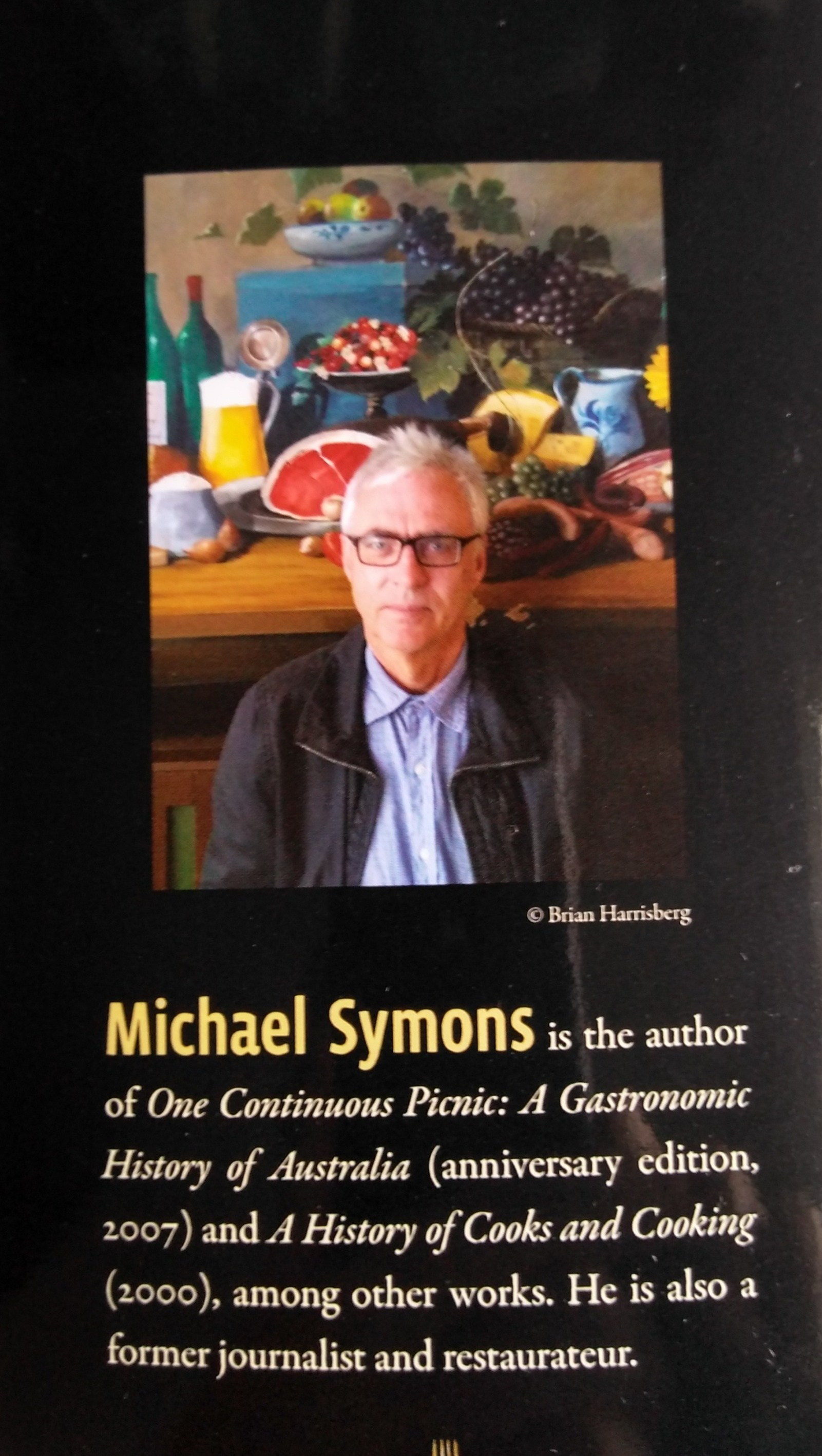
The back flap author photo was taken in mid-2019 by my wife, Marion Maddox, in Hannover, Germany. She took out the phone at the Max Walloschke restaurant, where we went several times. Our revisits explain the two versions (shown here) in different clothes in front of different still lives.

Max Walloschke, who was a weightlifter, professional wrestler and German bowls champion, opened the Kneipe (“pub”) on 19 June, 1952.

IMG_20200323_124344735_HDRIn Berlin, I suspected that smart locals crowded old-time Austrian restaurants, because they could not admit to enthusing about what some might call “heavy German kitsch”.
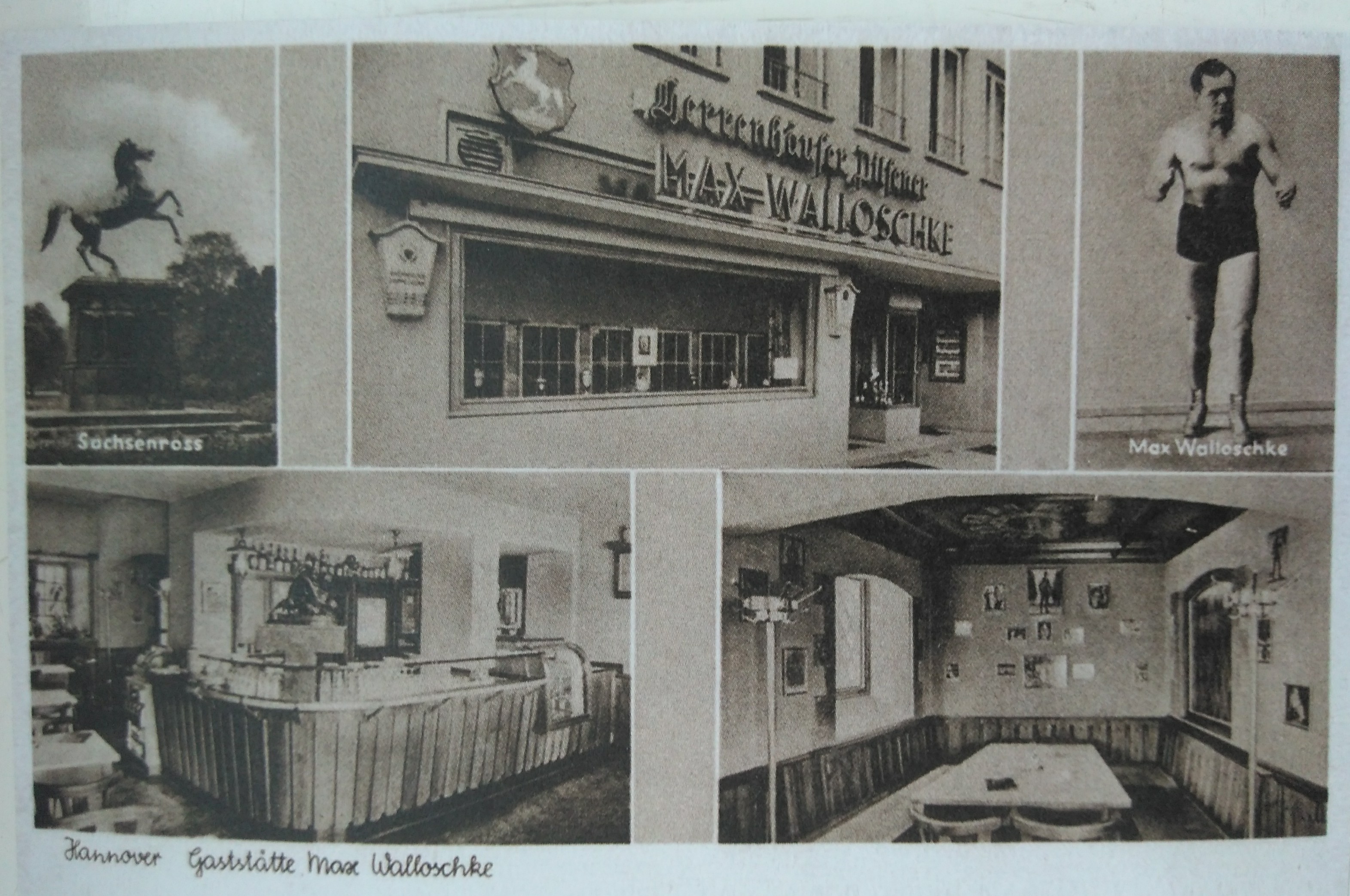
However, Max Walloschke remains unapologetic, calling itself “Das Kultrestaurant am Steintor” – the “cult restaurant at the Steintor”, that is, the place with a dedicated following at the city’s old “stone gate”.

Another of their claims is “Hier gibt es das wahrscheinlich beste Eisbein der Stadt” –  “probably the best pork knuckle in town”.

The restaurant’s official slogan, “Gutbürgerliche Küche und gemütliches Ambiente seit 1952“, uses two words that are allegedly untranslatable. “Gutbürgerliche” suggests “homely” in the sense of lots of sausages, potatoes, and beer. And “gemütlich” hints at a “cosy” atmosphere, and more, because: “Cosy captures an element of it but crucially lacks those of friendliness and belonging.”

Max postcard
Max Walloschke postcard

The restaurant also boasts “authenticity” and “tradition”, which we can believe, and “Herzlichkeit” (“warmth”), which we can confirm. (I plan to say more on this.)

As immoveable artworks, genuine murals (rather than wallpapers) have tended to be sponsored for public places, including cafes and restaurants, where they often employ faux architectural elements to give the illusion of grandeur, space or being in the homeland – sometimes all at once, such as a panorama of the Bay of Naples through trompe-l’oeil pillars. The more Gutbürgerlich murals of beer, pork and vegetables encourage Gemütlichkeit.

I must find out the name of the painter, whose food murals contribute so warmly to Max Walloschke’s welcome.

“Wall St Banquet” on left