Cooking therapy might help a person for whom the kitchen was a dangerous place when a child. Our bodies carry memories and meanings, including of meals. Couples can benefit.
More generally, chopping onions and listening to pots encourage mindfulness. Kitchen activities even work for aphantasics (like me), who do not visualise flowing streams for relaxation. Slicing potatoes keeps us in the here-and-now.
Counselling academic, and foodie, Michael Kocet taught a course on culinary therapy in Chicago in 2014. By then, cooking had also moved beyond psychotherapy. Psychosocial gains include socialisation, self-esteem and mental health.
Cookery schools promise improved health and welfare. Self-help books now include Charlotte Hastings. Kitchen Therapy: How to Become a Conscious Cook, and Debra Borden, Cooking as Therapy: A beginner’s guide to building mental wellness in the kitchen.
To quote Hastings: “The power of conscious cooking can shift us from the isolation of the individual journey into the security of human experience.”
Food therapy goes beyond the kitchen. Gardening proves beneficial, and the senses are even more involved when dining. The Epicurean “pleasure of the stomach” derives not least from the gut being the source of 95% of the body’s mood-lifting serotonin.
Beneath all this, cooking is the pivot of gathering up and sharing meals and so the basis of society, culture and civilisation. I have writtenbooks on that.
Meals put people back in touch with reality, which means ideologies necessarily put meals down. The early Christian Church persecuted Epicureans. Capitalism subordinates life to profit.
To re-ground health, welfare and happiness, we need meal therapy, society-wide!
YOU MIGHT NOT expect to read a scholarly tome about economics for pleasure. But this is gastronomic economics. As the Weekend Australian reviewer announces:
Revelling in the history, preparation and philosophy of food, he weaves its poetry into the text. Along with mesmerising descriptions of food …
For gastronomic works, such as Meals Matter, hedonism is not only a topic, but also a method, which is one reason why, unlike standard economics texts, I open each chapter not with a graph or financial table, but with a meal description.
Another reason is that the book challenges orthodoxies across economic theory, legal theory, political philosophy, food studies, and more. In the face of such transgressions, the hope is that the opening meals start out from a shared need to eat.
Hearteningly, academic readers for successive publishers gave strong support. The back-cover endorsements come from professors in disciplines as varied as politics, economics, anthropology, and European history.
In the 1980s, the “gastronomy” label put off academics, but this has plainly changed.
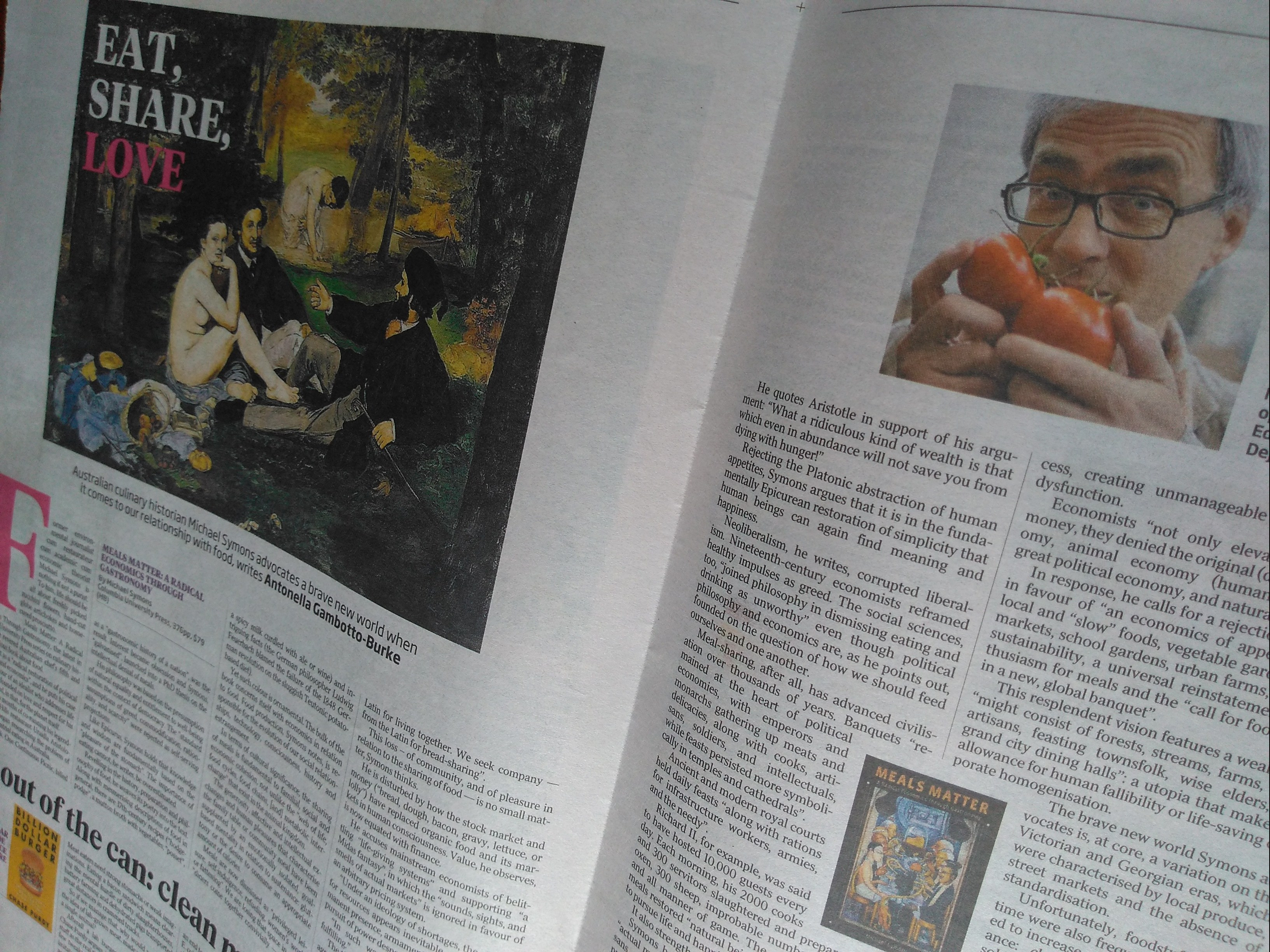
Eating and drinking brings in everyone, or almost everyone, and so what about the general or “trade” audience? At least in the book’s first extended review, Antonella Gambotto-Burke finds it enjoyable, with “mesmerising descriptions” (Weekend Australian Review, 8-9 August 2020, pp. 14-15).
Unlike the usual, more scholarly review, Gambotto-Burke does not attempt to set out the argument. Rather, she picks out key points, and joins the radical celebration, recommending:
Meals Matter is a passionate and inspiring proposal for change.
Antonella Gambotto-Burke
Antonella @gambottoburke is a seasoned reviewer and author (her next book is Apple: Sex, Motherhood and the Recovery of the Feminine). Inevitably, in close to 1300 words, she gets a couple of things wrong. I’m no “naive” idealist (that’s the self-proclaimed economists); I have thought of myself as a restaurateur but never as a chef – that was Jennifer Hillier at the Uraidla Aristologist (maybe I should?); and life generally improved after Dickensian England, because that was an exceptional low point, whose miserable conditions and food adulterations were brought on by laissez-faire capitalism.
For the full review, try clicking on Gambotto-Burke’s twitter link.
But since the Murdochs keep their gems behind a paywall, I’d better give some more, fairly random snippets, firstly, about present disasters:
Meals are now dismissed as “privileged leisure, self-indulgence, refueling, women’s work, or fattening”.
He is disturbed by how the stock market and money (“bread, dough, bacon, gravy, lettuce, or lolly”) have replaced organic food and its markets in human consciousness. Value, he observes, is now equated with finance.
He accuses mainstream economists of belittling “life-giving systems” and supporting “a Midas fantasy”, in which the “sounds, sights, and smells of actual markets” is ignored in favour of an arbitrary pricing system.
Neoliberalism, he writes, corrupted liberalism. Nineteenth-century economists reframed healthy impulses as greed.
And, secondly, about doing better:
He sees it as a “radical restoration of political philosophy and economics”, and he puts his case with the fervor of an idealist who addresses life as a pleasure founded on love and respect for his fellow man and, in that, for the planet itself.
This resplendent vision features a wealth that “might consist of forests, streams, farms, clever artisans, feasting townsfolk, wise elders, and grand city dining halls”: a utopia that makes no allowance for human fallibility or life-saving corporate homogenisation.
Meals Matter is a passionate and inspiring proposal for change. Symons’s suggestion that the “festal core” of democracy needs to be resurrected is certainly correct. Pleasure, in our culture, has come to be synonymous with stress relief rather than passion or joy.
Similarly, there is no question that sustainability and compensatory materialism must be addressed on a global level. We desperately need more love and idealism, if tempered by the recognition that the future cannot be found in the past.
PURCHASE MEALS MATTER THROUGH YOUR favourite seller, several mail-order firms, or through Columbia University Press with a discount.*** E-books are instant.
A surprising number of meal-related blog titles are occupied. Another difficulty in settling on a name is that, while some people actually used to consider meals a narrow topic, my publications have already roamed over such matters as:
other writers who endeavoured to make a diner’s sense of the world, such as the ancient Greek philosopher Epicurus and physiologist of taste Brillat-Savarin;
the problem of the “cooking animal”, namely, why do we cook? My book on cooks recommends a distributional theory – cooks share food around – against the much more common transformation claim;
two centuries of food industrialisation, explaining the horrors of Australian cuisine, until the heavy marketing of finished meals from the 1960s eventually revived interest;
Australian and New Zealand cakes and biscuits;
The flat white coffee as the greatest Antipodean gastronomic invention, and much more.
Adding to that, my next book is a critique of economics, based on the fact that meals matter more than money.
So, Meals Matter
[Update: With its publication in 2020, Columbia University Press promoted that manuscript’s subtitle “Meals matter more than money” to the book title, Meals Matter, making the blog name fortuitous]



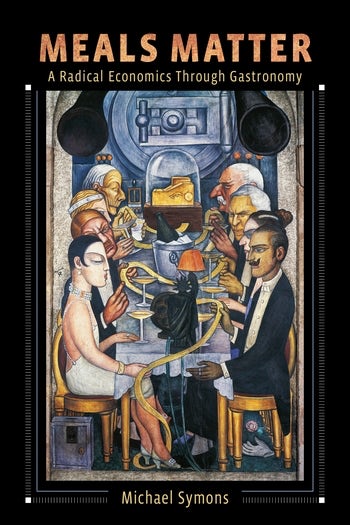 PURCHASE MEALS MATTER THROUGH YOUR favourite seller, several mail-order firms, or through Columbia University Press with a discount.*** E-books are instant.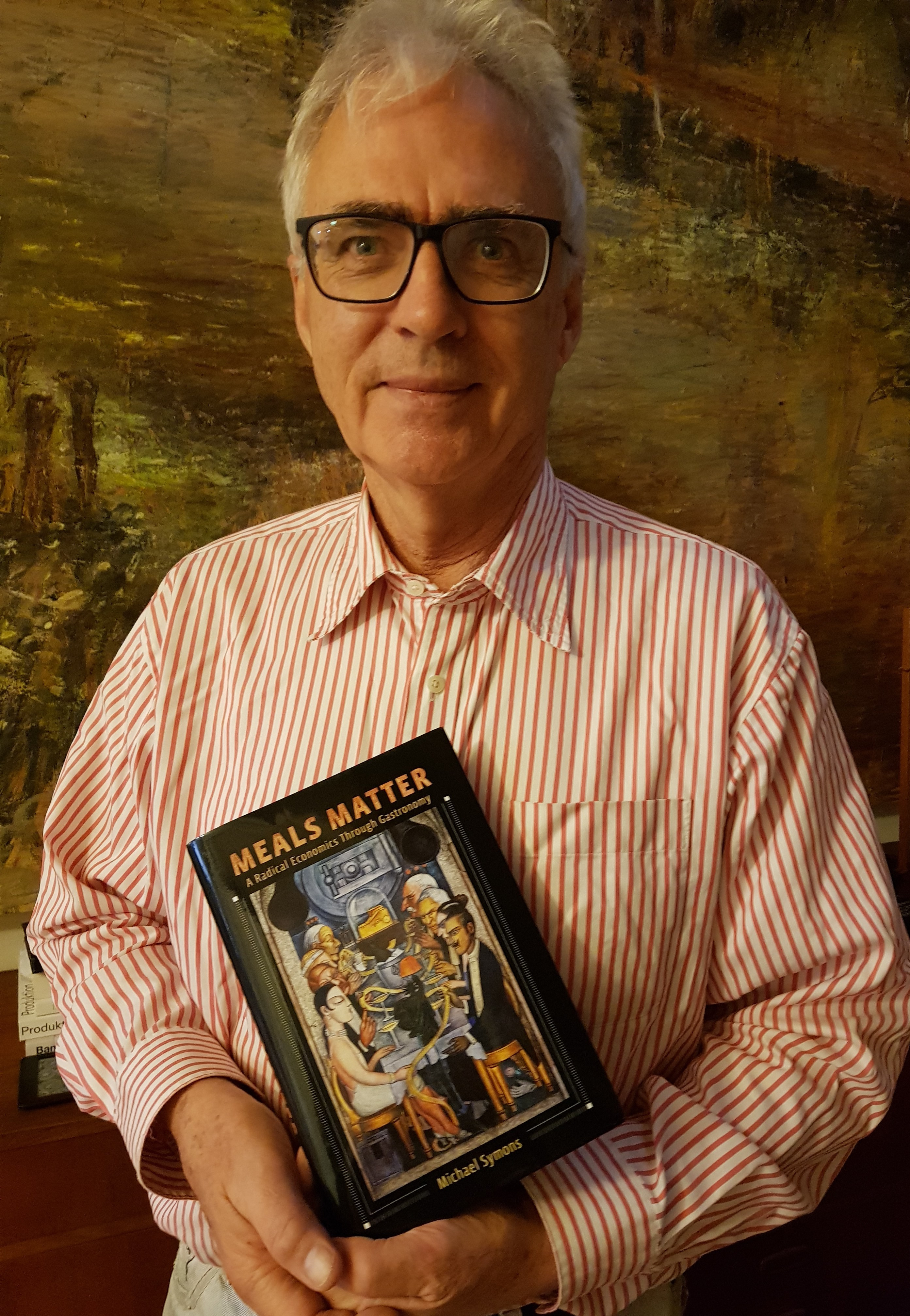
 Meals Matter