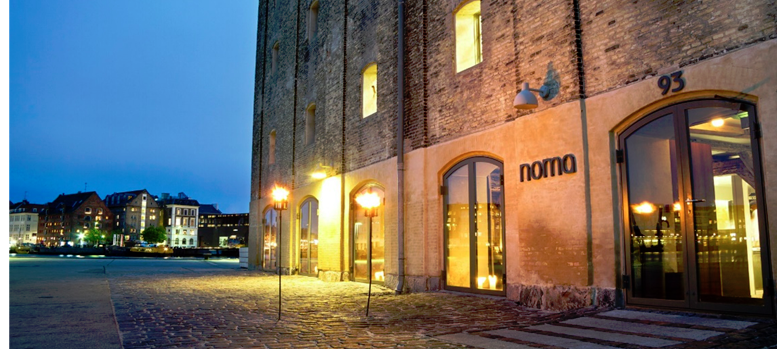
THE HEAD CHEF and co-founder of Noma, René Redzepi, resigned yesterday, after 35 former employees had gone public with his workplace abuse from 2009 to 2017.
Everyone seemed unusually friendly when we dined there at the end of May 2007. I even noted Redzepi’s sweet smile, as he worked at a bench overlooking the dining room.
Redzepi had opened Noma with a partner in 2003 in an old Copenhagen warehouse, which was being transformed into “North Atlantic House”, so they were to celebrate ingredients from Denmark, Iceland, Greenland and the Faroe Islands.
I remember numerous snips of this and that by way of found grasses, flowers, etc, before such additions became more common. I particularly recall tiny, cold, dense oysters.
The meal was unforgettable for its completeness, which means not just the food, but also that port location, and more. Our daughter and I sat outside in the late-afternoon sun waiting for Marion to cycle around the docks from her conference. My beautiful German Riesling seemed to be made for gazing at the city centre across the harbour, or back at the spiral church tower that Dorothy had just climbed.
And there was the exemplary kindliness. One notable instance was that, after they had found somewhere to stow Marion’s bike, they let us linger with her beside the water, bringing out an extra round of marvelous crisps of fish and chicken skin.
The thing we could never forget, however, concerned our severely disabled son left back in New Zealand. Marion and Dorothy were keen to phone him. Since this evening was an appropriate time to call, we inquired about a nearby public phone. They insisted on using theirs. But you don’t understand, we said, this is a phone call to New Zealand.
Given Lawrence’s brain damage, “phoning” really meant singing to him. When we were back together, a little emotional, the waiters slipped us small, black, textile handkerchiefs.
Noma proved much “less” – friendlier and more intimate – than might have been imagined from the hype, which, of course, was working up to it being named world No. 1 restaurant for several years (2010, 2011, 2012, 2014 and 2021). In 2007, I witnessed nothing but serious care and concern.
Our forthcoming Republic demands more than banishing a foreign monarch
OUR RECENT PUBLIC holiday to celebrate the King’s birthday reminded yet again that Australia needs to move to a democratic Commonwealth with a grown-up Constitution. The existing arrangements merely sign up Australian colonies under the Crown, rather than make a careful social contract between citizens.
AS a suggestion, a preamble might begin: Finding ourselves in an industrial civilisation, imposed violently on Indigenous nations, we each agree to cooperate in this Commonwealth. Obedient to ourselves, we remain wary of rule from above, whether by kings, ideologies, autocrats or big money. We, the People, organise ourselves. The Constitution inspires, while it sets out formal principles.
As citizens of the Commonwealth, we submit to the rule of law, democratically established by an informed citizenship, and managed by the state (government and bureaucracy), overlooked by a mindful judiciary. And there’s more.
But, before getting too far, a quick note that our King’s Birthday weekend is being followed immediately by the U.S. “No Kings” day. And this leads to an admission that conservatives make a reasonable point about a king or queen possibly providing stability, unlike what’s happening in a famous republic.
Neither a poet, nor a honed legal mind, but a meal-centred scholar, let me propose some essentials for our forthcoming Constitution.
As individuals and social beings, we respect the laws of nature, notably the ecological requirements of generation and preservation. We also obey laws, democratically achieved. That more or less paraphrases seventeenth-century English political philosopher John Locke’s arguments against paternalism, particularly monarchical, and for democracy.
Thinkers in his day understood a Commonwealth as a political economy, with, traditionally, a monarch organising food-centred infrastructure and services, such as irrigation, roads, art, science and welfare.
Replacing kings and queens, Locke envisaged a Commonwealth enhancing citizens’ “natural rights”, which were tolife, liberty and property. We achieve well-being through access to food and water, gardens and seashores, to housing and livable towns, to health through good medical care, knowledge gained through schools and research, and all embellished and reinforced through the arts.
The world has changed since Locke, and not only because powerful forces have abstracted “Bills of Rights” from natural realities.
The big problem now – worse than being subject to a king and queen – is Corporations. They rule more intricately, and more ideologically, than ever any monarch.
As explained in Meals Matter (2020), for-profit corporations essentially emerged after the modern republican pattern had been set. Lacking Constitutional legitimacy, corporations nonetheless gained legal support through such devices as “limited liability” and “corporate personhood”. They then appropriated rights, especially “liberty”, which supported “laissez-faire”, “free enterprise”, “neoliberalism” and lately “disruption”.
Corporate capitalist theory reassigned sovereignty to money. The system has now remodeled all in the corporate image, turning universities into businesses, and people into buying-and-selling machines.
Corporations supply our cars, and build the roads. Their advertising funds news dissemination. Their factories supply food, and armaments. This means having to engage closely with government through lobbying, consultation, outsourcing, and two-way personnel exchange. Who “understands” war better than military suppliers?
Invidiously, I mention just one of numerous experts now running the place: former SA Senator and Cabinet Minister, Christopher Pyne. To quote Wikipedia:
Since late 2020, Pyne has taken on roles in the Australian defence industry. He is chairman of the advisory board of Australia’s largest Australian owned small arms and munitions company Nioa, and chairman of the advisory board of the Australian Missile Corporation. He also sits on the board of ASX Listed, Xtek Ltd, a Canberra-based body armour and unmanned Vehicle manufacturer and supplier globally.
Lacking Constitutional status, corporations have captured government. They push politicians to the fringes, where they take photo opportunities. The frustrated electorate are expected to blame … “the government”!
In our serious Constitution, corporations lose “rights” and gain licences or something of the kind.
The loss of the Voice Referendum in Australia a year ago pointed to an uninspiring, irrelevant-seeming Constitution. Additionally, the perceived need for a consultative body highlighted the lack of power of actual citizens, in this case Indigenous people.
In the new Republic, I reckon the democratically-elected parliament might elect a President, who forms a Cabinet and outer Ministry from both elected members and from representatives of registered consultative bodies.
As recognised economic tools with government oversight, corporations might provide recommendations this way. All lobbying would be public through recorded debates and publications of registered representative assemblies.
Likewise, a wide collection of interests make their case. Trade unions make useful representations. And so on, through various advocacy groups, all overseen by a commission.
This commission is appointed by the parliament with reference to the bodies themselves. As well as collating submissions, the commission would support consultative bodies. The commission provides financial and logistical support, where appropriate.
Think of it as like a royal court of old, whose lively gossip, intelligence, opinion, and learning advised the ruler. In ridding ourselves of kings and queens in favour of parliaments, we need to replace not only monarchs, but also their clever courtiers.


 Meals Matter