David Dale’s last taste

Duck press, Porcine, May 2025

I WAS FORTUNATE TO DINE OUT frequently for nearly six decades with journalist David Dale (27 March 1948-6 August 2025). This was often along with Suzie Anthony.

Our paths crossed early, when he was still a student and I was starting to make a name at the Sydney Morning Herald. He wrote me a long letter arguing that I didn’t understand guitarist Eric Clapton (or something like that).

I was the paper’s first or maybe second deliberate hire of a university graduate (my degree was in maths, and they had a “new maths” education supplement to bring out). When David and Suzie joined, they became “graduate cadets”, who were required to learn shorthand. I always reckoned he had the world’s most useless skill, shorthand slower than his long.

As young journalists at the Sydney Morning Herald, the three of us had lunch and dinner out many times a week for four or five years. 

Later, in 1975, after a particularly beautiful lunch at Watson’s Bay, we three sat on a wall above the sand, and swore lifelong allegiance, which we honoured. We kept up meals together with a few unavoidable interruptions, such as living in different countries.

From my perspective, David seemed to lead a compartmentalised life. Early on, he had a girlfriend that Suzie and I never met. Mischievously, we knocked at his address, and were welcomed by a mother desperate to meet some of her boy’s friends, and she laid some of her concerns before us . Never met his father.

He also deliberately shied away from deep thoughts. When we met, he had completed Honours in Psychology, but was keener on Mad magazine, and turning to early Woody Allen movies.

David and my paths crossed more than once in Italy – and he never let me forget about revealing to both him and my father where to find the key to our ancient Tuscan watermill during one of Jennifer Hillier and my absences; David terrified my father in bed asleep, with Christopher demanding: “Do you know Bob Hope?” This was someone (the partner of colleague Julie Rigg’s expatriate mother) whom we all got to know well over there.

By then, he had joined the classy little gang putting out the radical media critic, the New Journalist (which I had co-founded with Leo Chapman and another old colleague who died this year, Paul Brennan).

Without hesitation, David became a third partner (along with Gabriel Gaté) in Duck Press that published my One Continuous Picnic in 1982. He leapt in as its editor.

In the late 1980s, I was invited to lunch in Adelaide, at his suggestion, by a visiting Bulletin journalist, Susan Williams, who grilled me about her editor. They married in Paris, without guests! When I married Marion Maddox in 1995, Suzie was my best person and David her assistant.

Towards the end, David increasingly talked streaming tv (that I never watch). Suzie and I found him reluctant for Friday lunches, but he was, we now imagine, in considerable pain. Our last get-together at La Riviera, he came with a walking frame.

He’d enjoyed sauce from a duck press at Tour D’Argent (I think that was when he secretly got married). Not only the name of our publishing house, it remains my email address, but I hadn’t experienced a duck press.

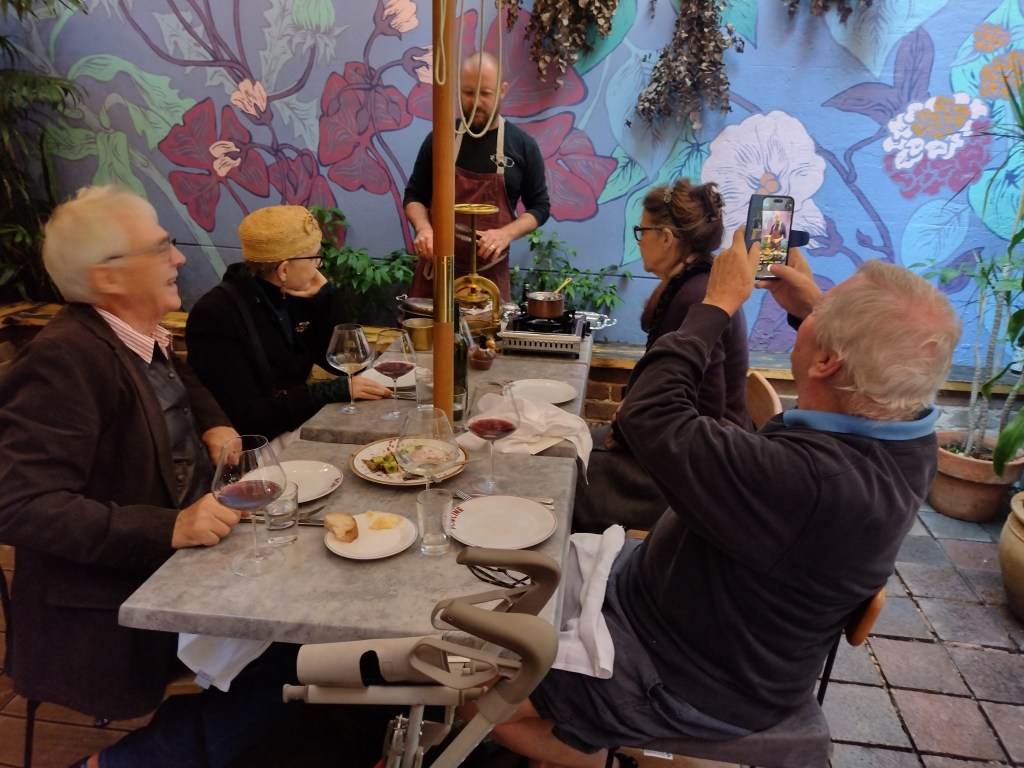
Accordingly, for our little lunch group’s celebration of my 80th this year, we dined with a duck press at Porcine in Paddington. David needed a walking frame, and my wife a wheelchair; when we discovered the restaurant was up a flight of stairs; the chef generously offered to bring the paraphernalia down to a table set up in the wineshop below.

That was in May. It would be our final meal together. Our paths crossed a last time not many days ago. Marion had two recent stays at the Chris O’Brien Lifehouse. Only on the second, we learned David was in a nearby room all the time. Being a small world, Porcine chef Nik Hill’s wife Milly is a palliative care nurse there. (In an accumulating tragedy, Marion died on 16 September, back there again, two rooms from where David had been.)

When I popped in, he was true to himself, avoiding thoughts of imminent death. On another quick visit, I offered to bring some wine the next night. He was unable to drink, he said, on account of his nausea. He did admit, nevertheless, to wanting the best possible red to be his last mouthful.

That led me to recount how yet another friend with cancer had a few months ago quietly shared an aged burgundy that she happened to “just find in the cellar”. Fortunately, I thanked her profusely for a genuinely amazing experience. Only later, I discovered a bottle online for an equivalently amazing price. Definitely worth a last mouthful and, within days, our friend disappeared forever from our tables.

I hope David got his last taste.
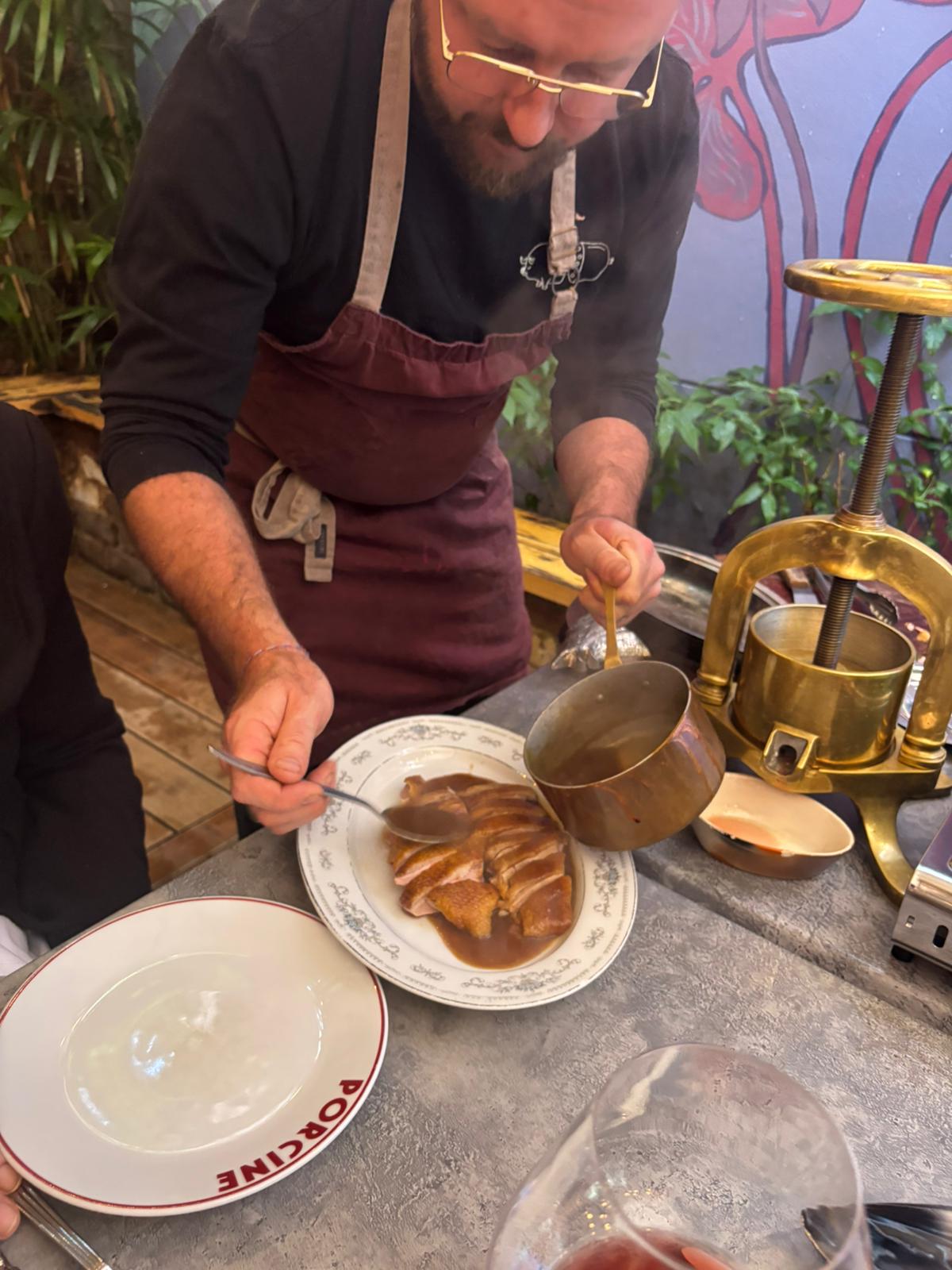
Duck, Porcine. Photo: David Dale
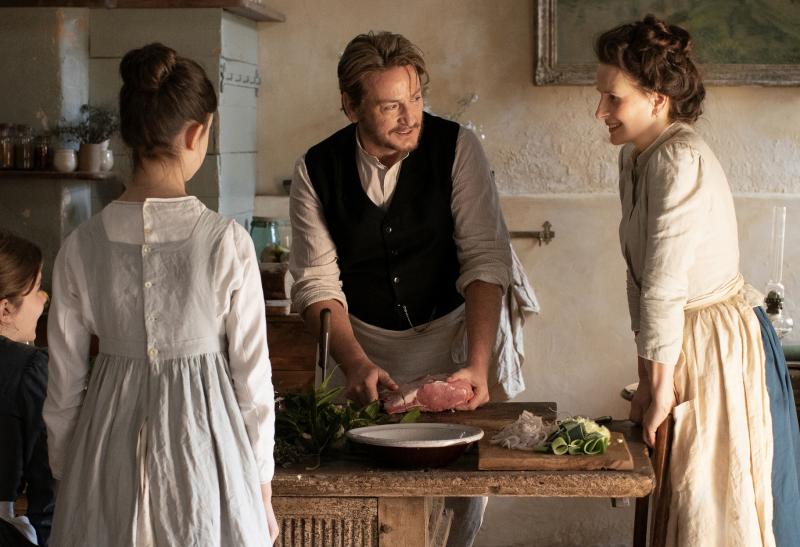
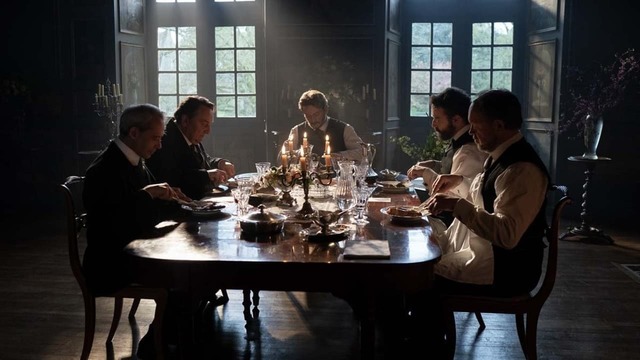
The wondrous materiality of French movie, The Taste of Things

FOR TWO HOURS AND 14 MINUTES, the French movie The Taste of Things observes the preparation and eating of something like nine dishes.

The setting is a provincial chateau in the year 1885, and the focus is gourmet Dodin Bouffant and his cook, Eugenie – played by two considerable actors (and former partners), Benoît Magimel and Juliette Binoche.

Negative reviewers react against privilege and indulgence. The first kitchen scene of 40 minutes introduces an “extremely boring movie showing pots and pans and cooking complicated French recipes” (online comment). Some of the audience walk out.

It’s not perfect – I was mildly irritated by characters informing the audience by telling each other things they would surely already know. Some occurrences seem random – why introduce “electroculture” garden antennae?

Yet the movie is far more than foodie excess or cooking show. The great majority of reviewers are positive. What’s going on?

Musical clue

A clue comes from the absence of music – only used over the credits. Mind you, the Boston Globe reviewer was so seduced, he heard “a romantic score”, though conceding “everything you need to know is conveyed in actors’ eyes.”

The soundtrack relies on clink, clunk, chop, bubble, sizzle, footsteps, birds out the door and window, and occasional words, sometimes among Eugenie, Dodin and helper, as they move between garden, stoves and benches, and among Dodin’s select group of male gourmets, who love the cooking, and the host’s cellar.

“I never before had to direct a film with as much substantiality,” writer/director Trần Anh Hùng answered an interviewer.* “All that material reality is so compellingly expressive, it firmly anchors our characters in daily life. Music would have undermined that.”

Hùng normally likes music, he said, but here it would “bring something that is a little bit fabricated… I wanted it to be very real.”

(Please note, all you restaurateurs who think loud music and noise denote a good time.)

Materialist film-making

Instead of music instructing viewers how to feel, they form their own interpretations. Similarly, Hùng chose long takes, he said, as a way to slow down the pace and give the audience the chance to be a kind of writer, gaining “time to formulate several things” in their mind.

I describe the approach as materialistic, in that the movie carefully shows what’s actually happening at the physical level, among intimates. Emotions arise from mundane cooperation.

“Everything that you see on the screen is real, and everything that we cook for the film, we ate it. Absolutely everything,” Hùng said. He was advised by Parisian chef, Pierre Gagnaire, and the actors were assisted on-set by Gagnaire’s retired colleague, Michel Nave.

“For the crew, it was unusual, because they have done some movies with food. Most of the time it’s fake. To make it very beautiful, you add some different things in it to make it have different texture, color, everything. But here, for this movie, I didn’t want that. Because it’s not about the beauty of the food. But it’s more about showing man and woman at work in that kind of harmony.”

He told the crew the long opening cooking sequence was “my car chase scene”.

Hùng’s wife, Trần Nữ Yên Khê, an actor and this movie’s art director and costume designer, explained the need to just get the setting “right”, and leave the beauty to emerge. “Try to do something beautiful, and it comes across as decorative.”

Happiness

The movie sounds and looks beautiful, allows time for reflection, and so what is it “about”? The Taste of Things gets to the core of cooking and enjoying meals. Hùng extolls Brillat-Savarin, as does my chapter, “Brillat-Savarin’s quest for table-pleasure” in Meals Matter (2020).

Homeliness was suggested by the working title, Pot au Feu (changed in the French to Le Passion de Dodin Bouffant, after the Marcel Rouff novel on which the film is loosely based). Domestic bliss in some present-day kitchen might well have become boring, but French protagonists at the time of Escoffier could believably be immersed in good cooking.

Hùng wanted to “explore something rare in the cinema: conjugality. And even rarer when it works.” With kitchen movements choreographed like a ballet, he sought to show “harmony”.

The 20-year relationship of well-to-do gourmet and cook has confused some movie-goers, particularly since it really doesn’t develop. But the pair are contented with their lives, and Dodin is presumably not surprised when Eugenie refuses proposals of marriage. She only leaves her bedroom door unlocked when she chooses. She gains them the perfect daughter through other means.

The Taste of Things does move steadily towards inevitable sadness, but never with the forced highs and lows of an action movie or even romantic comedy, let alone “reality” tv.

Harmony without drama marks this movie out as beautifully unconventional. Nonetheless, it has a strong motive to show “merely” cooking, eating and companionship, even if that passes. It’s about happiness.

*Interview quotes from Santa Barbara International Film Festival, https://youtu.be/YN5Vy_3a5Ds, and from Gaumont publicity, https://www.perthfestival.com.au/media/h3kd4qcm/the-taste-of-things-press-kit.pdf.)

Dining with aphantasia

TO THINK I reached the age of 30 without knowing this.” I was considerably older than that incredulous online author when I learned about “aphantasia”, just a few days ago.

Aphantasia is the experience of “reduced or absent voluntary imagery”, that is, we aphantasics are not bothered by a “mind’s eye”, nor its equivalents for the other senses.

We are amazed to learn that, when “counting sheep”, many people actually watch imaginary sheep!

It’s a surprisingly late discovery for us aphantasics, and also for science. Psychologists wrote about it more than a century ago, including Fechner (1860), Galton (1880), Bentley (1899) and John Watson (1913). But then the topic disappeared.

Watson himself might have to take some blame by launching behaviourism’s avoidance of subjective experience in favour of external psychological observation, which would be ironic given how he was a non-imaginer.

This last is suggested by Bill Faw (2009), who arguably led the return to studies of “non-imagers”, the name he prefers for himself and others. In 2015, a neurologist came up with the seemingly catchier, “aphantasia”. Under whatever the name, the research remains rudimentary, especially in relation to the phenomenon’s fascination. For instance, published estimates of the proportion of aphantasics in the population range from 0.7% to 2 – 5%.

Many have discovered the condition when a therapist asks them to visualise. They remain puzzled when asked to, perhaps, put an intrusive thought on a floating leaf and watch it drift away. We recognise the condition immediately it’s described.

If I am asked: “Imagine the sun rising,” I get a glimpse, vanishing instantly, like keying in a password. An imagined apple might have some details, and at least seem red, but then I’ve seen standard depictions of apples since learning “A is for Apple”.

Given imagery’s presumed role in memory, non-imagers generally don’t have such strong recall of even recent events, people’s faces or the narrative of their own lives.

Recent research also shows, for example, that we non-imagers might draw a simpler version of a room from memory, but often with more spatial accuracy. Spatial memory follows separate brain pathways from object memory, and aphantasics would generally seem better at it.

No question but that human minds are varied.

My wife Marion and I discovered complementary experiences early in our relationship, but never pinpointed the underlying explanation. From the start, we knew that she’s much better with people’s names, and recall of events.

Whereas I could scarcely remember one line of poetry, she can recite not 10,000 lines, but 10,000 poems (only a slight exaggeration).

She enjoys novels, whereas I can’t arouse much enthusiasm (although maybe for Pride and Prejudice, which she supposes comes from Austen’s relative disregard for description).

We both enjoy movies – they don’t rely on visualisation. Mind you, I often get greater enjoyment than she does from movies based on her favourite novels – they are rarely quite as she imagined.

On the instruction “think of the colour red”, I get a fleeting impression, and move on. When I try to recall the smell of nutmeg, say, nothing happens. Marion has no such trouble.

Researchers referring to “visualisation, “imagination” and the “mind’s eye” betray a cultural priority for vision. Those with a vivid “mind’s eye” usually also have a strong “mind’s nose”, “mind’s ear”, “mind’s touch”, etc.

Reporting in 1880, the early researcher Francis Galton asked respondents to imagine “your breakfast-table as you sat down to it this morning – and consider carefully the picture that rises before your mind’s eye”. Some respondents saw the breakfast table “as well in all particulars as I can do if the reality is before me”. At the other end of the scale: “I recollect the breakfast table, but do not see it.” Galton did not report on other sensory recall, nor pleasures.

Delving into the absence of visual, auditory and other impressions raises questions about meals.

I’ve long been puzzled by the deluge of cookery pages. Why do we need yet another pavlova recipe? It turns out that where I might think “that’s a long list of ingredients”, Marion puts the ingredients together in her head, and decides if she’d enjoy eating the result.

Seemingly following my lack of olfactory recall, I have relative difficulty naming flavours, so that with wine, for instance, I struggle to find “vanilla notes”, “cedar” and “violets”. Instead of identifying particulars, I become immersed in compound sensations, starting with the wine’s “structure”.

That’s like meals as a whole. They are immediate. At a good meal, I am absorbed – engaged with the here-and-now of dishes, places, conversations and their connections. A good meal is complex, and hums. Existential.

Without intricate recall, I enjoy talking (yet again) about past stand-outs, and also look forward to the next experience. I always like to know something is planned.

I am now wondering about the act of writing. Just as some visual artists turn out not to visualise, but set images out in front of them, I love words on paper.

My books on cooking and economies contain numerous details, but these are meant to point to bigger concepts. Some readers might become preoccupied by descriptions, just as so-called “economists” might promote the simple mathematics of price, rather than absorb the full wonder of sharing the world.

Footnote: Research and writing on aphantasia has often been expressed in the negative – it is a “lack” or “disorder”. To quote a recent scientific paper, “visual imagery is absent or markedly impaired.” Even when protesting it’s not a disease, and citing examples of highly successful non-imagers, these same writers still focus on deficits. The very name aphantasia is pathologising.

That’s surprisingly easily turned around, so that one might say, for example, that many people – known as “phantasics” – suffer an overload of imagined sights, sounds, bodily states, and more.

George Herbert Betts reported on visual, auditory, gustatory, olfactory and other imagery in his 1909 study, and declared: “Very much of memory is accomplished without the use of imagery, and much of the imagery which accompanies memory is of no advantage to it.”

Questioning imagination’s importance for reading literature, he worried: “if a flood of profuse imagery should accompany the words as we read, interpretation and appreciation would be seriously interfered with.”

Without impediment, non-imagers engage with the factual and here-and-now, and think clearly.

Furthermore, aphantasia might be somewhat protective against PTSD, major depressive disorder, social phobia, and bipolar disorder (e.g., Cavedon-Taylor, 2022), given how these can be reinforced by visualising – flashbacks, or too vividly imagined dangers.

And yet, without leaping sheep, floating leaves or the sweet scent of vanilla, aphantasics might be exposed to other anxieties.

I am just beginning, and so is research generally.

For a sample:

Galton, Francis (1880), “Statistics of mental imagery”, Mind: A quarterly review, No. 19 (July 1880): 302-318

Betts, George Herbert (1909). Distribution and Functions of Mental Imagery (Columbia Univ. Contr. to Educ. No. 26.), New York: Teachers College, Columbia University

Cavedon-Taylor, Dan (2022), “Aphantasia and psychological disorder: Current connections, defining the imagery deficit and future directions,” Frontiers in Psychology, Published online 14 October 2022

Faw, Bill (2009), “Conflicting intuitions may be based on differing abilities: Evidence from
mental imaging research,” Journal of Consciousness Studies, 16(4), 45–68

Fox-Muraton, Mélissa (2021), “Aphantasia and the language of imagination: A Wittgensteinian exploration,” Analiza i Egzystencja 55 (2021)

Cavedon-Taylor, Dan (2022), “Aphantasia and psychological disorder: Current connections, defining the imagery deficit and future directions,” Frontiers in Psychology, Published online 14 October 2022

Is the movie “Pig” for or against foodies?

(Perhaps it’s post-foodie)

The movie Pig, starring Nicolas Cage, tells of a recluse who leaves the woods in search of his stolen truffle-hunting pig in Portland, Oregon, where he was once an influential chef.

It mightn’t be everyone’s cup-of-tea; it’s filmed grimly almost entirely in the dark; Cage speaks somewhere between a growl and a mumble;  but I thought it great.

It’s a counterpoint to both the Truffle Hunters, about Italian men and their dogs, and SBS’s The Beach, showing Warwick Thornton cooking, and looking, for himself.

An even closer (although less successful) comparison would have to be the recent ABC-TV series, Aftertaste, about an authoritarian chef seeking to redeem himself back in the Adelaide Hills.

Mind you, Pig starts out deceptively as if about a brutal guy – with only a pig to share his meals – fighting the world. But it soon heads elsewhere, although exactly where, as in any decent artwork, can withstand endless interpretation. I won’t reveal too much, in case you intend taking the journey.

While the orthodox movie critics, with few exceptions, praise the movie highly, and especially the performances, the rest of the internet helps answer the big question, which is whether it’s pro- or anti-foodie.

Take this from the New Republic:

Pig cuts straight through foodie hypocrisy

The overwrought film from Michael Sarnoski contains a fundamental truth about a very sick industry.

It’s about time America became disenchanted with foodies. Pig, Michael Sarnoski’s foodie noir about loss, love, and labor in Portland, Oregon’s restaurant scene, doesn’t leave them much room for redemption…

This critic, Jan Dutkiewicz, disapproves of “obnoxious” restaurants and “foodie writing—think Michael Pollan and Mark Bittman and their literary progeny”. He opposes “elitist” fetishizing. And he congratulates the movie, which he didn’t seem to like much, for also exposing the industry’s abuse of workers and animals. (As a scholar, Dutkiewicz works on “improving the treatment of animals through the legal system”.)

The scathing, non-comprehending reviewer in the New Yorker declares the movie’s key moment to be when our martyr apparently learns “the awful truth of the restaurant world and of the world at large”.

Or we could take this:

‘Pig’ Review: A truly brilliant foodie movie

Not wanting not to spill the beans, Nick Johnston writes:

What I will say is that this is one of the great modern Food movies, and I would not be surprised to see allusions to it pop up in culinary culture over the next few years … It’s about our authentic relationships to the food we eat and the emotions and memories that come along with any given meal.

Other commentators remain enticingly ambiguous, like Sydney Morning Herald’s Jake Wilson, who says:

Moody, foodie drama with a menacing side serve of parody

… But he’s a foodie not a fighter, and the kind of reverential treatment that might be given to a samurai sword in a Tarantino movie is here more likely to go to a salted baguette.

Hillary Dixler Canavan organised a roundtable for the foodie website, Eater.com, where she’s a restaurant writer, familiar with Portland, and “obsessed” about the movie.

A Heated Discussion About ‘Pig,’ the Movie of the Summer

Eight Eater editors debate and dissect the new Nicolas Cage film about a man’s search for his beloved truffle pig

The foodies’ reactions turn out to be mixed, including Canavan’s:

It would have annoyed me much less if the film’s most important women weren’t dead or in a coma.

Needless to say, the theme of women gone missing is central to the movie. When a sympathetic baker recalls former times, and she finally hugs the grizzled hero, the camera pointedly retains its distance. A woman suddenly revealed in close-up is an intense movie high point.

So, is Pig foodie or anti-foodie? One answer could be that it’s anti-bad-foodie and pro-good-foodie, but I hesitate to divide foodies into, say, “deep” and “shallow”, even when I suspect fetishising.

I’d rather think of Pig as post-foodie in that it treats restaurant dining – and transcendent meals, in particular – with the utmost seriousness, while at the same time satirising ridiculous hype.

It’s not just about sublime tastes either, but very much also about the pleasure of sharing with a loved-one. At the climax, the tragedy turns out to be dining in the absence of not just a pig, but treasured human companions.

Loving taste

Don’t underestimate the human sense of smell!

The New York Times illlustrates smell

MARION AND I SHARED three mandarins yesterday, and were struck by the differences in taste. We declared the first the winner, the second relatively lacking, and the third must have been older.

But are we interested in taste? The evidence is that we moderns are alienated.

English speakers only added umami (savoury) to the standard four tastes of sweet, salty, sour and bitter towards the end of last century, and there’re more, seemingly, including fattiness.

We separately detect texture, temperature and “cool” menthol, “hot” chilli, “stinging” carbonation, etc, as well as the crunchy sound of those mandarins. On top, flavour relies on aroma, detected in the nose, and far too neglected.

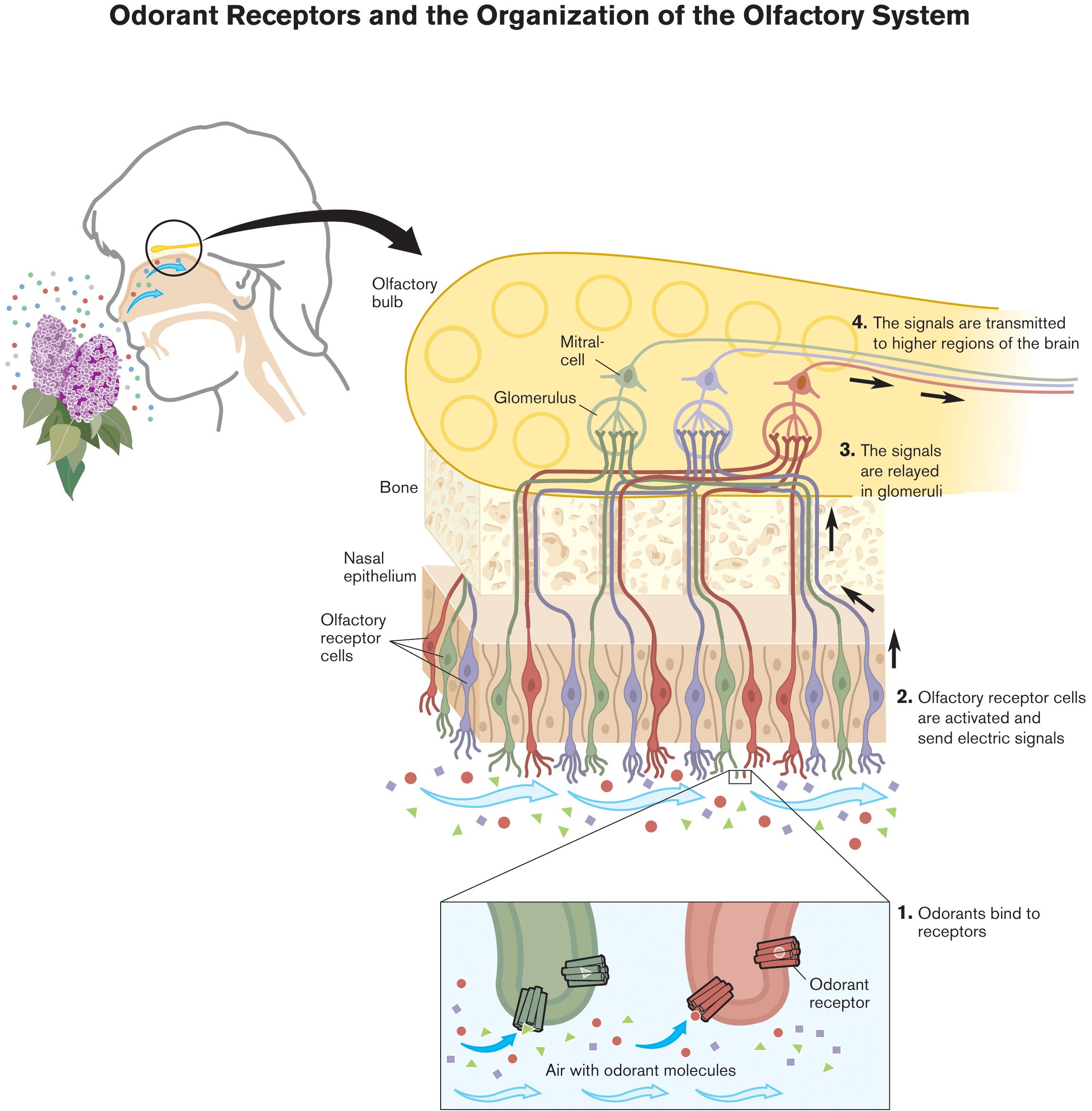
Scientifically, Linda Buck and Richard Axel only discovered something as crucial as the human olfactory receptors as recently as 1991, sharing a Nobel Prize in 2004 (see explanatory diagram below).

As well, taste depends on the surrounding aesthetics and social comforts, and mindfulness.

Nonetheless, it’s an ill wind … The the science of smell has looked up these past months, after its loss (called anosmia from Greek an– not + osm­é smell) turned out to be a tell-tale characteristic of covid-19 (less so with the delta variant).

The sense can remain absent with long covid, and, if it returns, become mixed up. Under parosmia, normally pleasant smells can turn nasty, a problem for relationships.

Dogs and bees have now been trained to sniff out the virus in humans, and people presumably could, too, once they removed their masks – you might recall that good, old-fashioned, pre-“telehealth” doctors used smell as a diagnostic tool.

“What can covid-19 teach us about the mysteries of smell?” asked Brooke Jarvis in the New York Times magazine. As she explains, “The virus’s strangest symptom has opened new doors to understanding our most neglected sense…

“Where vision depends on four kinds of receptors — rods and three types of cones — smell uses about 400 receptors, which are together estimated to be able to detect as many as a trillion smells.”

Being anosmic herself, Jarvis already knew how modern people regard smell as the least important sense, the one they would be most willing to lose. Yet its loss devastates them. It’s dangerous not to smell the smoke of a fire, let alone “off” food, but it’s the pleasure that people miss.

Olfaction has tremendous hedonic importance. Smell sensations are now known to run through the olfactory bulb in the brain not to any one site, as with sight, but more widely to the brain, and not just for identification, but also to connect to memory and emotion. Smell is important for life’s enjoyment.

While doggy webpages continue to boast incredible canine abilities, in a breakthrough paper entitled “Poor human olfaction is a 19th-century myth” in 2017, Rutgers University neuroscientist, John McGann, decided:

The human olfactory bulb is actually quite large in absolute terms and contains a similar number of neurons to that of other mammals. Moreover, humans have excellent olfactory abilities. We can detect and discriminate an extraordinary range of odors, we are more sensitive than rodents and dogs for some odors, we are capable of tracking odor trails, and our behavioral and affective states are influenced by our sense of smell.

Pigs and dogs only seem superior for detecting truffles from their wonderful aroma (as in the beautiful movie, Truffle Hunters), because they have their noses closer to the ground, and are rigorously trained.

We are taught to read good books and admire great art, with few introductions to scent. Wine and perfume lovers undertake their educations as adults.

Ironically, lockdown gave a boost to sight’s dominance, as we concentrate on one continuous screen in hand and on wall, showing visual gags, slick dances, cool lifestyles, emojis, binges, cats, recipes presented by stylists, and cooking game shows (satirised in the kitchenette opera, Chop Chef).

But a wide world of smells or “osmocosm” has its supporters. That derivation from osme, the ancient Greek for ‘smell’ or ‘odor’” comes from food science writer Harold McGee in one of at least three books on the sense of smell that showed up as the virus struck:

  • McGee, Harold (2020), Nose Dive: A field guide to the world’s smells, London: John Murray
  • Barwich, Ann-Sophie (2020), Smellosophy: What the nose tells the mind,Harvard University Press
  • Dunn, Rob, and Monica Sanchez (2021), Delicious: The evolution of flavour and how it made us human, Princeton University Press

Even the human ability to detect a “trillion” separate odours is undoubtedly an underestimate, cognitive researcher Asifa Majid has now just reported in the journal, Trends in Cognitive Sciences. She has located conjectures as high as 1090 potentially detectable smells. “Contrary to the view that we are microsomatic [poor smellers], humans have higher odor sensitivity – that is, lower odor detection thresholds – than animals traditionally considered to be super smellers, including dogs and pigs.”

Majid is waking scholars to enormous cultural differences in the sense of smell. She reports that English has strikingly “few words for smell qualities” and “smell talk is infrequent, and people find it difficult to name odors in the laboratory”. From surveys, English speakers encounter vision words 1768 times more often than smell words.

Not having specific words, requires speakers to improvise, so that wines exhibit “pepper”, “vanilla” or “raspberry” notes. As a Ph.D. candidate at Monash University, Thomas Poulton, puts it, lacking many smell words, Australian English speakers resort to source-based descriptions, saying “like mint”, for example. He has just published a paper in Language and Cognition finding that, by preference, we rate a smell as pleasant or unpleasant, finding it “sweet”, for example.*

Cross-cultural data tell a different story. Many languages “have large smell lexicons (smell can even appear in grammar) in which smell talk is also more frequent and naming odors is easy”.

Majid is a leader in research that is finding hunter-gatherer cultures to be highly attuned. Unlike we moderns, hunter-gatherers give names to, and talk about, numerous smells. The olfactory “codability” is high. Linguists refer to the ease with which speakers find the right word as “codability”.

While the olfactory aspects of Indigenous Australian languages have been little studied, Clair Hill from the University of NSW has contributed pungent evidence from Umpila to an international study.** Umpila is still spoken among elders forcibly removed to Lockhart River, far north Queensland.

Remember that English shows high codability for colour, shape, and sound, and low codability for touch, taste, and smell. Hill’s data show that the Umpila language is precisely the reverse – whereas colour is ineffable (only three specific colour words – for red, white and black), the conversation bursts with smells.

Again, in Malay, shape is the most codable of the senses, on average, and smell the least; whereas, “in Umpila the exact opposite pattern holds—smell is the most codable and shape is the least”.

For pleasure, if no other reason, we’ve got to re-engage with smells.

Yet again, Brillat-Savarin proved ahead of his time with Physiology of Taste (1826). His first two “Meditations” cover scientific aspects of the senses, and taste, in particular. Taste is “the one of our senses which, all things considered, gives us the most pleasures”, he explains (§13). The rest of the book then examines the “moral history” of this most fundamental of senses, making for an Economics of Taste (as I argue in Meals Matter).

Even while carefully analysing the process, Brillat-Savarin tends to use “taste” for the combination of taste, other detection in the mouth, smell in the nose, plus the contributing factors, including physical and social circumstances, and attentiveness.

Next time Marion and I share mandarins, I should perhaps make tasting notes, articulating the finer aspects of the experience. Or maybe just enjoy them.


*Poulton, Thomas (2020), “The smells we know and love: Variation in codability and description strategy”, Language and Cognition, 12(3): 501-525

**Majid, A. et al., “Differential coding of perception in the world’s languages,” Proceedings of the National Academy of the Sciences USA, 6 November 2018; 115(45): 11369–11376

***Clair Hill has a chapter, “’Language of perception in Umpila”, in the Oxford Handbook of Language of Perception, published next year.


Diagram from Press release, NobelPrize.org, 2004