
The wondrous materiality of French movie, The Taste of Things

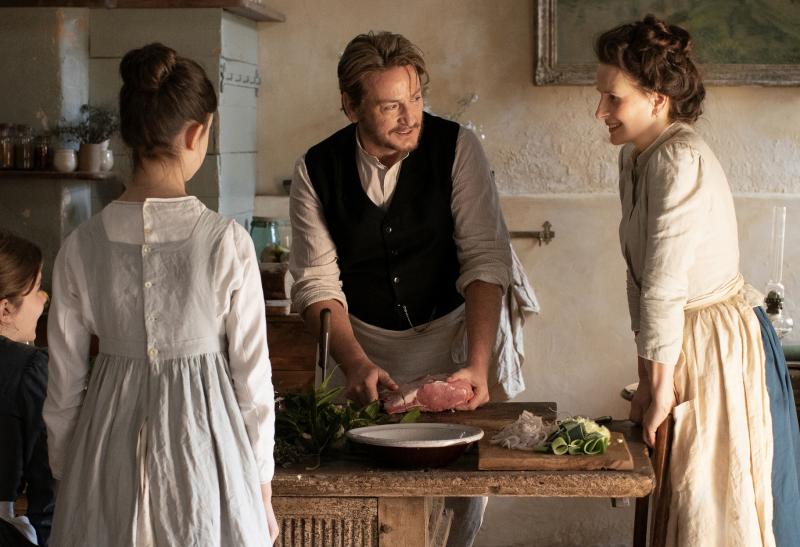
FOR TWO HOURS AND 14 MINUTES, the French movie The Taste of Things observes the preparation and eating of something like nine dishes.

The setting is a provincial chateau in the year 1885, and the focus is gourmet Dodin Bouffant and his cook, Eugenie – played by two considerable actors (and former partners), Benoît Magimel and Juliette Binoche.

Negative reviewers react against privilege and indulgence. The first kitchen scene of 40 minutes introduces an “extremely boring movie showing pots and pans and cooking complicated French recipes” (online comment). Some of the audience walk out.

It’s not perfect – I was mildly irritated by characters informing the audience by telling each other things they would surely already know. Some occurrences seem random – why introduce “electroculture” garden antennae?

Yet the movie is far more than foodie excess or cooking show. The great majority of reviewers are positive. What’s going on?

Musical clue

A clue comes from the absence of music – only used over the credits. Mind you, the Boston Globe reviewer was so seduced, he heard “a romantic score”, though conceding “everything you need to know is conveyed in actors’ eyes.”

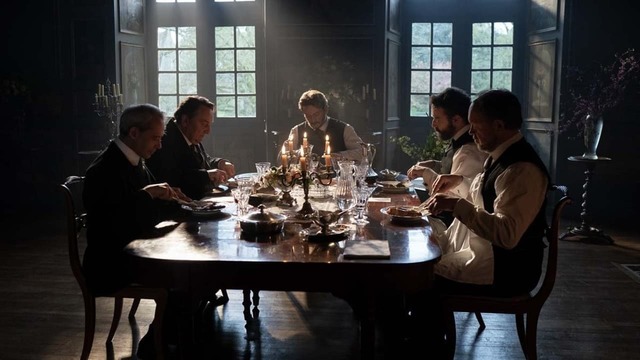
The soundtrack relies on clink, clunk, chop, bubble, sizzle, footsteps, birds out the door and window, and occasional words, sometimes among Eugenie, Dodin and helper, as they move between garden, stoves and benches, and among Dodin’s select group of male gourmets, who love the cooking, and the host’s cellar.

“I never before had to direct a film with as much substantiality,” writer/director Trần Anh Hùng answered an interviewer.* “All that material reality is so compellingly expressive, it firmly anchors our characters in daily life. Music would have undermined that.”

Hùng normally likes music, he said, but here it would “bring something that is a little bit fabricated… I wanted it to be very real.”

(Please note, all you restaurateurs who think loud music and noise denote a good time.)

Materialist film-making

Instead of music instructing viewers how to feel, they form their own interpretations. Similarly, Hùng chose long takes, he said, as a way to slow down the pace and give the audience the chance to be a kind of writer, gaining “time to formulate several things” in their mind.

I describe the approach as materialistic, in that the movie carefully shows what’s actually happening at the physical level, among intimates. Emotions arise from mundane cooperation.

“Everything that you see on the screen is real, and everything that we cook for the film, we ate it. Absolutely everything,” Hùng said. He was advised by Parisian chef, Pierre Gagnaire, and the actors were assisted on-set by Gagnaire’s retired colleague, Michel Nave.

“For the crew, it was unusual, because they have done some movies with food. Most of the time it’s fake. To make it very beautiful, you add some different things in it to make it have different texture, color, everything. But here, for this movie, I didn’t want that. Because it’s not about the beauty of the food. But it’s more about showing man and woman at work in that kind of harmony.”

He told the crew the long opening cooking sequence was “my car chase scene”.

Hùng’s wife, Trần Nữ Yên Khê, an actor and this movie’s art director and costume designer, explained the need to just get the setting “right”, and leave the beauty to emerge. “Try to do something beautiful, and it comes across as decorative.”

Happiness

The movie sounds and looks beautiful, allows time for reflection, and so what is it “about”? The Taste of Things gets to the core of cooking and enjoying meals. Hùng extolls Brillat-Savarin, as does my chapter, “Brillat-Savarin’s quest for table-pleasure” in Meals Matter (2020).

Homeliness was suggested by the working title, Pot au Feu (changed in the French to Le Passion de Dodin Bouffant, after the Marcel Rouff novel on which the film is loosely based). Domestic bliss in some present-day kitchen might well have become boring, but French protagonists at the time of Escoffier could believably be immersed in good cooking.

Hùng wanted to “explore something rare in the cinema: conjugality. And even rarer when it works.” With kitchen movements choreographed like a ballet, he sought to show “harmony”.

The 20-year relationship of well-to-do gourmet and cook has confused some movie-goers, particularly since it really doesn’t develop. But the pair are contented with their lives, and Dodin is presumably not surprised when Eugenie refuses proposals of marriage. She only leaves her bedroom door unlocked when she chooses. She gains them the perfect daughter through other means.

The Taste of Things does move steadily towards inevitable sadness, but never with the forced highs and lows of an action movie or even romantic comedy, let alone “reality” tv.

Harmony without drama marks this movie out as beautifully unconventional. Nonetheless, it has a strong motive to show “merely” cooking, eating and companionship, even if that passes. It’s about happiness.

*Interview quotes from Santa Barbara International Film Festival, https://youtu.be/YN5Vy_3a5Ds, and from Gaumont publicity, https://www.perthfestival.com.au/media/h3kd4qcm/the-taste-of-things-press-kit.pdf.)
Dining with aphantasia

TO THINK I reached the age of 30 without knowing this.” I was considerably older than that incredulous online author when I learned about “aphantasia”, just a few days ago.

Aphantasia is the experience of “reduced or absent voluntary imagery”, that is, we aphantasics are not bothered by a “mind’s eye”, nor its equivalents for the other senses.

We are amazed to learn that, when “counting sheep”, many people actually watch imaginary sheep!

It’s a surprisingly late discovery for us aphantasics, and also for science. Psychologists wrote about it more than a century ago, including Fechner (1860), Galton (1880), Bentley (1899) and John Watson (1913). But then the topic disappeared.

Watson himself might have to take some blame by launching behaviourism’s avoidance of subjective experience in favour of external psychological observation, which would be ironic given how he was a non-imaginer.

This last is suggested by Bill Faw (2009), who arguably led the return to studies of “non-imagers”, the name he prefers for himself and others. In 2015, a neurologist came up with the seemingly catchier, “aphantasia”. Under whatever the name, the research remains rudimentary, especially in relation to the phenomenon’s fascination. For instance, published estimates of the proportion of aphantasics in the population range from 0.7% to 2 – 5%.

Many have discovered the condition when a therapist asks them to visualise. They remain puzzled when asked to, perhaps, put an intrusive thought on a floating leaf and watch it drift away. We recognise the condition immediately it’s described.

If I am asked: “Imagine the sun rising,” I get a glimpse, vanishing instantly, like keying in a password. An imagined apple might have some details, and at least seem red, but then I’ve seen standard depictions of apples since learning “A is for Apple”.

Given imagery’s presumed role in memory, non-imagers generally don’t have such strong recall of even recent events, people’s faces or the narrative of their own lives.

Recent research also shows, for example, that we non-imagers might draw a simpler version of a room from memory, but often with more spatial accuracy. Spatial memory follows separate brain pathways from object memory, and aphantasics would generally seem better at it.

No question but that human minds are varied.

My wife Marion and I discovered complementary experiences early in our relationship, but never pinpointed the underlying explanation. From the start, we knew that she’s much better with people’s names, and recall of events.

Whereas I could scarcely remember one line of poetry, she can recite not 10,000 lines, but 10,000 poems (only a slight exaggeration).

She enjoys novels, whereas I can’t arouse much enthusiasm (although maybe for Pride and Prejudice, which she supposes comes from Austen’s relative disregard for description).

We both enjoy movies – they don’t rely on visualisation. Mind you, I often get greater enjoyment than she does from movies based on her favourite novels – they are rarely quite as she imagined.

On the instruction “think of the colour red”, I get a fleeting impression, and move on. When I try to recall the smell of nutmeg, say, nothing happens. Marion has no such trouble.

Researchers referring to “visualisation, “imagination” and the “mind’s eye” betray a cultural priority for vision. Those with a vivid “mind’s eye” usually also have a strong “mind’s nose”, “mind’s ear”, “mind’s touch”, etc.

Reporting in 1880, the early researcher Francis Galton asked respondents to imagine “your breakfast-table as you sat down to it this morning – and consider carefully the picture that rises before your mind’s eye”. Some respondents saw the breakfast table “as well in all particulars as I can do if the reality is before me”. At the other end of the scale: “I recollect the breakfast table, but do not see it.” Galton did not report on other sensory recall, nor pleasures.

Delving into the absence of visual, auditory and other impressions raises questions about meals.

I’ve long been puzzled by the deluge of cookery pages. Why do we need yet another pavlova recipe? It turns out that where I might think “that’s a long list of ingredients”, Marion puts the ingredients together in her head, and decides if she’d enjoy eating the result.

Seemingly following my lack of olfactory recall, I have relative difficulty naming flavours, so that with wine, for instance, I struggle to find “vanilla notes”, “cedar” and “violets”. Instead of identifying particulars, I become immersed in compound sensations, starting with the wine’s “structure”.

That’s like meals as a whole. They are immediate. At a good meal, I am absorbed – engaged with the here-and-now of dishes, places, conversations and their connections. A good meal is complex, and hums. Existential.

Without intricate recall, I enjoy talking (yet again) about past stand-outs, and also look forward to the next experience. I always like to know something is planned.

I am now wondering about the act of writing. Just as some visual artists turn out not to visualise, but set images out in front of them, I love words on paper.

My books on cooking and economies contain numerous details, but these are meant to point to bigger concepts. Some readers might become preoccupied by descriptions, just as so-called “economists” might promote the simple mathematics of price, rather than absorb the full wonder of sharing the world.

Footnote: Research and writing on aphantasia has often been expressed in the negative – it is a “lack” or “disorder”. To quote a recent scientific paper, “visual imagery is absent or markedly impaired.” Even when protesting it’s not a disease, and citing examples of highly successful non-imagers, these same writers still focus on deficits. The very name aphantasia is pathologising.

That’s surprisingly easily turned around, so that one might say, for example, that many people – known as “phantasics” – suffer an overload of imagined sights, sounds, bodily states, and more.

George Herbert Betts reported on visual, auditory, gustatory, olfactory and other imagery in his 1909 study, and declared: “Very much of memory is accomplished without the use of imagery, and much of the imagery which accompanies memory is of no advantage to it.”

Questioning imagination’s importance for reading literature, he worried: “if a flood of profuse imagery should accompany the words as we read, interpretation and appreciation would be seriously interfered with.”

Without impediment, non-imagers engage with the factual and here-and-now, and think clearly.

Furthermore, aphantasia might be somewhat protective against PTSD, major depressive disorder, social phobia, and bipolar disorder (e.g., Cavedon-Taylor, 2022), given how these can be reinforced by visualising – flashbacks, or too vividly imagined dangers.

And yet, without leaping sheep, floating leaves or the sweet scent of vanilla, aphantasics might be exposed to other anxieties.

I am just beginning, and so is research generally.

For a sample:

Galton, Francis (1880), “Statistics of mental imagery”, Mind: A quarterly review, No. 19 (July 1880): 302-318

Betts, George Herbert (1909). Distribution and Functions of Mental Imagery (Columbia Univ. Contr. to Educ. No. 26.), New York: Teachers College, Columbia University

Cavedon-Taylor, Dan (2022), “Aphantasia and psychological disorder: Current connections, defining the imagery deficit and future directions,” Frontiers in Psychology, Published online 14 October 2022

Faw, Bill (2009), “Conflicting intuitions may be based on differing abilities: Evidence from
mental imaging research,” Journal of Consciousness Studies, 16(4), 45–68

Fox-Muraton, Mélissa (2021), “Aphantasia and the language of imagination: A Wittgensteinian exploration,” Analiza i Egzystencja 55 (2021)

Cavedon-Taylor, Dan (2022), “Aphantasia and psychological disorder: Current connections, defining the imagery deficit and future directions,” Frontiers in Psychology, Published online 14 October 2022

“Don’t Look Up” stole my ending

The story so far:

  • Writer/director Adam McKay attracted big names (Jennifer Lawrence, Leonardo DiCaprio, Cate Blanchett, Meryl Streep, Ariana Grande, Timothée Chalamet, Rob Morgan, Mark Rylance, etc) to depict the apocalypse.
  • Movie critics are luke-warm – Don’t Look Up rates only 55% on Rotten Tomatoes (“slapdash, scattershot sendup”).
  • But some scientists say, “Please watch – this is just what it feels like.”

Both sides have a point. As a movie, Don’t Look Up falls short of the artistic clout of, say, Invasion of the Body Snatchers (1956) or Dr Strangelove (1964) – and both rate 98% on RT. But the new movies is breaking streaming records, and gets a 78% audience rating.

As to the scientists’ pleas, the movie might demonstrate the benefits of following “the science” in terms of peer-reviewed facts. The discovery of the fatal asteroid by astronomy postgraduate (Jennifer Lawrence) should have benefitted humanity.

But the movie also reveals reasons to be sceptical of “the scientists” – with teams of them aiding and abetting capitalism, personified here by a tech billionaire with a life-long dream of shooting himself into space.

The final flourishes of capitalism deserve greater movies, and Don’t Look Up’s audience success will surely stimulate more.

The immediate question here, nonetheless, is whether Don’t Look Up goes on my list of best foodie movies. Okay, it’s more about the distractions, vividly capturing Guy Debord’s “Society of the Spectacle” of political illusion, tv chat, TikTok, bottled water and packet snacks.

Eventually, the movie also turns to the only serious contender for human grounding, where? – to a simple meal.

However, the care and consideration of sharing food and conversation is what we need right now, not when it’s too late!

Don’t Look Up is compulsory viewing – it illustrates what happens when greed trumps appetite. Nevertheless, to get a real grip on the issues, I recommend Meals Matter: A Radical Economics through Gastronomy (2020). The endings are similar, but the paths are different.

Jennifer Lawrence

“Delicious” joins the great foodie movies

Words are the aspect of meals that helps their planning, description and acclamation.

Likewise, movies are additions – before, after, or with a glass of wine or popcorn –  that can also proclaim dining’s centrality to human existence.

Any good movie is bound to include meals. Charlie Chaplin shares his boiled boot in Gold Rush (1925). Katharine Hepburn and Spencer Tracy play battling barristers in Adam’s Rib (1949), so that George Kukor establishes their happy domestic relationship by them working comfortably together in the kitchen.

It’s not enough just to show pretty food to make a foodie movie – that’s like bringing in stars like Meg Ryan and Billy Crystal without actually establishing their love.

Foodie movies (initial list below) have to bring the whole world together, however fleetingly. As Italian cook Primo reveals in Big Night (1996): “To eat good food is to be close to God.”

Délicieux (Delicious) (2021)

Where does Eric Besnard’s new movie, Delicious, rate on the foodie scale?

Not up with Babette’s Feast, but what is? But it sits alongside, say, The Truffle Hunters (2020) and Pig (2021).

Some movie reviewers mustn’t be blessed with the “sacred fire” that Brillat-Savarin described, so that they “regard meals as hours of enforced labour, put on the same level everything that might nourish them, and sit at table like an oyster on its bed”. Accordingly, critics who found Pig merely a trite satire revealed they had missed the central, dramatic point.

In Delicious, another big, obsessive chef has also retreated to the woods, but, whereas Nicolas Cage’s recluse produces one overpowering meal, Grégory Gadeboi’s character ostensibly opens the first restaurant a few days before the French Revolution.

Not that Delicious even tries to be accurate in its details. By 1789, a new kind of dining had already emerged based on restoring broths or “restaurants”, served in private booths. Even more to the point, Antoine Beauvilliers had already brought aristocratic dining to the streets of Paris.

I talk about these developments, and explain why true restaurants are “open domestic households”, in Meals Matter.

Overall, nonetheless, through unashamedly fictional means, Delicious makes bigger statements about the fundamental importance of gastronomic pleasure, and its relationship to French foundation myths.

It is, for example, entirely believable that the French Church decried underground produce as further from God – chef Manceron combines potatoes and truffles in his little pastries that give the movie its title.

In anticipation of you catching Delicious, I won’t give more of the plot, except to disclose that Isabelle Carré, although not so well known outside France, is mesmerising.

Initial list of foodie movies:

Tampopo (1985); Babette’s Feast (1987); Chicken and Duck Talk (1988); Au Petit Marguery (1991); Like Water for Chocolate (1992); Eat, Drink, Man, Woman (1994); Big Night (1996); Chocolat (2000); Mostly Martha (2002); Sideways (2004); Ratatouille (2007); The Trip (2010); The Lunchbox (2013); The Truffle Hunters (2020); Pig (2021); Délicieux (Delicious) (2021)….

Postscript: Lock-down would appear to have unlocked ridiculous numbers of foodie movies. I’ve just noticed (September, 2022) a couple more that don’t in this case sound all that appetising, namely, Flux Gourmet and The Menu.

Add your favourite foodie movies in the comments.