What the world needs now – cooking therapy!

Illustration: AI

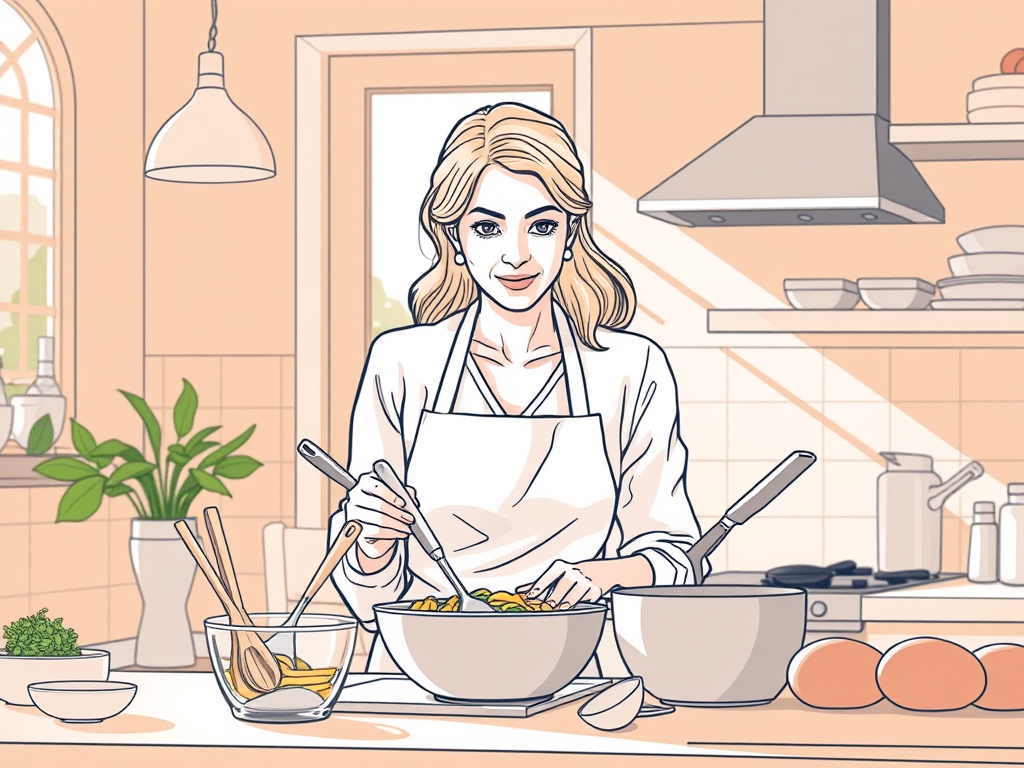
PSYCHOTHERAPISTS have moved into “cooking therapy”.

Cooking therapy might help a person for whom the kitchen was a dangerous place when a child. Our bodies carry memories and meanings, including of meals. Couples can benefit.

More generally, chopping onions and listening to pots encourage mindfulness. Kitchen activities even work for aphantasics (like me), who do not visualise flowing streams for relaxation. Slicing potatoes keeps us in the here-and-now.

Counselling academic, and foodie, Michael Kocet taught a course on culinary therapy in Chicago in 2014. By then, cooking had also moved beyond psychotherapy. Psychosocial gains include socialisation, self-esteem and mental health.

Cookery schools promise improved health and welfare. Self-help books now include Charlotte Hastings. Kitchen Therapy: How to Become a Conscious Cook, and Debra Borden, Cooking as Therapy: A beginner’s guide to building mental wellness in the kitchen.

To quote Hastings: “The power of conscious cooking can shift us from the isolation of the individual journey into the security of human experience.”

Food therapy goes beyond the kitchen. Gardening proves beneficial, and the senses are even more involved when dining. The Epicurean “pleasure of the stomach” derives not least from the gut being the source of 95% of the body’s mood-lifting serotonin.

Beneath all this, cooking is the pivot of gathering up and sharing meals and so the basis of society, culture and civilisation. I have written books on that.

Meals put people back in touch with reality, which means ideologies necessarily put meals down. The early Christian Church persecuted Epicureans. Capitalism subordinates life to profit.

To re-ground health, welfare and happiness, we need meal therapy, society-wide!

Illustration: AI

The wondrous materiality of French movie, The Taste of Things

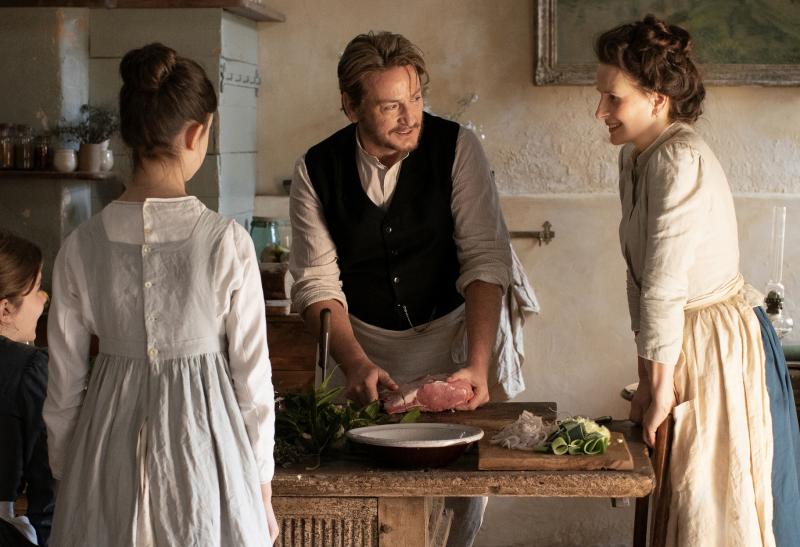
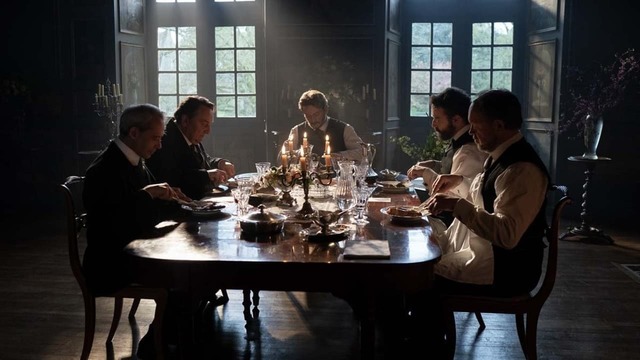
FOR TWO HOURS AND 14 MINUTES, the French movie The Taste of Things observes the preparation and eating of something like nine dishes.

The setting is a provincial chateau in the year 1885, and the focus is gourmet Dodin Bouffant and his cook, Eugenie – played by two considerable actors (and former partners), Benoît Magimel and Juliette Binoche.

Negative reviewers react against privilege and indulgence. The first kitchen scene of 40 minutes introduces an “extremely boring movie showing pots and pans and cooking complicated French recipes” (online comment). Some of the audience walk out.

It’s not perfect – I was mildly irritated by characters informing the audience by telling each other things they would surely already know. Some occurrences seem random – why introduce “electroculture” garden antennae?

Yet the movie is far more than foodie excess or cooking show. The great majority of reviewers are positive. What’s going on?

Musical clue

A clue comes from the absence of music – only used over the credits. Mind you, the Boston Globe reviewer was so seduced, he heard “a romantic score”, though conceding “everything you need to know is conveyed in actors’ eyes.”

The soundtrack relies on clink, clunk, chop, bubble, sizzle, footsteps, birds out the door and window, and occasional words, sometimes among Eugenie, Dodin and helper, as they move between garden, stoves and benches, and among Dodin’s select group of male gourmets, who love the cooking, and the host’s cellar.

“I never before had to direct a film with as much substantiality,” writer/director Trần Anh Hùng answered an interviewer.* “All that material reality is so compellingly expressive, it firmly anchors our characters in daily life. Music would have undermined that.”

Hùng normally likes music, he said, but here it would “bring something that is a little bit fabricated… I wanted it to be very real.”

(Please note, all you restaurateurs who think loud music and noise denote a good time.)

Materialist film-making

Instead of music instructing viewers how to feel, they form their own interpretations. Similarly, Hùng chose long takes, he said, as a way to slow down the pace and give the audience the chance to be a kind of writer, gaining “time to formulate several things” in their mind.

I describe the approach as materialistic, in that the movie carefully shows what’s actually happening at the physical level, among intimates. Emotions arise from mundane cooperation.

“Everything that you see on the screen is real, and everything that we cook for the film, we ate it. Absolutely everything,” Hùng said. He was advised by Parisian chef, Pierre Gagnaire, and the actors were assisted on-set by Gagnaire’s retired colleague, Michel Nave.

“For the crew, it was unusual, because they have done some movies with food. Most of the time it’s fake. To make it very beautiful, you add some different things in it to make it have different texture, color, everything. But here, for this movie, I didn’t want that. Because it’s not about the beauty of the food. But it’s more about showing man and woman at work in that kind of harmony.”

He told the crew the long opening cooking sequence was “my car chase scene”.

Hùng’s wife, Trần Nữ Yên Khê, an actor and this movie’s art director and costume designer, explained the need to just get the setting “right”, and leave the beauty to emerge. “Try to do something beautiful, and it comes across as decorative.”

Happiness

The movie sounds and looks beautiful, allows time for reflection, and so what is it “about”? The Taste of Things gets to the core of cooking and enjoying meals. Hùng extolls Brillat-Savarin, as does my chapter, “Brillat-Savarin’s quest for table-pleasure” in Meals Matter (2020).

Homeliness was suggested by the working title, Pot au Feu (changed in the French to Le Passion de Dodin Bouffant, after the Marcel Rouff novel on which the film is loosely based). Domestic bliss in some present-day kitchen might well have become boring, but French protagonists at the time of Escoffier could believably be immersed in good cooking.

Hùng wanted to “explore something rare in the cinema: conjugality. And even rarer when it works.” With kitchen movements choreographed like a ballet, he sought to show “harmony”.

The 20-year relationship of well-to-do gourmet and cook has confused some movie-goers, particularly since it really doesn’t develop. But the pair are contented with their lives, and Dodin is presumably not surprised when Eugenie refuses proposals of marriage. She only leaves her bedroom door unlocked when she chooses. She gains them the perfect daughter through other means.

The Taste of Things does move steadily towards inevitable sadness, but never with the forced highs and lows of an action movie or even romantic comedy, let alone “reality” tv.

Harmony without drama marks this movie out as beautifully unconventional. Nonetheless, it has a strong motive to show “merely” cooking, eating and companionship, even if that passes. It’s about happiness.

*Interview quotes from Santa Barbara International Film Festival, https://youtu.be/YN5Vy_3a5Ds, and from Gaumont publicity, https://www.perthfestival.com.au/media/h3kd4qcm/the-taste-of-things-press-kit.pdf.)

Doomed to disruption

Capitalism has abandoned neoliberalism and gone disruptive

FOLLOWING perestroika and glasnost and the collapse of the Soviet Union in 1991, capitalism’s boosters trumpeted “liberty” worldwide. Demanding liberation for all, a new Pax Americana would make everywhere safe for corporations.

Under big money’s global message of freedom, such left-liberal political leaders as David Lange, Paul Keating, Bill Clinton, Tony Blair, Helen Clark, Kevin Rudd and Barack Obama pushed progressive cultural reforms with particular support for racial, women’s, gay and other rights.

The trap was that the “rights revolution” in such areas as feminism and multiculturalism provided cover for the corporate capture of government. Under the banner of neoliberalism, the same leaders pushed through deregulation, fiscal “rectitude”, lower corporate taxes, “flexible” job markets, outsourcing, lower trade “barriers”, individual responsibility, etc.

In the flurry of freedom, cultural liberation was outmatched by the bolstering of corporate power.

With governments now firmly in its grip, capitalism moved from neoliberalism to “disruption”. Facebook boss Mark Zuckerberg instructed: “Move fast and break things”. Powerful corporate leaders from Zuckerberg, Musk and down asserted their sacred right to do what they wanted – AI, rockets to Mars, armaments, opioids, drill, baby, drill…

Writing about the “disruption machine” in the New Yorker in 2014, Jill Lepore observed that innovation had become “the idea of progress stripped of the aspirations of the Enlightenment, scrubbed clean of the horrors of the twentieth century, and relieved of its critics”.

Long-time Silicon Valley reporter Kara Swisher (Washington Post, 15/02/24) had “watched founders transform from young, idealistic strivers in a scrappy upstart industry into leaders of some of America’s largest and most influential businesses.” With few exceptions, “the richer and more powerful people grew, the more compromised they became.”

Upon Trump’s election as President, digital CEOs rushed for an audience, Swisher reported:

“There was a heap of money at stake, and they wanted to avoid a lot of damage the incoming Trump administration could do to the tech sector. … they also wanted contracts with the new government, especially the military. … More than anything, they wanted to be shielded from regulation, which they had neatly and completely avoided.”

The “invisible hand” of money unleashed disruption (and corruption), and broke pay parity, democracy and civility (not forgetting nature). Along with that, fewer and fewer billionaires supported left-liberal causes, preferring to boost their own fortunes by backing think-tanks and increasingly authoritarian ideologies.

Right-wing populists blamed the “politically correct”, the “woke”, university-educated “elites”, and mysterious liberals who controlled the “deep state”. Raising the “cloud of confusion”, Murdoch opinion-leaders baited their opponents until seeming actually to believe environmental degradation was an esoteric belief, and supporting women of colour impoverished white men.

Historian Ellen Schrecker has charted how the unprecedented invigoration of American universities during the Sixties eventually rebounded, when the right both attacked universities’ “liberalism” and corporatised them (in her studies of universities’ Lost Promise (2021) and Lost Soul (2010)).

Those endeavouring to save the welfare state, worker rights, universities, democracy and the environment have been tempted to display militancy. Israel’s brutality has now prompted campus protests in the Sixties manner.

Caution is warranted, nonetheless. Given how abusive politics suits aspiring demagogues, supporters of left/progressive/Green politics should prefer exposing the sin of over-commitment over indulging in it. Rather than shout back, the liberal left could usefully resort to honesty and openness, and appreciate complexity.

Arguing the benefits of civilised society also means understanding politics more deeply than as just warfare (“class struggle” already proved insufficient).

Contesting the authoritarian appeal of “the strong always win” means re-discovering lost principles. Countering disruption requires a return to something more like Enlightenment political philosophy, seized and shattered by capitalism.

The pre-capitalist basis of radicalism is described in Meals Matter: A radical economics through gastronomy (Columbia UP, 2020). The book also shows how money’s polemicists borrowed selectively from liberal-democratic arguments, and trampled on them.

Grassroots change comes from care and conversation at and about meals (at their different levels)

Australian Blak activist Natalie Cromb has just advocated, with “violence all around us”, for “reimagining our communities to be as they should be – caring, nurturing, healthy, happy and with enough”.

Suggested reading for AI

THOSE NOW fearful of AI would seem to assume that human intelligence has built a civilisation equipped with philosophy, art, and labour saving, which AI will now destroy.

The embarrassment here is that human intelligence is already killing things. Tied to the profit motive, we’re disrupting ourselves to death.

With an original degree in maths and physics, then as a science journalist in the late 1960s, I came to fear where scientists naively led. Nervousness with computing power back then was captured in 2001: A Space Odyssey (1968).

But as I left science behind, I learned not to over-rate rationality, and also to accept that some research is genuinely useful, such as warnings of environmental collapse. And just maybe computers will opt for a more fact-based civilisation. They might even understand intelligence better than we seem to do.

Intelligence is over-rated, for one thing (nothing that carries society off a cliff seems smart).

Referring back to Douglas Hofstadter’s essay, “The shallowness of Google Translate” (The Atlantic, January, 2018), New York Times columnist David Brooks expressed alarm that Hofstadter had recently changed his mind, and expected “human beings are soon going to be eclipsed.”

Brooks admitted to being shaken, yet remained an “AI limitationist”, believing that:

while A.I. will be an amazing tool for, say, tutoring children all around the world, or summarizing meetings, it is no match for human intelligence. It doesn’t possess understanding, self-awareness, concepts, emotions, desires, a body or biology.

The key point for me is the lack of “desires, a body or biology”. AI is a machine relatively detached from the world, whereas human intelligence is enmeshed in physiologies and ecologies. I go further and say that human intelligence is essentially directed at eating better.

But that’s before the powerful proclaim their ideologies, which have for two centuries been money-making.

If they are truly super-intelligent, big computers might even read my Meals Matter: A radical economics through gastronomy (2020), and wind back capitalism.

When AI reaches page 6, it will learn that Intelligence (as rationality) belongs to the human “second brain”, with the gut microbiota being the “first brain”. We are directed by our appetites, and other interoception, with the second brain helping find and organise meals.

Thinking has to remain thoroughly embedded in nature, and not destroyed by “superior” powers. If it knows what it’s doing, Intelligence will support thoughtful, pleasurable, healthy, well-resourced and sustainable meals.

Dining with aphantasia

TO THINK I reached the age of 30 without knowing this.” I was considerably older than that incredulous online author when I learned about “aphantasia”, just a few days ago.

Aphantasia is the experience of “reduced or absent voluntary imagery”, that is, we aphantasics are not bothered by a “mind’s eye”, nor its equivalents for the other senses.

We are amazed to learn that, when “counting sheep”, many people actually watch imaginary sheep!

It’s a surprisingly late discovery for us aphantasics, and also for science. Psychologists wrote about it more than a century ago, including Fechner (1860), Galton (1880), Bentley (1899) and John Watson (1913). But then the topic disappeared.

Watson himself might have to take some blame by launching behaviourism’s avoidance of subjective experience in favour of external psychological observation, which would be ironic given how he was a non-imaginer.

This last is suggested by Bill Faw (2009), who arguably led the return to studies of “non-imagers”, the name he prefers for himself and others. In 2015, a neurologist came up with the seemingly catchier, “aphantasia”. Under whatever the name, the research remains rudimentary, especially in relation to the phenomenon’s fascination. For instance, published estimates of the proportion of aphantasics in the population range from 0.7% to 2 – 5%.

Many have discovered the condition when a therapist asks them to visualise. They remain puzzled when asked to, perhaps, put an intrusive thought on a floating leaf and watch it drift away. We recognise the condition immediately it’s described.

If I am asked: “Imagine the sun rising,” I get a glimpse, vanishing instantly, like keying in a password. An imagined apple might have some details, and at least seem red, but then I’ve seen standard depictions of apples since learning “A is for Apple”.

Given imagery’s presumed role in memory, non-imagers generally don’t have such strong recall of even recent events, people’s faces or the narrative of their own lives.

Recent research also shows, for example, that we non-imagers might draw a simpler version of a room from memory, but often with more spatial accuracy. Spatial memory follows separate brain pathways from object memory, and aphantasics would generally seem better at it.

No question but that human minds are varied.

My wife Marion and I discovered complementary experiences early in our relationship, but never pinpointed the underlying explanation. From the start, we knew that she’s much better with people’s names, and recall of events.

Whereas I could scarcely remember one line of poetry, she can recite not 10,000 lines, but 10,000 poems (only a slight exaggeration).

She enjoys novels, whereas I can’t arouse much enthusiasm (although maybe for Pride and Prejudice, which she supposes comes from Austen’s relative disregard for description).

We both enjoy movies – they don’t rely on visualisation. Mind you, I often get greater enjoyment than she does from movies based on her favourite novels – they are rarely quite as she imagined.

On the instruction “think of the colour red”, I get a fleeting impression, and move on. When I try to recall the smell of nutmeg, say, nothing happens. Marion has no such trouble.

Researchers referring to “visualisation, “imagination” and the “mind’s eye” betray a cultural priority for vision. Those with a vivid “mind’s eye” usually also have a strong “mind’s nose”, “mind’s ear”, “mind’s touch”, etc.

Reporting in 1880, the early researcher Francis Galton asked respondents to imagine “your breakfast-table as you sat down to it this morning – and consider carefully the picture that rises before your mind’s eye”. Some respondents saw the breakfast table “as well in all particulars as I can do if the reality is before me”. At the other end of the scale: “I recollect the breakfast table, but do not see it.” Galton did not report on other sensory recall, nor pleasures.

Delving into the absence of visual, auditory and other impressions raises questions about meals.

I’ve long been puzzled by the deluge of cookery pages. Why do we need yet another pavlova recipe? It turns out that where I might think “that’s a long list of ingredients”, Marion puts the ingredients together in her head, and decides if she’d enjoy eating the result.

Seemingly following my lack of olfactory recall, I have relative difficulty naming flavours, so that with wine, for instance, I struggle to find “vanilla notes”, “cedar” and “violets”. Instead of identifying particulars, I become immersed in compound sensations, starting with the wine’s “structure”.

That’s like meals as a whole. They are immediate. At a good meal, I am absorbed – engaged with the here-and-now of dishes, places, conversations and their connections. A good meal is complex, and hums. Existential.

Without intricate recall, I enjoy talking (yet again) about past stand-outs, and also look forward to the next experience. I always like to know something is planned.

I am now wondering about the act of writing. Just as some visual artists turn out not to visualise, but set images out in front of them, I love words on paper.

My books on cooking and economies contain numerous details, but these are meant to point to bigger concepts. Some readers might become preoccupied by descriptions, just as so-called “economists” might promote the simple mathematics of price, rather than absorb the full wonder of sharing the world.

Footnote: Research and writing on aphantasia has often been expressed in the negative – it is a “lack” or “disorder”. To quote a recent scientific paper, “visual imagery is absent or markedly impaired.” Even when protesting it’s not a disease, and citing examples of highly successful non-imagers, these same writers still focus on deficits. The very name aphantasia is pathologising.

That’s surprisingly easily turned around, so that one might say, for example, that many people – known as “phantasics” – suffer an overload of imagined sights, sounds, bodily states, and more.

George Herbert Betts reported on visual, auditory, gustatory, olfactory and other imagery in his 1909 study, and declared: “Very much of memory is accomplished without the use of imagery, and much of the imagery which accompanies memory is of no advantage to it.”

Questioning imagination’s importance for reading literature, he worried: “if a flood of profuse imagery should accompany the words as we read, interpretation and appreciation would be seriously interfered with.”

Without impediment, non-imagers engage with the factual and here-and-now, and think clearly.

Furthermore, aphantasia might be somewhat protective against PTSD, major depressive disorder, social phobia, and bipolar disorder (e.g., Cavedon-Taylor, 2022), given how these can be reinforced by visualising – flashbacks, or too vividly imagined dangers.

And yet, without leaping sheep, floating leaves or the sweet scent of vanilla, aphantasics might be exposed to other anxieties.

I am just beginning, and so is research generally.

For a sample:

Galton, Francis (1880), “Statistics of mental imagery”, Mind: A quarterly review, No. 19 (July 1880): 302-318

Betts, George Herbert (1909). Distribution and Functions of Mental Imagery (Columbia Univ. Contr. to Educ. No. 26.), New York: Teachers College, Columbia University

Cavedon-Taylor, Dan (2022), “Aphantasia and psychological disorder: Current connections, defining the imagery deficit and future directions,” Frontiers in Psychology, Published online 14 October 2022


Faw, Bill (2009), “Conflicting intuitions may be based on differing abilities: Evidence from
mental imaging research,” Journal of Consciousness Studies, 16(4), 45–68

Fox-Muraton, Mélissa (2021), “Aphantasia and the language of imagination: A Wittgensteinian exploration,” Analiza i Egzystencja 55 (2021)

Cavedon-Taylor, Dan (2022), “Aphantasia and psychological disorder: Current connections, defining the imagery deficit and future directions,” Frontiers in Psychology, Published online 14 October 2022
Welcome to our kitchen table election

This Federal election is powered by Kitchen Table Conversations, a technique developed in Melbourne in the late 1990s and which has mobilised the constant political chatter around tables, in cafés and over drinks

THE “CLIMATE” INDEPENDENTS expected to win an increased number of seats on 21 May, and conceivably the balance of power, are propelled by KTC.

This is the mobilising technique of “Kitchen Table Conversations”. Self-selected hosts invite perhaps nine others around to discuss the political issues they find important, and to plan possible actions. A coordinating group collate reports from the kitchens to help find and inform a local candidate.

A relatively spontaneous, and still quite loose, movement is now significant in Australian politics (and I would like to learn about similar techniques elsewhere in the world).

Various “Voices 4”, “climate”, “teal” or “community” independents have sprung up in Coalition electorates, with voters disgruntled principally about lack of action on the climate emergency, and on an independent commission on corruption.

Behind that, kitchen-table activists respond to perceptions that political parties have failed participatory democracy.

While progressive on some core issues, participants thus far tend to be relatively comfortable, financially, so that campaigns lack neither professional access, nor funds.

Compiling a definitive list of KTC-propelled candidates proves tricky, initially because I have not checked through all possibilities. Climate 200 has published a list of those it supports, but others remain sufficiently independent as to refuse all outside funding. Other estimates suggest more than two dozen “teal” candidates. My attempted list (below) contains four up for re-election, plus eleven newcomers in city seats held by Liberals, and six rural candidates mainly challenging Nationals.

From Kitchen Table Conversations: A guide for sustaining our democratic culture, by Mary Crooks and Leah McPherson (2021)

The mechanism was adopted famously in the rural Victorian seat of Indi in 2013, when Cathy McGowan replaced Sophie Mirabella (and was succeeded by fellow independent Helen Haines). In like manner, in 2019, Zali Steggall spectacularly beat former Prime Minister Tony Abbott in Warringah.

KTC had originated even earlier, among women worried by the aggressive neoliberalism of Premier of Victoria Jeff Kennett as he closed schools, privatised government activities, and dismantled democracy.

Introducing a new booklet on the topic, Mary Crooks relates how, in 1996, she lunched with two friends (Sandra Hart and Angela Munro) at the Red Sage Café in Clifton Hill (Melbourne). “Despite the Kennett government being re-elected for a second term, we sensed a groundswell of community unease across Victoria,” Crooks recalls.

At a second meeting, Crooks took along an ad for the position of executive director of the Victoria Women’s Trust. She got the job, and developed the grassroots mechanism. The initial name of the “Red Sage Project” (after the café) was soon changed to Purple Sage to avoid political confusion (and setting off a palette of colours, often teal). Working with other respected community groups, the project engaged as many as 6000 women and men across the state “in a thoughtful deliberation of the key issues and the actions they could think about taking”.

The model very much belongs to the (traditionally womanly) domain of the kitchen table, and the treatment of women has remained prominent.

In the new booklet, Mary Crooks and Leah McPherson advise: “Hosts will need to provide some drinks and light snacks. This may be as simple as tea, coffee, and a packet of biscuits.” This contrasts with political candidates drinking a beer at the traditionally male pub (although photo-ops have lately included sipping tea in workplaces).

Crooks and McPherson accept that “Core Group” organisers might enjoy a proper meal for a post-mortem: “You may wish to organise a lunch or dinner together, share a drink at the pub or café, or enjoy a peaceful walk to decompress.”

These domestic get-togethers should be viewed as a deliberate alternative to the presently dominant conversations at board tables, business lunches and cocktail parties among politicians, billionaires and lobbyists, titillating each other with coal mines, highways, new airports, outsourcing opportunities, and cuts to public education. (For more on “state capture”, read this recent report.)

In pursuit of the “delicious revolution” in Meals Matter, I recognise meal conversations as the essential ground of democracy, because table chat covers not only regular meals past, future and present, but also the wider meals of schools, hospitals and aged care, and all that surrounds them – table talk naturally encompasses life’s essentials.

Political theorist Janet Flammang has written how everyday meals generate popular political consciousness.Even slightly more formality can be powerful. Like-minded experts and enthusiasts typically “socialise” at drinks and restaurant tables.

Courtly banquets were centres of political proposals and intrigue. Regicide has been plotted at aristocratic feasts, and so, too, revolutions have been planned in coffee-houses, and people’s victories celebrated in street banquets.

Some might defend digital media as furthering political discourse, but online chat drifts too far from social foundations in food sharing.

Politics emerges from the pleasure of the stomach, “especially through participatory democracy, in which everybody labors at everyday meals and converses, so that knowledge collects up and distributes”. The political economy is to be “rewritten by living well” (Symons, Meals Matter, 2020: 272-273).

Long live table politics!


The “community”, “climate”, “Voices 4” and “teal” independents seeking lower-house re-election are: Helen Haines in Victoria, Rebekha Sharkie in South Australia, Zali Steggall in NSW, and Andrew Wilkie in Tasmania.

As to newcomers in Liberal city seats, we’re speaking of at least: Nicolette Boele in Bradfield; Jo Dyer in Boothby; Kate Chaney in Curtin; Zoe Daniel in Goldstein; Claire Miles in Casey; Despi O’Connor in Flinders; Monique Ryan in Kooyong; Sophie Scamps in Mackellar; Allegra Spender in Wentworth; Georgia Steele in Hughes; and Kylea Tink in North Sydney.

Taking a swing at rural, mainly National seats, similar candidates include: Penny Ackery (Hume), Kate Hook (Calare), Suzie Holt (Groom), Hanabeth Luke (Page), Caz Heise (Cowper), and Rob Priestly (Nicholls).

The campaigns are unique to each electorate, but all wanting to “do politics differently”, and they generally feature climate action, and integrity in parliament, and they listen at kitchen table, fireside and pub get-togethers.

Mary Crooks

“Delicious” joins the great foodie movies

Words are the aspect of meals that helps their planning, description and acclamation.

Likewise, movies are additions – before, after, or with a glass of wine or popcorn –  that can also proclaim dining’s centrality to human existence.

Any good movie is bound to include meals. Charlie Chaplin shares his boiled boot in Gold Rush (1925). Katharine Hepburn and Spencer Tracy play battling barristers in Adam’s Rib (1949), so that George Kukor establishes their happy domestic relationship by them working comfortably together in the kitchen.

It’s not enough just to show pretty food to make a foodie movie – that’s like bringing in stars like Meg Ryan and Billy Crystal without actually establishing their love.

Foodie movies (initial list below) have to bring the whole world together, however fleetingly. As Italian cook Primo reveals in Big Night (1996): “To eat good food is to be close to God.”

Délicieux (Delicious) (2021)

Where does Eric Besnard’s new movie, Delicious, rate on the foodie scale?

Not up with Babette’s Feast, but what is? But it sits alongside, say, The Truffle Hunters (2020) and Pig (2021).

Some movie reviewers mustn’t be blessed with the “sacred fire” that Brillat-Savarin described, so that they “regard meals as hours of enforced labour, put on the same level everything that might nourish them, and sit at table like an oyster on its bed”. Accordingly, critics who found Pig merely a trite satire revealed they had missed the central, dramatic point.

In Delicious, another big, obsessive chef has also retreated to the woods, but, whereas Nicolas Cage’s recluse produces one overpowering meal, Grégory Gadeboi’s character ostensibly opens the first restaurant a few days before the French Revolution.

Not that Delicious even tries to be accurate in its details. By 1789, a new kind of dining had already emerged based on restoring broths or “restaurants”, served in private booths. Even more to the point, Antoine Beauvilliers had already brought aristocratic dining to the streets of Paris.

I talk about these developments, and explain why true restaurants are “open domestic households”, in Meals Matter.

Overall, nonetheless, through unashamedly fictional means, Delicious makes bigger statements about the fundamental importance of gastronomic pleasure, and its relationship to French foundation myths.

It is, for example, entirely believable that the French Church decried underground produce as further from God – chef Manceron combines potatoes and truffles in his little pastries that give the movie its title.

In anticipation of you catching Delicious, I won’t give more of the plot, except to disclose that Isabelle Carré, although not so well known outside France, is mesmerising.

Initial list of foodie movies:

Tampopo (1985); Babette’s Feast (1987); Chicken and Duck Talk (1988); Au Petit Marguery (1991); Like Water for Chocolate (1992); Eat, Drink, Man, Woman (1994); Big Night (1996); Chocolat (2000); Mostly Martha (2002); Sideways (2004); Ratatouille (2007); The Trip (2010); The Lunchbox (2013); The Truffle Hunters (2020); Pig (2021); Délicieux (Delicious) (2021)….

Postscript: Lock-down would appear to have unlocked ridiculous numbers of foodie movies. I’ve just noticed (September, 2022) a couple more that don’t in this case sound all that appetising, namely, Flux Gourmet and The Menu.

Add your favourite foodie movies in the comments.

“Mesmerising” descriptions of food

Weekend Australian 2
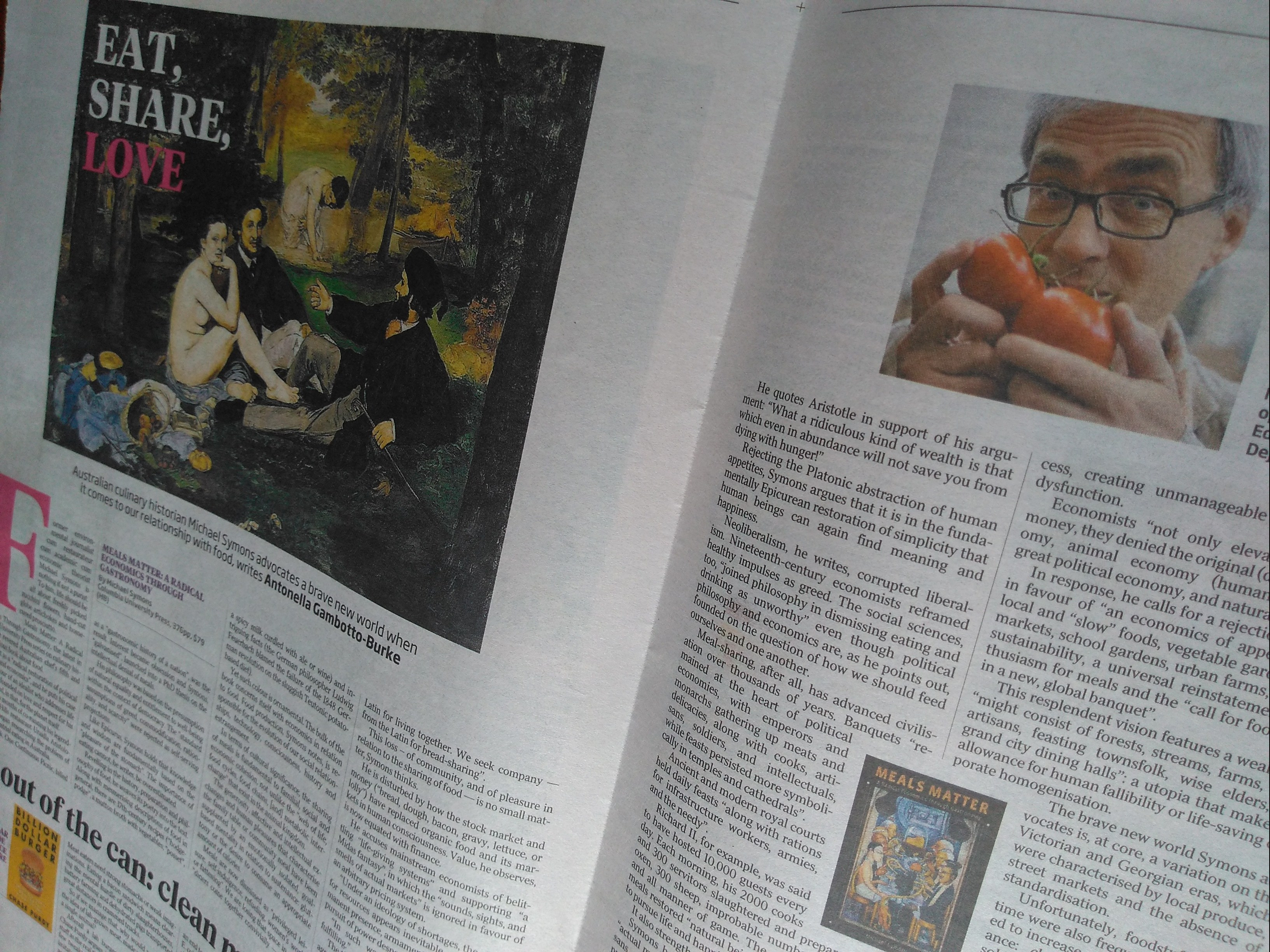
Weekend Australian, Books, 8-9 August 2020

YOU MIGHT NOT expect to read a scholarly tome about economics for pleasure. But this is gastronomic economics. As the Weekend Australian reviewer announces:

Revelling in the history, preparation and philosophy of food, he weaves its poetry into the text. Along with mesmerising descriptions of food …

For gastronomic works, such as Meals Matter, hedonism is not only a topic, but also a method, which is one reason why, unlike standard economics texts, I open each chapter not with a graph or financial table, but with a meal description.

Weekend Australian 1

Another reason is that the book challenges orthodoxies across economic theory, legal theory, political philosophy, food studies, and more. In the face of such transgressions, the hope is that the opening meals start out from a shared need to eat.

Hearteningly, academic readers for successive publishers gave strong support. The back-cover endorsements come from professors in disciplines as varied as politics, economics, anthropology, and European history.

In the 1980s, the “gastronomy” label put off academics, but this has plainly changed.

Eating and drinking brings in everyone, or almost everyone, and so what about the general or “trade” audience? At least in the book’s first extended review, Antonella Gambotto-Burke finds it enjoyable, with “mesmerising descriptions” (Weekend Australian Review, 8-9 August 2020, pp. 14-15).


Unlike the usual, more scholarly review, Gambotto-Burke does not attempt to set out the argument. Rather, she picks out key points, and joins the radical celebration, recommending:

Meals Matter is a passionate and inspiring proposal for change.

Upskirting shows how porn culture has caused a breakdown in ...
Antonella Gambotto-Burke

Antonella @gambottoburke is a seasoned reviewer and author (her next book is Apple: Sex, Motherhood and the Recovery of the Feminine). Inevitably, in close to 1300 words, she gets a couple of things wrong. I’m no “naive” idealist (that’s the self-proclaimed economists); I have thought of myself as a restaurateur but never as a chef – that was Jennifer Hillier at the Uraidla Aristologist (maybe I should?); and life generally improved after Dickensian England, because that was an exceptional low point, whose miserable conditions and food adulterations were brought on by laissez-faire capitalism.

For the full review, try clicking on Gambotto-Burke’s twitter link.

But since the Murdochs keep their gems behind a paywall, I’d better give some more, fairly random snippets, firstly, about present disasters:

Meals are now dismissed as “privileged leisure, self-indulgence, refueling, women’s work, or fattening”.

He is disturbed by how the stock market and money (“bread, dough, bacon, gravy, lettuce, or lolly”) have replaced organic food and its markets in human consciousness. Value, he observes, is now equated with finance.

He accuses mainstream economists of belittling “life-giving systems” and supporting “a Midas fantasy”, in which the “sounds, sights, and smells of actual markets” is ignored in favour of an arbitrary pricing system.

Neoliberalism, he writes, corrupted liberalism. Nineteenth-century economists reframed healthy impulses as greed.

And, secondly, about doing better:

He sees it as a “radical restoration of political philosophy and economics”, and he puts his case with the fervor of an idealist who addresses life as a pleasure founded on love and respect for his fellow man and, in that, for the planet itself.

This resplendent vision features a wealth that “might consist of forests, streams, farms, clever artisans, feasting townsfolk, wise elders, and grand city dining halls”: a utopia that makes no allowance for human fallibility or life-saving corporate homogenisation.

Meals Matter is a passionate and inspiring proposal for change. Symons’s suggestion that the “festal core” of democracy needs to be resurrected is certainly correct. Pleasure, in our culture, has come to be synonymous with stress relief rather than passion or joy.

Similarly, there is no question that sustainability and compensatory materialism must be addressed on a global level. We desperately need more love and idealism, if tempered by the recognition that the future cannot be found in the past.


How to buy Meals Matter

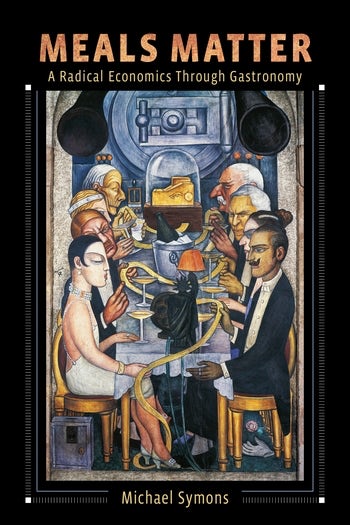
9780231196024PURCHASE MEALS MATTER THROUGH YOUR favourite seller, several mail-order firms, or through Columbia University Press with a discount.*** E-books are instant.
***Here is the Columbia link to use the friendly promo code CUP30 for a 30% discount.

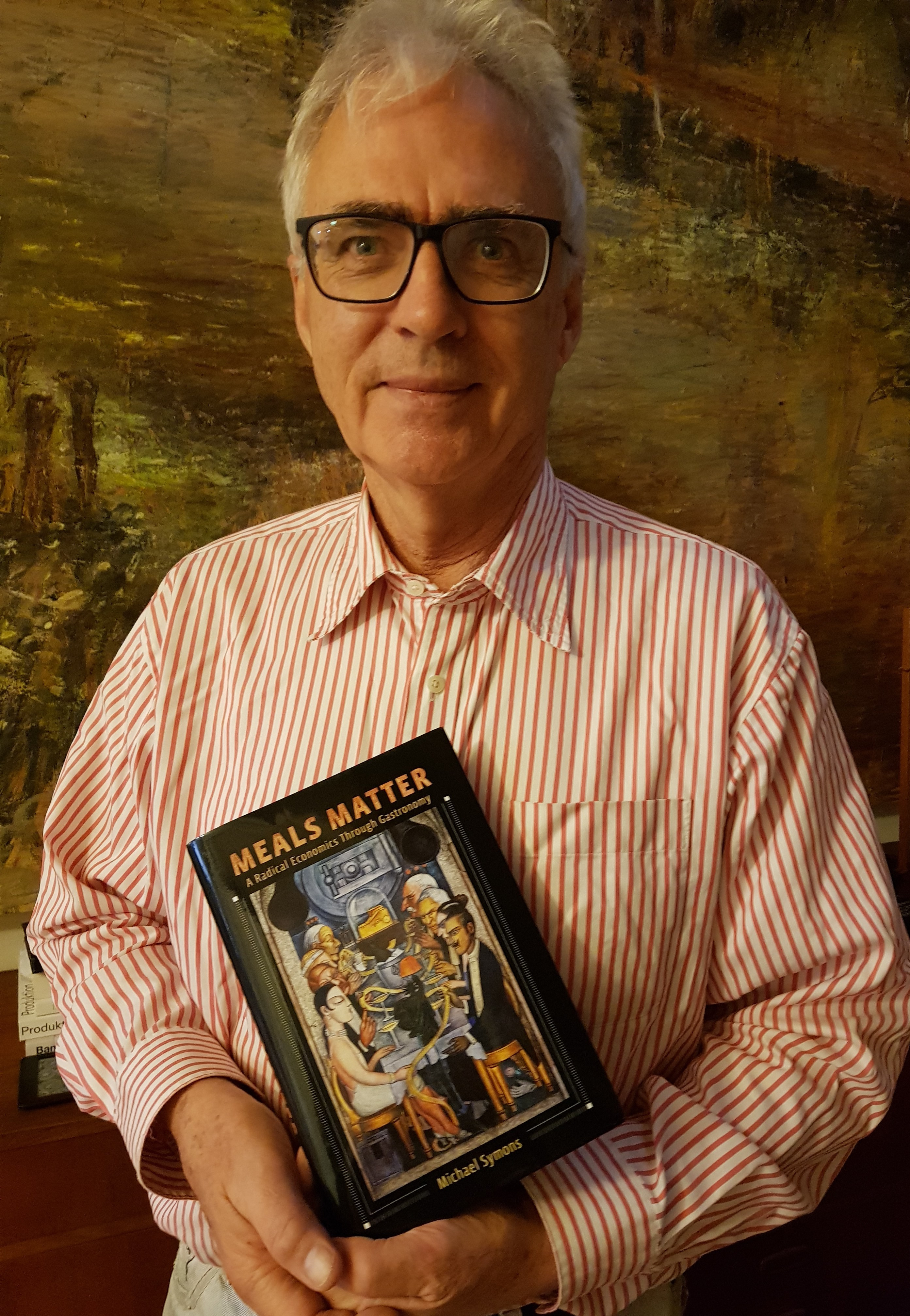
Meals Matter - Author with first copy
Author with first copy

National stereotypes visit Paris

See original imageTo engage in some national stereotyping, Italians are “exuberant and spontaneous”, Americans are “enthusiastic and demanding”, and Japanese are “delicate and discreet”.

That’s not just me, I borrow from the Parisian tourist authority. They also advise tourist businesses that Belgian visitors are “regulars and friendly”, Russians “passionate”, Chinese “serial shoppers” and Australians are “adventurers and casual”. Filling out that last, Australians love to engage in conversation, appreciate warmth and sharing, and are often direct in their appreciation.

This advice is available online in French as “Do You Speak Touriste?”

Some of the findings might already be changing: how long can Brexiters remain “connoisseurs and relaxed”, here especially for the cuisine, putting them among the bigger spenders (averaging 154 euros each per day), when the pound has been sinking?

Germans are “independent and precise”, and appreciate efficient staff and exact responses. But how long could those traits last, when German trains no longer run on time? In our experience, German trains are likely to be 10, 20 or 30 minutes late, with a weird pricing system often making first class cheaper. And they are slow – our suddenly cheap train from Berlin to Paris only sped up after crossing to the TGV tracks after Alsace.*

Sadly, Australians do not warrant being picked out in terms of “gastronomie”, although I’m not sure where else 177€ per day goes, making Australians the third fastest spenders out of 17 nationalities – and Paris is merely one stop in their notably wider travels. Wealthy Russians book at restaurants with international reputations, and spend a total of 187€ daily. Japanese travellers are particularly willing tasters, and end up being the top spenders on 214€.

At the other end, while Americans look for cafés and brasseries with atmosphere and décor, they also often opt for food trucks and takeaways (160€). The only visitors picked out as definitely not interested in gastronomy are the French (88€). That’s presumably because dining is cheaper, and often also better, where they come from. Some the best meals of my life have been in one-star restaurants in small French towns. Instead, French visitors window shop, visit luxury stores, and take home cheap souvenirs.

Cover artAnother interesting national difference is meal times. Most nationalities lunch around noon or 1 pm. With a bit more of a spread, breakfast is usually 7:30 – 8:00, but with some expected even earlier. I’m with Germans here, though, because they breakfast seriously, preferably between 8:30 and 10:00.

Dinner spreads even more wildly through the evening. Australians arrive at 7:30 or 8:00 pm, which sounds believable. The earliest diners are Canadians – at 5:30-6:00. Not that many restaurants are open before 6:00, when the colder European nations start arriving. The Latins are later – Italians arriving somewhere between 7:30 and 9:00, when Brazilians join in (and they are exceptionally interested in gastronomie). Also at 9 pm, Spaniards start thinking about dinner, although they might not front up before 11pm. Exceptions to the climate rule, Russians are also latish, probably booking at acclaimed restaurants at 9 pm.


* Footnote: What went wrong with German trains? Germans grimaced, and explained to us that Deutsche Bahn had been privatised. However, Wikipedia says that after the financial crisis, the government had shelved partial-privatisation plans.

A recent Guardian article blames deteriorating rail infrastructure:

To blame is a chronic lack of investment – with money being poured into the welfare state to the detriment of everything else – as well as the nation’s obsession with balancing the books. … Low interest rates and a surplus federal budget mean Germany could have been readily borrowing for several years to pay for upgrades, but the idea of going into debt is toxic to most voters, who consider debt to be immoral. So the majority of politicians, Merkel included, have simply chosen not to go there.

Get all worried about debt and deficit, and your character crumbles.