
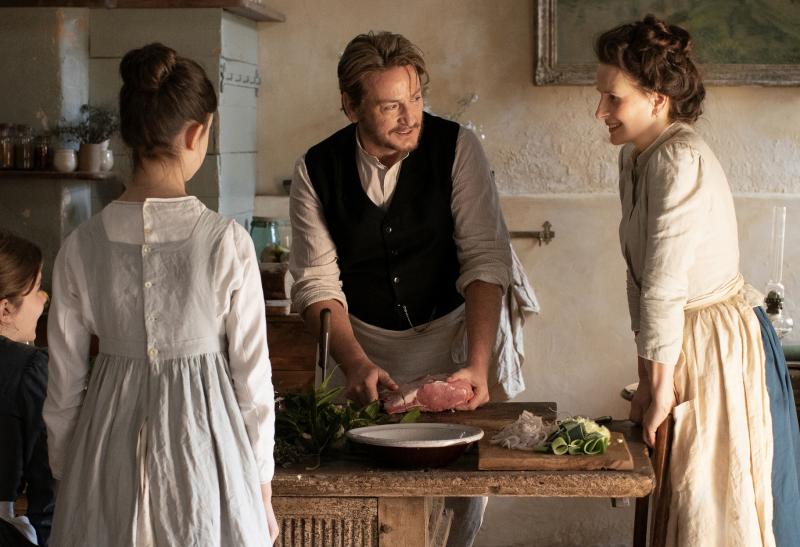
The wondrous materiality of French movie, The Taste of Things

FOR TWO HOURS AND 14 MINUTES, the French movie The Taste of Things observes the preparation and eating of something like nine dishes.

The setting is a provincial chateau in the year 1885, and the focus is gourmet Dodin Bouffant and his cook, Eugenie – played by two considerable actors (and former partners), Benoît Magimel and Juliette Binoche.

Negative reviewers react against privilege and indulgence. The first kitchen scene of 40 minutes introduces an “extremely boring movie showing pots and pans and cooking complicated French recipes” (online comment). Some of the audience walk out.

It’s not perfect – I was mildly irritated by characters informing the audience by telling each other things they would surely already know. Some occurrences seem random – why introduce “electroculture” garden antennae?

Yet the movie is far more than foodie excess or cooking show. The great majority of reviewers are positive. What’s going on?

Musical clue

A clue comes from the absence of music – only used over the credits. Mind you, the Boston Globe reviewer was so seduced, he heard “a romantic score”, though conceding “everything you need to know is conveyed in actors’ eyes.”

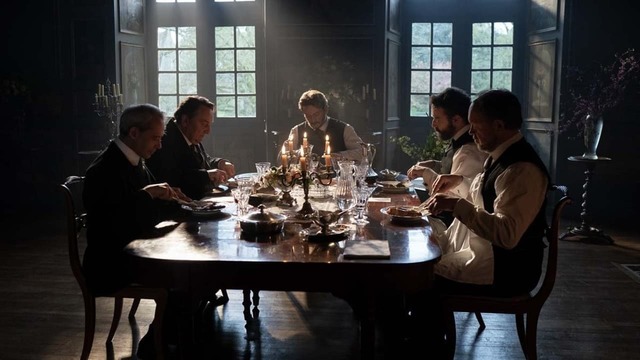
The soundtrack relies on clink, clunk, chop, bubble, sizzle, footsteps, birds out the door and window, and occasional words, sometimes among Eugenie, Dodin and helper, as they move between garden, stoves and benches, and among Dodin’s select group of male gourmets, who love the cooking, and the host’s cellar.

“I never before had to direct a film with as much substantiality,” writer/director Trần Anh Hùng answered an interviewer.* “All that material reality is so compellingly expressive, it firmly anchors our characters in daily life. Music would have undermined that.”

Hùng normally likes music, he said, but here it would “bring something that is a little bit fabricated… I wanted it to be very real.”

(Please note, all you restaurateurs who think loud music and noise denote a good time.)

Materialist film-making

Instead of music instructing viewers how to feel, they form their own interpretations. Similarly, Hùng chose long takes, he said, as a way to slow down the pace and give the audience the chance to be a kind of writer, gaining “time to formulate several things” in their mind.

I describe the approach as materialistic, in that the movie carefully shows what’s actually happening at the physical level, among intimates. Emotions arise from mundane cooperation.

“Everything that you see on the screen is real, and everything that we cook for the film, we ate it. Absolutely everything,” Hùng said. He was advised by Parisian chef, Pierre Gagnaire, and the actors were assisted on-set by Gagnaire’s retired colleague, Michel Nave.

“For the crew, it was unusual, because they have done some movies with food. Most of the time it’s fake. To make it very beautiful, you add some different things in it to make it have different texture, color, everything. But here, for this movie, I didn’t want that. Because it’s not about the beauty of the food. But it’s more about showing man and woman at work in that kind of harmony.”

He told the crew the long opening cooking sequence was “my car chase scene”.

Hùng’s wife, Trần Nữ Yên Khê, an actor and this movie’s art director and costume designer, explained the need to just get the setting “right”, and leave the beauty to emerge. “Try to do something beautiful, and it comes across as decorative.”

Happiness

The movie sounds and looks beautiful, allows time for reflection, and so what is it “about”? The Taste of Things gets to the core of cooking and enjoying meals. Hùng extolls Brillat-Savarin, as does my chapter, “Brillat-Savarin’s quest for table-pleasure” in Meals Matter (2020).

Homeliness was suggested by the working title, Pot au Feu (changed in the French to Le Passion de Dodin Bouffant, after the Marcel Rouff novel on which the film is loosely based). Domestic bliss in some present-day kitchen might well have become boring, but French protagonists at the time of Escoffier could believably be immersed in good cooking.

Hùng wanted to “explore something rare in the cinema: conjugality. And even rarer when it works.” With kitchen movements choreographed like a ballet, he sought to show “harmony”.

The 20-year relationship of well-to-do gourmet and cook has confused some movie-goers, particularly since it really doesn’t develop. But the pair are contented with their lives, and Dodin is presumably not surprised when Eugenie refuses proposals of marriage. She only leaves her bedroom door unlocked when she chooses. She gains them the perfect daughter through other means.

The Taste of Things does move steadily towards inevitable sadness, but never with the forced highs and lows of an action movie or even romantic comedy, let alone “reality” tv.

Harmony without drama marks this movie out as beautifully unconventional. Nonetheless, it has a strong motive to show “merely” cooking, eating and companionship, even if that passes. It’s about happiness.

*Interview quotes from Santa Barbara International Film Festival, https://youtu.be/YN5Vy_3a5Ds, and from Gaumont publicity, https://www.perthfestival.com.au/media/h3kd4qcm/the-taste-of-things-press-kit.pdf.)
The centre can be radical. Look what happened at the recent Australian election

THE POLITICALLY COMMITTED often decry the “centre” as wishy-washy, and as cosying up to the other side. But, being less ideological, the centre can be more radical.

Just one piece of evidence is the recent electoral success of “community independents”, whose pronounced liberalism produced policies more radical than either main party, left or right.

Liberalism? Corporate capitalism has rewritten our political language (chronicled in Meals Matter), and that necessitates being more open to rethinking liberalism.

The liberalism of its often-acknowledged founder, John Locke, tends to live on with so-called “small-l” or “left-” or “social-” liberals, who have multiplied over recent decades.

They eschew extremes, and yet have become such a threat that the right’s “culture warriors” have ridiculed them variously as “chardonnay socialists”, “latte liberals”, “smoked salmon socialists”, “gauche caviar”, “Toskana-Fraktion”,  “Salonsozialist”, “yuppies”, “politically correct”, “chattering classes”, “bobos”, “educated classes”, “liberal elite”, “inner-city greenies”, “mad left”, and on and on.

These liberals are committed to everyday, kitchen-table reality, which is perceived through practical experiences and face-to-face conversations, and informed by learning, with a consequent embrace of equality, tolerance, and democracy. Combined with the rejection of high authority and ideology and other extremes, these liberals are definitively radical in the sense of getting back to material basics.

The recent rise of so-called “teal” independents has been explained as “professional women” rejecting “merely” climate inaction, political corruption, and mistreatment of women.

They are better identified as genuine liberals, unimpressed by the Coalition’s obfuscations on global warming and women. Disturbed by political corruption and capture, they are determinedly “community” candidates, and I have already described their “kitchen table conversations” – grassroots exercises in interpersonal respect and participatory democracy.

Community independents belong to a centre that’s definitely not a weak compromise, not at least in terms of climate action, political integrity and gender equality.

Their policies are reliant on facts and expertise, not ideology, suggesting radicalism that’s not extreme, but literally getting to the root of the matter (deriving from Latin radix radicis).

Max Chandler-Mather

Likewise, the Greens would appear to have somewhat furled their wilderness and class war wings, and boosted their liberal radicalism. “People have lost faith in a political system that puts the interests of a few big corporations ahead of the rest of us,” according to Max Chandler-Mather. So, he ran “the biggest grassroots campaign in Greens’ history”, and won the Brisbane seat of Griffith.

Unusually for an Australian campaign, they established themselves as community carers by, for example, building a community garden on Defence land being disposed of to a developer. Their volunteer teams used some of the garden’s produce when helping out during covid lockdowns and after floods.

Historically, the major Australian parties – Labor and Liberal – represented the interests of the working class and bosses, respectively, although both always contained liberal elements.

Labor outgrew the class war with the Whitlam revolution of 1972, although its liberal leadership then fell in with neoliberalism. Labor’s agenda remains hypnotised by “jobs, jobs, jobs”, which is sunny way to support corporate capitalism.

We might be lucky, and the new Labor government might get behind the common-wealth of health, social justice, infrastructure, environment, education, research and the arts. But that means standing up to capitalist rule by profit.

Perhaps Labor needs to become the Labourer/Worker/Housekeeper/Carer/Professional/ Artisan/Farmer/Small businessperson/LGBTIQA+/Immigrant/Aged/Disabled/Indigenous/Abused/Student/Etc Party. A new name is not easy to come up with… Perhaps “Commonwealth Party”?

The “Liberal” name is already taken by the occasionally liberal party of Robert Menzies, but whose main demand is “freedom” for money, and which now has to choose between becoming a “broad church” or a reality-inventing, fact-denying, cynical rump.

Likewise, the National Party has to decide between being a Country Party, concerned with increasingly perilous bread-and-butter rural issues, or Trumpian authoritarians.

Perhaps the party system is doomed, anyway, as a relic of hierarchies with “party discipline” under the Leader, announcing policy, allocating ministries, and making “captain’s picks”.

Rather than rely on backroom deals, sloganised messaging and last-minute hi-vis pageantry, Members and Senators might deliberate on the floor of parliament. Now that’s an idea.

The community independents have shown the way. And let’s not forget that a thriving democracy in a complex society requires a highly informed citizenry, and therefore strong public education, responsible media, and a committed and open public service.

With determination, it’s possible that a new centre might hold, and a radical centre at that.

To repeat, by “centre”, I do not speak of midway between two extremes, but caring, honest, informed and pragmatic “liberalism”.

What explains economists’ raptures?

supply and demand chart
Economists’ esoteric truth

THE SIMPLE PHILOSOPHICAL distinction between materialism and idealism is a handy way to understand how neoclassical economists came to worship the price mechanism as God. Here is Michael Symons’ essay on the topic, recently published in the online New Economy Journal under the heading, “Capitalism is idealism, perfected”

FOR MANY OF US, the market is an actual gathering of human buyers and sellers, chatting, tasting and sharing produce, which is often fresh and artisanal. At market benches and shop counters, people display and take in a community meal.

Mainstream economists turned that market into differential equations. In so doing, they perfected the idealism of capitalism. That is a big problem.

Idealism puts some high authority in charge of ordinary lives. The ancient Greek philosopher, Plato, claimed to glimpse the “world of forms” that shaped our inferior version.

Market capitalism directs human-beings through numbers, from higher interest rates to a supermarket saving of 60 cents.

Often perversely labelled “materialism”, the financial heights remake the world. Seemingly inevitably, profit and loss impose their rarefied rule. Of indisputable rationality, the price mechanism is God.

The promise is that, strictly obeyed, money will multiply eternally – cynically called “growth”, because it actually destroys growing things, from the heating biosphere to koalas without habitats.

Money is weightless, but a fierce enforcer that accumulates through heartless extraction, most efficiently from those with less.

It’s the most rationalised value system conceivable – valuing something not for being ethical, beautiful or tasty, but purely by price.

Every nonreflex action is taken to obtain or increase value in some sense; otherwise, no action takes place

– Investopedia explains

Many capitalist apologists pretend to being hard-nosed dealers in the grubby arts. Yet they worship an entirely spiritual desire, called “greed”.

The distinction between idealism and materialism is that the former sees the world as run by higher thoughts, and the latter by material fundamentals.

Idealists teach that actual bodies and everyday practices become misleading diversions, and materialists emphasise the provisional nature of ideas.

As a meal-lover, I fear that idealism is far too dangerously easy to adopt, unthinkingly. Proclaimed truths mould our minds.

Open-minded protagonists, on either side, allow that both rational thought and natural forces play big roles. The difference comes from which holds more sway. Do ideas come “from above” or “from below”?

A greater appreciation of the distinction should help to understand, and combat, the dictatorship of money. Does money run us, or do we keep it as an occasionally handy instrument?

I don’t propose some anarchic or hermitic refusal of money. Money is not without its uses, but only when clearly kept as a tool – as a community exchange system, and as a funder of cooperative endeavour.

Nonetheless, in moving towards a radical political economy, the plan is to regenerate care and consideration from below. Great schemes are built from the ground-up. Ordinary, everyday actions generate democratic supervision of political expenditures, programs and safeguards.

This is liberal “radicalism”, which does not mean extremism, but arguing from material basics… it literally gets to the root (Latin, radix) of the matter.

Materialists play close attention to commonplace sensations and activities. These “little things” are slighted as “trivial” from lofty vantage-points. Up-close, they are highly significant, and they multiply across human experience. The deterioration of relations with China, the rise of the FTSE 100, or some militant action might seem “important”, but only from its emergence from, and continuing connection with, everyday realities.

That’s to uphold the benefit of gardening, cooking and eating together. Community gardens and food rescue schemes are acknowledged actions of a “new economy”.

My latest book, Meals Matter: A Radical Economics Through Gastronomy, explores how a cluster of actual economies puts food on the table. There is no single “the economy”, but bodily, domestic, market, political and natural economies.

Capitalism simplified and up-ended that, diminishing basic human needs, with unhappy results. Instead of being guided by appetites, we were instructed to pursue ever-receding gain. Instead of cooperating through meals, we were to compete for dollars, euros, yuan and yen.

Radical arguments “from below” return to “the simple fact, hitherto concealed by an overgrowth of ideology, that mankind must first of all eat, drink, and have shelter and clothing”, to cite Friedrich Engels (at Karl Marx’s graveside, 17 March, 1883). Likewise, in a lengthy introductory section to Wealth of Nations (1776), Adam Smith launched modern economics with the claim that, through the “co-operation and assistance of great multitudes”, such as the butcher, brewer, and baker, “we expect our dinner”.

Too often, higher authorities have exploited, distorted, and suppressed gastronomic knowledge. The historical materialism of Marx and Engels turned into a narrow class war over the ownership of “production”, which split ruler irrevocably from ruled.

Meanwhile, in the service of the mighty financial superstructure, modern economists transformed market exchanges of actual meat, beer and bread into the perfection of the price mechanism.