Cooking therapy might help a person for whom the kitchen was a dangerous place when a child. Our bodies carry memories and meanings, including of meals. Couples can benefit.
More generally, chopping onions and listening to pots encourage mindfulness. Kitchen activities even work for aphantasics (like me), who do not visualise flowing streams for relaxation. Slicing potatoes keeps us in the here-and-now.
Counselling academic, and foodie, Michael Kocet taught a course on culinary therapy in Chicago in 2014. By then, cooking had also moved beyond psychotherapy. Psychosocial gains include socialisation, self-esteem and mental health.
Cookery schools promise improved health and welfare. Self-help books now include Charlotte Hastings. Kitchen Therapy: How to Become a Conscious Cook, and Debra Borden, Cooking as Therapy: A beginner’s guide to building mental wellness in the kitchen.
To quote Hastings: “The power of conscious cooking can shift us from the isolation of the individual journey into the security of human experience.”
Food therapy goes beyond the kitchen. Gardening proves beneficial, and the senses are even more involved when dining. The Epicurean “pleasure of the stomach” derives not least from the gut being the source of 95% of the body’s mood-lifting serotonin.
Beneath all this, cooking is the pivot of gathering up and sharing meals and so the basis of society, culture and civilisation. I have writtenbooks on that.
Meals put people back in touch with reality, which means ideologies necessarily put meals down. The early Christian Church persecuted Epicureans. Capitalism subordinates life to profit.
To re-ground health, welfare and happiness, we need meal therapy, society-wide!
FOR TWO HOURS AND 14 MINUTES, the French movie The Taste of Things observes the preparation and eating of something like nine dishes.
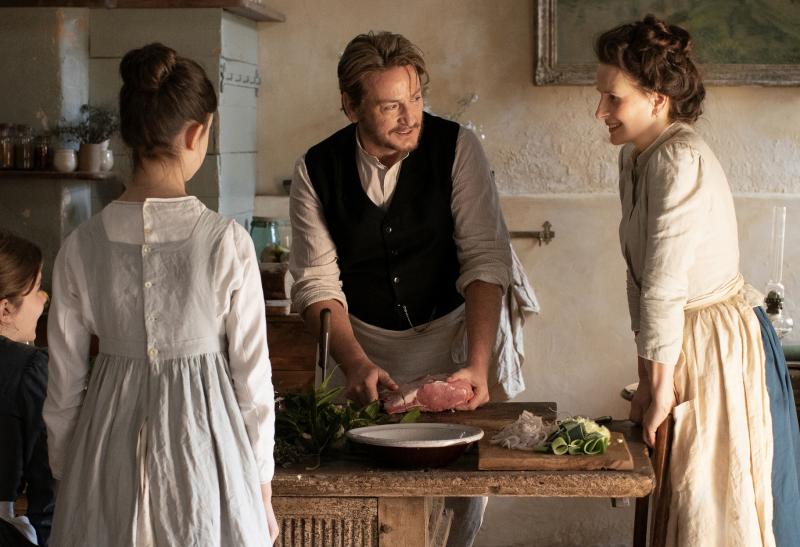
The setting is a provincial chateau in the year 1885, and the focus is gourmet Dodin Bouffant and his cook, Eugenie – played by two considerable actors (and former partners), Benoît Magimel and Juliette Binoche.
Negative reviewers react against privilege and indulgence. The first kitchen scene of 40 minutes introduces an “extremely boring movie showing pots and pans and cooking complicated French recipes” (online comment). Some of the audience walk out.
It’s not perfect – I was mildly irritated by characters informing the audience by telling each other things they would surely already know. Some occurrences seem random – why introduce “electroculture” garden antennae?
Yet the movie is far more than foodie excess or cooking show. The great majority of reviewers are positive. What’s going on?
Musical clue
A clue comes from the absence of music – only used over the credits. Mind you, the Boston Globe reviewer was so seduced, he heard “a romantic score”, though conceding “everything you need to know is conveyed in actors’ eyes.”
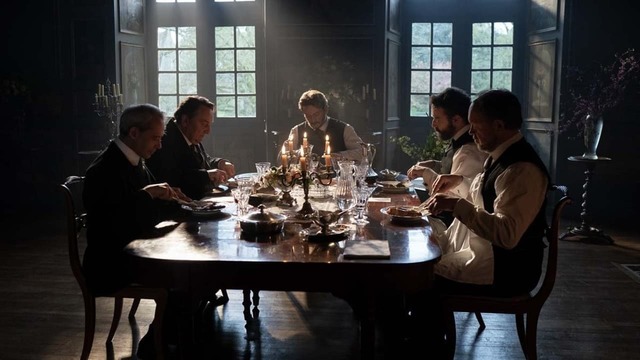
The soundtrack relies on clink, clunk, chop, bubble, sizzle, footsteps, birds out the door and window, and occasional words, sometimes among Eugenie, Dodin and helper, as they move between garden, stoves and benches, and among Dodin’s select group of male gourmets, who love the cooking, and the host’s cellar.
“I never before had to direct a film with as much substantiality,” writer/director Trần Anh Hùng answered an interviewer.* “All that material reality is so compellingly expressive, it firmly anchors our characters in daily life. Music would have undermined that.”
Hùng normally likes music, he said, but here it would “bring something that is a little bit fabricated… I wanted it to be very real.”
(Please note, all you restaurateurs who think loud music and noise denote a good time.)
Materialist film-making
Instead of music instructing viewers how to feel, they form their own interpretations. Similarly, Hùng chose long takes, he said, as a way to slow down the pace and give the audience the chance to be a kind of writer, gaining “time to formulate several things” in their mind.
I describe the approach as materialistic, in that the movie carefully shows what’s actually happening at the physical level, among intimates. Emotions arise from mundane cooperation.
“Everything that you see on the screen is real, and everything that we cook for the film, we ate it. Absolutely everything,” Hùng said. He was advised by Parisian chef, Pierre Gagnaire, and the actors were assisted on-set by Gagnaire’s retired colleague, Michel Nave.
“For the crew, it was unusual, because they have done some movies with food. Most of the time it’s fake. To make it very beautiful, you add some different things in it to make it have different texture, color, everything. But here, for this movie, I didn’t want that. Because it’s not about the beauty of the food. But it’s more about showing man and woman at work in that kind of harmony.”
He told the crew the long opening cooking sequence was “my car chase scene”.
Hùng’s wife, Trần Nữ Yên Khê, an actor and this movie’s art director and costume designer, explained the need to just get the setting “right”, and leave the beauty to emerge. “Try to do something beautiful, and it comes across as decorative.”
Happiness
The movie sounds and looks beautiful, allows time for reflection, and so what is it “about”? The Taste of Things gets to the core of cooking and enjoying meals. Hùng extolls Brillat-Savarin, as does my chapter, “Brillat-Savarin’s quest for table-pleasure” in Meals Matter (2020).
Homeliness was suggested by the working title, Pot au Feu (changed in the French to Le Passion de Dodin Bouffant, after the Marcel Rouff novel on which the film is loosely based). Domestic bliss in some present-day kitchen might well have become boring, but French protagonists at the time of Escoffier could believably be immersed in good cooking.
Hùng wanted to “explore something rare in the cinema: conjugality. And even rarer when it works.” With kitchen movements choreographed like a ballet, he sought to show “harmony”.
The 20-year relationship of well-to-do gourmet and cook has confused some movie-goers, particularly since it really doesn’t develop. But the pair are contented with their lives, and Dodin is presumably not surprised when Eugenie refuses proposals of marriage. She only leaves her bedroom door unlocked when she chooses. She gains them the perfect daughter through other means.
The Taste of Things does move steadily towards inevitable sadness, but never with the forced highs and lows of an action movie or even romantic comedy, let alone “reality” tv.
Harmony without drama marks this movie out as beautifully unconventional. Nonetheless, it has a strong motive to show “merely” cooking, eating and companionship, even if that passes. It’s about happiness.
This Federal election is powered by Kitchen Table Conversations, a technique developed in Melbourne in the late 1990s and which has mobilised the constant political chatter around tables, in cafés and over drinks
THE “CLIMATE” INDEPENDENTS expected to win an increased number of seats on 21 May, and conceivably the balance of power, are propelled by KTC.
This is the mobilising technique of “Kitchen Table Conversations”. Self-selected hosts invite perhaps nine others around to discuss the political issues they find important, and to plan possible actions. A coordinating group collate reports from the kitchens to help find and inform a local candidate.
A relatively spontaneous, and still quite loose, movement is now significant in Australian politics (and I would like to learn about similar techniques elsewhere in the world).
Various “Voices 4”, “climate”, “teal” or “community” independents have sprung up in Coalition electorates, with voters disgruntled principally about lack of action on the climate emergency, and on an independent commission on corruption.
Behind that, kitchen-table activists respond to perceptions that political parties have failed participatory democracy.
While progressive on some core issues, participants thus far tend to be relatively comfortable, financially, so that campaigns lack neither professional access, nor funds.
Compiling a definitive list of KTC-propelled candidates proves tricky, initially because I have not checked through all possibilities. Climate 200 has published a list of those it supports, but others remain sufficiently independent as to refuse all outside funding. Other estimates suggest more than two dozen “teal” candidates. My attempted list (below) contains four up for re-election, plus eleven newcomers in city seats held by Liberals, and six rural candidates mainly challenging Nationals.
From Kitchen Table Conversations: A guide for sustaining our democratic culture, by Mary Crooks and Leah McPherson (2021)
The mechanism was adopted famously in the rural Victorian seat of Indi in 2013, when Cathy McGowan replaced Sophie Mirabella (and was succeeded by fellow independent Helen Haines). In like manner, in 2019, Zali Steggall spectacularly beat former Prime Minister Tony Abbott in Warringah.
KTC had originated even earlier, among women worried by the aggressive neoliberalism of Premier of Victoria Jeff Kennett as he closed schools, privatised government activities, and dismantled democracy.
Introducing a new booklet on the topic, Mary Crooks relates how, in 1996, she lunched with two friends (Sandra Hart and Angela Munro) at the Red Sage Café in Clifton Hill (Melbourne). “Despite the Kennett government being re-elected for a second term, we sensed a groundswell of community unease across Victoria,” Crooks recalls.
At a second meeting, Crooks took along an ad for the position of executive director of the Victoria Women’s Trust. She got the job, and developed the grassroots mechanism. The initial name of the “Red Sage Project” (after the café) was soon changed to Purple Sage to avoid political confusion (and setting off a palette of colours, often teal). Working with other respected community groups, the project engaged as many as 6000 women and men across the state “in a thoughtful deliberation of the key issues and the actions they could think about taking”.
The model very much belongs to the (traditionally womanly) domain of the kitchen table, and the treatment of women has remained prominent.
In the new booklet, Mary Crooks and Leah McPherson advise: “Hosts will need to provide some drinks and light snacks. This may be as simple as tea, coffee, and a packet of biscuits.” This contrasts with political candidates drinking a beer at the traditionally male pub (although photo-ops have lately included sipping tea in workplaces).
Crooks and McPherson accept that “Core Group” organisers might enjoy a proper meal for a post-mortem: “You may wish to organise a lunch or dinner together, share a drink at the pub or café, or enjoy a peaceful walk to decompress.”
These domestic get-togethers should be viewed as a deliberate alternative to the presently dominant conversations at board tables, business lunches and cocktail parties among politicians, billionaires and lobbyists, titillating each other with coal mines, highways, new airports, outsourcing opportunities, and cuts to public education. (For more on “state capture”, read this recent report.)
In pursuit of the “delicious revolution” in Meals Matter, I recognise meal conversations as the essential ground of democracy, because table chat covers not only regular meals past, future and present, but also the wider meals of schools, hospitals and aged care, and all that surrounds them – table talk naturally encompasses life’s essentials.
Political theorist Janet Flammang has written how everyday meals generate popular political consciousness.Even slightly more formality can be powerful. Like-minded experts and enthusiasts typically “socialise” at drinks and restaurant tables.
Courtly banquets were centres of political proposals and intrigue. Regicide has been plotted at aristocratic feasts, and so, too, revolutions have been planned in coffee-houses, and people’s victories celebrated in street banquets.
Some might defend digital media as furthering political discourse, but online chat drifts too far from social foundations in food sharing.
Politics emerges from the pleasure of the stomach, “especially through participatory democracy, in which everybody labors at everyday meals and converses, so that knowledge collects up and distributes”. The political economy is to be “rewritten by living well” (Symons, Meals Matter, 2020: 272-273).
Long live table politics!
The “community”, “climate”, “Voices 4” and “teal” independents seeking lower-house re-election are: Helen Haines in Victoria, Rebekha Sharkie in South Australia, Zali Steggall in NSW, and Andrew Wilkie in Tasmania.
As to newcomers in Liberal city seats, we’re speaking of at least: Nicolette Boele in Bradfield; Jo Dyer in Boothby; Kate Chaney in Curtin; Zoe Daniel in Goldstein; Claire Miles in Casey; Despi O’Connor in Flinders; Monique Ryan in Kooyong; Sophie Scamps in Mackellar; Allegra Spender in Wentworth; Georgia Steele in Hughes; and Kylea Tink in North Sydney.
Taking a swing at rural, mainly National seats, similar candidates include: Penny Ackery (Hume), Kate Hook (Calare), Suzie Holt (Groom), Hanabeth Luke (Page), Caz Heise (Cowper), and Rob Priestly (Nicholls).
The campaigns are unique to each electorate, but all wanting to “do politics differently”, and they generally feature climate action, and integrity in parliament, and they listen at kitchen table, fireside and pub get-togethers.
Restaurant dining teaches new dishes, and how much better ingredients can be than we thought. And civil behaviour. Working in someone else’s kitchen – perhaps house-sitting, leasing an apartment or just contributing a course – teaches about equipment.
A borrowed kitchen can show that other people don’t cook or, if they do, put up with thin saucepans and ineffective knives. But we often learn useful tips.
No doubt you have lifted out toast without burning your fingers using toaster tongs all your life. I only discovered them in a sunny apartment in Le Marais a few years ago.
Couvercle
Our present Latin Quarter studio provides more basic kitchen equipment. No toaster tongs, but why no ordinary kitchen tongs? I don’t really miss a microwave oven; the small, bench-top oven is handier.
We do have “1 Couvercle (petit)” and “1 Couvercle (moyen)“, which translate on the inventory as “Cover (small)” and “Cover (big)”. These are interchangeable lids for the three sizes of “Casserole” (saucepan).
The name, “ouvre–boîte camping“, puts the familiar can-opener in its place, as does the translation, “Military can-opener”.
Clef universelle
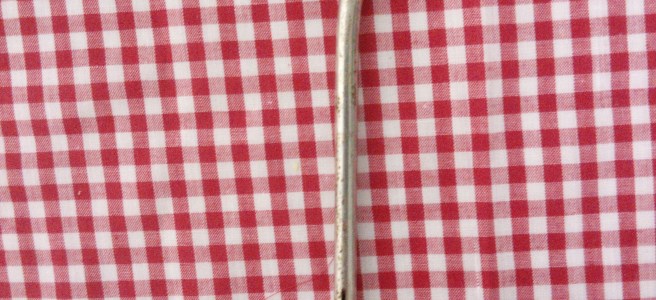
The item, “1 Clef universelle” (shown left), translates as “Sardine tin key”. I recognised its purpose immediately, having grown up with smaller versions welded to such tins. Searching the supermarkets, we are yet to find a tin without its own ring-pull. We’ll hunt the specialty shops.
Many of us enjoy cooking, especially with good produce, and perhaps with a glass of wine. But why do human-beings cook in some anthropological sense? Why could James Boswell call Homo sapiens the “cooking animal”?
For such a fundamental question, it has been left surprisingly unanswered. Too often, cooking has been ignored as “women’s work”, “drudgery”, “leisure” or “indulgence”. For too long, scholars went along with Plato’s warning against cooking as pandering.
Anthropologist Claude Lévi-Strauss might have written about the “raw” and “cooked” in the 1960s, but somewhat mysteriously. Cooking expressed human cultural structure, or something. Still, he started gastronomic reflections on the slow road back to academic respectability.
In recent years, two books have promoted versions of what might be termed a “transformational” theory of cooking. Where Lévi-Strauss saw cooking as a “language”, evolutionary biologist Richard Wrangham wrote about the energy advantages of cooking as a form of pre-digestion. His Catching Fire: How cooking made us human (2009) thus aligned with the dictionary meaning, “to prepare (food) by heating”. Heat transforms raw ingredients to make them more digestible in Wrangham’s case, or possibly also tastier or more expressive. As the subtitle indicates, Michael Pollan’s Cooked: A natural history of transformation (2013) went along with fire.
The flame is important for me, too, but not as basic as the knife – I often put down the glass of wine to pick up a knife. The knife fits another, and more basic, theory of cooking. This is distributional. According to this approach, the cook’s essential duty is dividing up the food among the diners. This makes the “cooking animal” much older than the fire-maker, taking cooking back to the beginning of the stone age, and the sharp flint.
The importance of food sharing for the human story was the topic of my book, originally published in 1998 and currently available under the title A History of Cooks and Cooking (http://www.press.uillinois.edu/books/catalog/87xzf7wp9780252025808.html ). That’s where others found the Boswell’s “cooking animal” quote, without them always transmitting the beauty of the distributional theory.
The distributional foundations had already cropped up occasionally, and were touched on by Launcelot Sturgeon in his Essays, Moral, Philosophical, and Stomachical in 1822. I’ve since read a claim that Sturgeon might have been the nom-de-plume of Charles Lamb, but, whatever the case, look out for the clever pair of essays, “On the physical and political consequences of sauces” and “On the importance of forming good connexions; and on the moral qualities of the stomach”.
I can see how a transformational theory would appeal especially to anthropologists in their fascination with culture. The refinements are often highly civilising. However, the more social slant of distribution should attract sociologists, and also economists. That’s because the distribution of food at the meal is the concomitant of the distribution of labour. The often-quoted early section of Adam Smith’s Wealth of Nations on the division of labour could hardly by more gastronomic.




 Meals Matter