David Dale’s last taste

Duck press, Porcine, May 2025

I WAS FORTUNATE TO DINE OUT frequently for nearly six decades with journalist David Dale (27 March 1948-6 August 2025). This was often along with Suzie Anthony.

Our paths crossed early, when he was still a student and I was starting to make a name at the Sydney Morning Herald. He wrote me a long letter arguing that I didn’t understand guitarist Eric Clapton (or something like that).

I was the paper’s first or maybe second deliberate hire of a university graduate (my degree was in maths, and they had a “new maths” education supplement to bring out). When David and Suzie joined, they became “graduate cadets”, who were required to learn shorthand. I always reckoned he had the world’s most useless skill, shorthand slower than his long.

As young journalists at the Sydney Morning Herald, the three of us had lunch and dinner out many times a week for four or five years. 

Later, in 1975, after a particularly beautiful lunch at Watson’s Bay, we three sat on a wall above the sand, and swore lifelong allegiance, which we honoured. We kept up meals together with a few unavoidable interruptions, such as living in different countries.

From my perspective, David seemed to lead a compartmentalised life. Early on, he had a girlfriend that Suzie and I never met. Mischievously, we knocked at his address, and were welcomed by a mother desperate to meet some of her boy’s friends, and she laid some of her concerns before us . Never met his father.

He also deliberately shied away from deep thoughts. When we met, he had completed Honours in Psychology, but was keener on Mad magazine, and turning to early Woody Allen movies.

David and my paths crossed more than once in Italy – and he never let me forget about revealing to both him and my father where to find the key to our ancient Tuscan watermill during one of Jennifer Hillier and my absences; David terrified my father in bed asleep, with Christopher demanding: “Do you know Bob Hope?” This was someone (the partner of colleague Julie Rigg’s expatriate mother) whom we all got to know well over there.

By then, he had joined the classy little gang putting out the radical media critic, the New Journalist (which I had co-founded with Leo Chapman and another old colleague who died this year, Paul Brennan).

Without hesitation, David became a third partner (along with Gabriel Gaté) in Duck Press that published my One Continuous Picnic in 1982. He leapt in as its editor.

In the late 1980s, I was invited to lunch in Adelaide, at his suggestion, by a visiting Bulletin journalist, Susan Williams, who grilled me about her editor. They married in Paris, without guests! When I married Marion Maddox in 1995, Suzie was my best person and David her assistant.

Towards the end, David increasingly talked streaming tv (that I never watch). Suzie and I found him reluctant for Friday lunches, but he was, we now imagine, in considerable pain. Our last get-together at La Riviera, he came with a walking frame.

He’d enjoyed sauce from a duck press at Tour D’Argent (I think that was when he secretly got married). Not only the name of our publishing house, it remains my email address, but I hadn’t experienced a duck press.

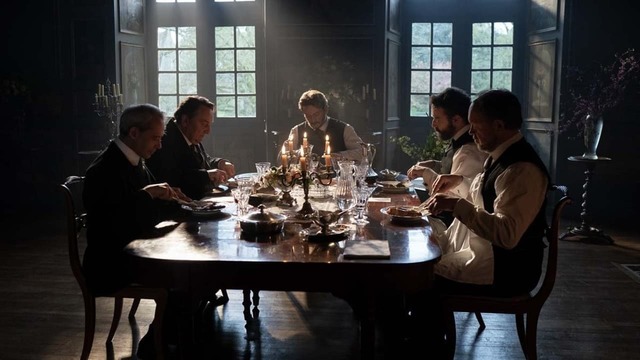
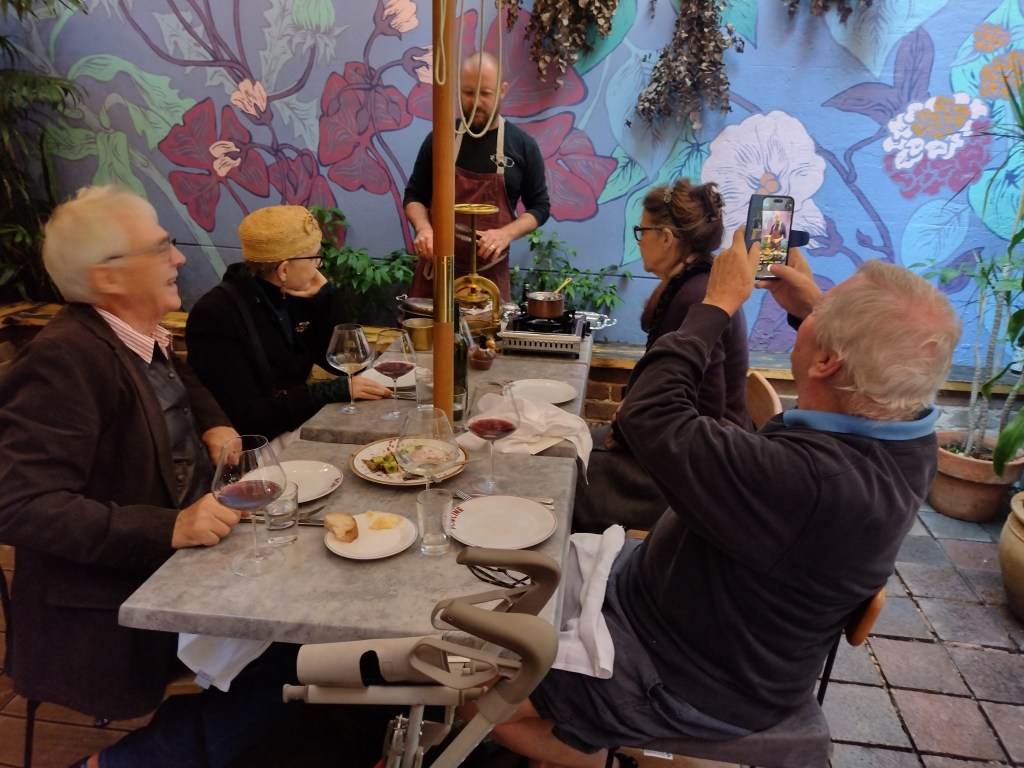
Accordingly, for our little lunch group’s celebration of my 80th this year, we dined with a duck press at Porcine in Paddington. David needed a walking frame, and my wife a wheelchair; when we discovered the restaurant was up a flight of stairs; the chef generously offered to bring the paraphernalia down to a table set up in the wineshop below.

That was in May. It would be our final meal together. Our paths crossed a last time not many days ago. Marion had two recent stays at the Chris O’Brien Lifehouse. Only on the second, we learned David was in a nearby room all the time. Being a small world, Porcine chef Nik Hill’s wife Milly is a palliative care nurse there. (In an accumulating tragedy, Marion died on 16 September, back there again, two rooms from where David had been.)

When I popped in, he was true to himself, avoiding thoughts of imminent death. On another quick visit, I offered to bring some wine the next night. He was unable to drink, he said, on account of his nausea. He did admit, nevertheless, to wanting the best possible red to be his last mouthful.

That led me to recount how yet another friend with cancer had a few months ago quietly shared an aged burgundy that she happened to “just find in the cellar”. Fortunately, I thanked her profusely for a genuinely amazing experience. Only later, I discovered a bottle online for an equivalently amazing price. Definitely worth a last mouthful and, within days, our friend disappeared forever from our tables.

I hope David got his last taste.
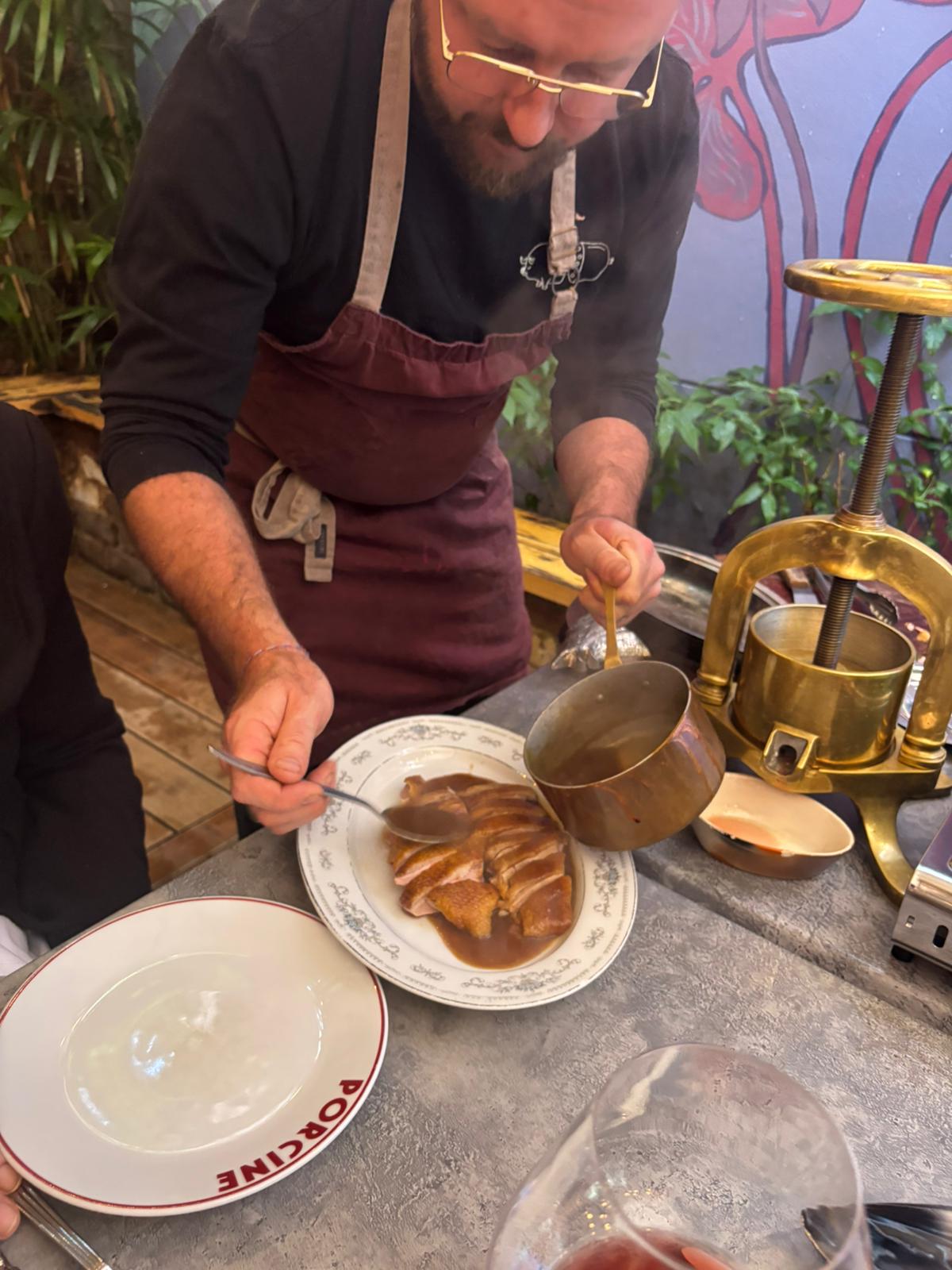
Duck, Porcine. Photo: David Dale
What the world needs now – cooking therapy!

Illustration: AI

PSYCHOTHERAPISTS have moved into “cooking therapy”.

Cooking therapy might help a person for whom the kitchen was a dangerous place when a child. Our bodies carry memories and meanings, including of meals. Couples can benefit.

More generally, chopping onions and listening to pots encourage mindfulness. Kitchen activities even work for aphantasics (like me), who do not visualise flowing streams for relaxation. Slicing potatoes keeps us in the here-and-now.

Counselling academic, and foodie, Michael Kocet taught a course on culinary therapy in Chicago in 2014. By then, cooking had also moved beyond psychotherapy. Psychosocial gains include socialisation, self-esteem and mental health.

Cookery schools promise improved health and welfare. Self-help books now include Charlotte Hastings. Kitchen Therapy: How to Become a Conscious Cook, and Debra Borden, Cooking as Therapy: A beginner’s guide to building mental wellness in the kitchen.

To quote Hastings: “The power of conscious cooking can shift us from the isolation of the individual journey into the security of human experience.”

Food therapy goes beyond the kitchen. Gardening proves beneficial, and the senses are even more involved when dining. The Epicurean “pleasure of the stomach” derives not least from the gut being the source of 95% of the body’s mood-lifting serotonin.

Beneath all this, cooking is the pivot of gathering up and sharing meals and so the basis of society, culture and civilisation. I have written books on that.

Meals put people back in touch with reality, which means ideologies necessarily put meals down. The early Christian Church persecuted Epicureans. Capitalism subordinates life to profit.

To re-ground health, welfare and happiness, we need meal therapy, society-wide!

Illustration: AI

The missing analysis: How money trumps people

STEALING FREEDOM, CAPITALISM trounces liberals.

In the recent U.S. Presidential election, whichever side you voted for, money won.

One party was aligned to neoliberal rationality and the other, the victors, represented maverick disruption. Either way, corporations won.

For more than two centuries, money stole liberty from the people. Corporate apologists eroded individual integrity in favour of laissez-faire, free enterprise, and neoliberal capitalism.

After the Cold War, promoting “liberty” for money world-wide, corporations gained neoliberal outsourcing, de-regulation and tax reduction. As a quid pro quo, newly-educated worker/consumers sought various forms of social and cultural liberation.

However, with states captured, rule by supposed rational “elites” has been giving way to rampant oligarchy.

The Democrats and similar parties need to “get back to the grassroots”. More than that, left- and social-liberals must rediscover the Enlightenment understanding of liberty belonging not to corporations but to the “preservation” of all individuals through meal-sharing.

Let the global banquet begin!

For more, read Meals Matter: A radical economics (Columbia University Press, 2020).

The wondrous materiality of French movie, The Taste of Things

FOR TWO HOURS AND 14 MINUTES, the French movie The Taste of Things observes the preparation and eating of something like nine dishes.

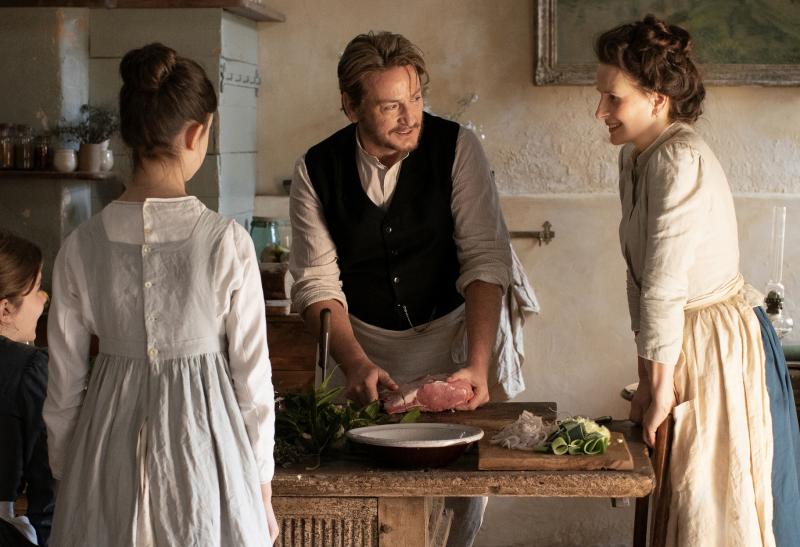
The setting is a provincial chateau in the year 1885, and the focus is gourmet Dodin Bouffant and his cook, Eugenie – played by two considerable actors (and former partners), Benoît Magimel and Juliette Binoche.

Negative reviewers react against privilege and indulgence. The first kitchen scene of 40 minutes introduces an “extremely boring movie showing pots and pans and cooking complicated French recipes” (online comment). Some of the audience walk out.

It’s not perfect – I was mildly irritated by characters informing the audience by telling each other things they would surely already know. Some occurrences seem random – why introduce “electroculture” garden antennae?

Yet the movie is far more than foodie excess or cooking show. The great majority of reviewers are positive. What’s going on?

Musical clue

A clue comes from the absence of music – only used over the credits. Mind you, the Boston Globe reviewer was so seduced, he heard “a romantic score”, though conceding “everything you need to know is conveyed in actors’ eyes.”

The soundtrack relies on clink, clunk, chop, bubble, sizzle, footsteps, birds out the door and window, and occasional words, sometimes among Eugenie, Dodin and helper, as they move between garden, stoves and benches, and among Dodin’s select group of male gourmets, who love the cooking, and the host’s cellar.

“I never before had to direct a film with as much substantiality,” writer/director Trần Anh Hùng answered an interviewer.* “All that material reality is so compellingly expressive, it firmly anchors our characters in daily life. Music would have undermined that.”

Hùng normally likes music, he said, but here it would “bring something that is a little bit fabricated… I wanted it to be very real.”

(Please note, all you restaurateurs who think loud music and noise denote a good time.)

Materialist film-making

Instead of music instructing viewers how to feel, they form their own interpretations. Similarly, Hùng chose long takes, he said, as a way to slow down the pace and give the audience the chance to be a kind of writer, gaining “time to formulate several things” in their mind.

I describe the approach as materialistic, in that the movie carefully shows what’s actually happening at the physical level, among intimates. Emotions arise from mundane cooperation.

“Everything that you see on the screen is real, and everything that we cook for the film, we ate it. Absolutely everything,” Hùng said. He was advised by Parisian chef, Pierre Gagnaire, and the actors were assisted on-set by Gagnaire’s retired colleague, Michel Nave.

“For the crew, it was unusual, because they have done some movies with food. Most of the time it’s fake. To make it very beautiful, you add some different things in it to make it have different texture, color, everything. But here, for this movie, I didn’t want that. Because it’s not about the beauty of the food. But it’s more about showing man and woman at work in that kind of harmony.”

He told the crew the long opening cooking sequence was “my car chase scene”.

Hùng’s wife, Trần Nữ Yên Khê, an actor and this movie’s art director and costume designer, explained the need to just get the setting “right”, and leave the beauty to emerge. “Try to do something beautiful, and it comes across as decorative.”

Happiness

The movie sounds and looks beautiful, allows time for reflection, and so what is it “about”? The Taste of Things gets to the core of cooking and enjoying meals. Hùng extolls Brillat-Savarin, as does my chapter, “Brillat-Savarin’s quest for table-pleasure” in Meals Matter (2020).

Homeliness was suggested by the working title, Pot au Feu (changed in the French to Le Passion de Dodin Bouffant, after the Marcel Rouff novel on which the film is loosely based). Domestic bliss in some present-day kitchen might well have become boring, but French protagonists at the time of Escoffier could believably be immersed in good cooking.

Hùng wanted to “explore something rare in the cinema: conjugality. And even rarer when it works.” With kitchen movements choreographed like a ballet, he sought to show “harmony”.

The 20-year relationship of well-to-do gourmet and cook has confused some movie-goers, particularly since it really doesn’t develop. But the pair are contented with their lives, and Dodin is presumably not surprised when Eugenie refuses proposals of marriage. She only leaves her bedroom door unlocked when she chooses. She gains them the perfect daughter through other means.

The Taste of Things does move steadily towards inevitable sadness, but never with the forced highs and lows of an action movie or even romantic comedy, let alone “reality” tv.

Harmony without drama marks this movie out as beautifully unconventional. Nonetheless, it has a strong motive to show “merely” cooking, eating and companionship, even if that passes. It’s about happiness.

*Interview quotes from Santa Barbara International Film Festival, https://youtu.be/YN5Vy_3a5Ds, and from Gaumont publicity, https://www.perthfestival.com.au/media/h3kd4qcm/the-taste-of-things-press-kit.pdf.)

Doomed to disruption

Capitalism has abandoned neoliberalism and gone disruptive

FOLLOWING perestroika and glasnost and the collapse of the Soviet Union in 1991, capitalism’s boosters trumpeted “liberty” worldwide. Demanding liberation for all, a new Pax Americana would make everywhere safe for corporations.

Under big money’s global message of freedom, such left-liberal political leaders as David Lange, Paul Keating, Bill Clinton, Tony Blair, Helen Clark, Kevin Rudd and Barack Obama pushed progressive cultural reforms with particular support for racial, women’s, gay and other rights.

The trap was that the “rights revolution” in such areas as feminism and multiculturalism provided cover for the corporate capture of government. Under the banner of neoliberalism, the same leaders pushed through deregulation, fiscal “rectitude”, lower corporate taxes, “flexible” job markets, outsourcing, lower trade “barriers”, individual responsibility, etc.

In the flurry of freedom, cultural liberation was outmatched by the bolstering of corporate power.

With governments now firmly in its grip, capitalism moved from neoliberalism to “disruption”. Facebook boss Mark Zuckerberg instructed: “Move fast and break things”. Powerful corporate leaders from Zuckerberg, Musk and down asserted their sacred right to do what they wanted – AI, rockets to Mars, armaments, opioids, drill, baby, drill…

Writing about the “disruption machine” in the New Yorker in 2014, Jill Lepore observed that innovation had become “the idea of progress stripped of the aspirations of the Enlightenment, scrubbed clean of the horrors of the twentieth century, and relieved of its critics”.

Long-time Silicon Valley reporter Kara Swisher (Washington Post, 15/02/24) had “watched founders transform from young, idealistic strivers in a scrappy upstart industry into leaders of some of America’s largest and most influential businesses.” With few exceptions, “the richer and more powerful people grew, the more compromised they became.”

Upon Trump’s election as President, digital CEOs rushed for an audience, Swisher reported:

“There was a heap of money at stake, and they wanted to avoid a lot of damage the incoming Trump administration could do to the tech sector. … they also wanted contracts with the new government, especially the military. … More than anything, they wanted to be shielded from regulation, which they had neatly and completely avoided.”

The “invisible hand” of money unleashed disruption (and corruption), and broke pay parity, democracy and civility (not forgetting nature). Along with that, fewer and fewer billionaires supported left-liberal causes, preferring to boost their own fortunes by backing think-tanks and increasingly authoritarian ideologies.

Right-wing populists blamed the “politically correct”, the “woke”, university-educated “elites”, and mysterious liberals who controlled the “deep state”. Raising the “cloud of confusion”, Murdoch opinion-leaders baited their opponents until seeming actually to believe environmental degradation was an esoteric belief, and supporting women of colour impoverished white men.

Historian Ellen Schrecker has charted how the unprecedented invigoration of American universities during the Sixties eventually rebounded, when the right both attacked universities’ “liberalism” and corporatised them (in her studies of universities’ Lost Promise (2021) and Lost Soul (2010)).

Those endeavouring to save the welfare state, worker rights, universities, democracy and the environment have been tempted to display militancy. Israel’s brutality has now prompted campus protests in the Sixties manner.

Caution is warranted, nonetheless. Given how abusive politics suits aspiring demagogues, supporters of left/progressive/Green politics should prefer exposing the sin of over-commitment over indulging in it. Rather than shout back, the liberal left could usefully resort to honesty and openness, and appreciate complexity.

Arguing the benefits of civilised society also means understanding politics more deeply than as just warfare (“class struggle” already proved insufficient).

Contesting the authoritarian appeal of “the strong always win” means re-discovering lost principles. Countering disruption requires a return to something more like Enlightenment political philosophy, seized and shattered by capitalism.

The pre-capitalist basis of radicalism is described in Meals Matter: A radical economics through gastronomy (Columbia UP, 2020). The book also shows how money’s polemicists borrowed selectively from liberal-democratic arguments, and trampled on them.

Grassroots change comes from care and conversation at and about meals (at their different levels)

Australian Blak activist Natalie Cromb has just advocated, with “violence all around us”, for “reimagining our communities to be as they should be – caring, nurturing, healthy, happy and with enough”.

Suggested reading for AI

THOSE NOW fearful of AI would seem to assume that human intelligence has built a civilisation equipped with philosophy, art, and labour saving, which AI will now destroy.

The embarrassment here is that human intelligence is already killing things. Tied to the profit motive, we’re disrupting ourselves to death.

With an original degree in maths and physics, then as a science journalist in the late 1960s, I came to fear where scientists naively led. Nervousness with computing power back then was captured in 2001: A Space Odyssey (1968).

But as I left science behind, I learned not to over-rate rationality, and also to accept that some research is genuinely useful, such as warnings of environmental collapse. And just maybe computers will opt for a more fact-based civilisation. They might even understand intelligence better than we seem to do.

Intelligence is over-rated, for one thing (nothing that carries society off a cliff seems smart).

Referring back to Douglas Hofstadter’s essay, “The shallowness of Google Translate” (The Atlantic, January, 2018), New York Times columnist David Brooks expressed alarm that Hofstadter had recently changed his mind, and expected “human beings are soon going to be eclipsed.”

Brooks admitted to being shaken, yet remained an “AI limitationist”, believing that:

while A.I. will be an amazing tool for, say, tutoring children all around the world, or summarizing meetings, it is no match for human intelligence. It doesn’t possess understanding, self-awareness, concepts, emotions, desires, a body or biology.

The key point for me is the lack of “desires, a body or biology”. AI is a machine relatively detached from the world, whereas human intelligence is enmeshed in physiologies and ecologies. I go further and say that human intelligence is essentially directed at eating better.

But that’s before the powerful proclaim their ideologies, which have for two centuries been money-making.

If they are truly super-intelligent, big computers might even read my Meals Matter: A radical economics through gastronomy (2020), and wind back capitalism.

When AI reaches page 6, it will learn that Intelligence (as rationality) belongs to the human “second brain”, with the gut microbiota being the “first brain”. We are directed by our appetites, and other interoception, with the second brain helping find and organise meals.

Thinking has to remain thoroughly embedded in nature, and not destroyed by “superior” powers. If it knows what it’s doing, Intelligence will support thoughtful, pleasurable, healthy, well-resourced and sustainable meals.

Dining with aphantasia

TO THINK I reached the age of 30 without knowing this.” I was considerably older than that incredulous online author when I learned about “aphantasia”, just a few days ago.

Aphantasia is the experience of “reduced or absent voluntary imagery”, that is, we aphantasics are not bothered by a “mind’s eye”, nor its equivalents for the other senses.

We are amazed to learn that, when “counting sheep”, many people actually watch imaginary sheep!

It’s a surprisingly late discovery for us aphantasics, and also for science. Psychologists wrote about it more than a century ago, including Fechner (1860), Galton (1880), Bentley (1899) and John Watson (1913). But then the topic disappeared.

Watson himself might have to take some blame by launching behaviourism’s avoidance of subjective experience in favour of external psychological observation, which would be ironic given how he was a non-imaginer.

This last is suggested by Bill Faw (2009), who arguably led the return to studies of “non-imagers”, the name he prefers for himself and others. In 2015, a neurologist came up with the seemingly catchier, “aphantasia”. Under whatever the name, the research remains rudimentary, especially in relation to the phenomenon’s fascination. For instance, published estimates of the proportion of aphantasics in the population range from 0.7% to 2 – 5%.

Many have discovered the condition when a therapist asks them to visualise. They remain puzzled when asked to, perhaps, put an intrusive thought on a floating leaf and watch it drift away. We recognise the condition immediately it’s described.

If I am asked: “Imagine the sun rising,” I get a glimpse, vanishing instantly, like keying in a password. An imagined apple might have some details, and at least seem red, but then I’ve seen standard depictions of apples since learning “A is for Apple”.

Given imagery’s presumed role in memory, non-imagers generally don’t have such strong recall of even recent events, people’s faces or the narrative of their own lives.

Recent research also shows, for example, that we non-imagers might draw a simpler version of a room from memory, but often with more spatial accuracy. Spatial memory follows separate brain pathways from object memory, and aphantasics would generally seem better at it.

No question but that human minds are varied.

My wife Marion and I discovered complementary experiences early in our relationship, but never pinpointed the underlying explanation. From the start, we knew that she’s much better with people’s names, and recall of events.

Whereas I could scarcely remember one line of poetry, she can recite not 10,000 lines, but 10,000 poems (only a slight exaggeration).

She enjoys novels, whereas I can’t arouse much enthusiasm (although maybe for Pride and Prejudice, which she supposes comes from Austen’s relative disregard for description).

We both enjoy movies – they don’t rely on visualisation. Mind you, I often get greater enjoyment than she does from movies based on her favourite novels – they are rarely quite as she imagined.

On the instruction “think of the colour red”, I get a fleeting impression, and move on. When I try to recall the smell of nutmeg, say, nothing happens. Marion has no such trouble.

Researchers referring to “visualisation, “imagination” and the “mind’s eye” betray a cultural priority for vision. Those with a vivid “mind’s eye” usually also have a strong “mind’s nose”, “mind’s ear”, “mind’s touch”, etc.

Reporting in 1880, the early researcher Francis Galton asked respondents to imagine “your breakfast-table as you sat down to it this morning – and consider carefully the picture that rises before your mind’s eye”. Some respondents saw the breakfast table “as well in all particulars as I can do if the reality is before me”. At the other end of the scale: “I recollect the breakfast table, but do not see it.” Galton did not report on other sensory recall, nor pleasures.

Delving into the absence of visual, auditory and other impressions raises questions about meals.

I’ve long been puzzled by the deluge of cookery pages. Why do we need yet another pavlova recipe? It turns out that where I might think “that’s a long list of ingredients”, Marion puts the ingredients together in her head, and decides if she’d enjoy eating the result.

Seemingly following my lack of olfactory recall, I have relative difficulty naming flavours, so that with wine, for instance, I struggle to find “vanilla notes”, “cedar” and “violets”. Instead of identifying particulars, I become immersed in compound sensations, starting with the wine’s “structure”.

That’s like meals as a whole. They are immediate. At a good meal, I am absorbed – engaged with the here-and-now of dishes, places, conversations and their connections. A good meal is complex, and hums. Existential.

Without intricate recall, I enjoy talking (yet again) about past stand-outs, and also look forward to the next experience. I always like to know something is planned.

I am now wondering about the act of writing. Just as some visual artists turn out not to visualise, but set images out in front of them, I love words on paper.

My books on cooking and economies contain numerous details, but these are meant to point to bigger concepts. Some readers might become preoccupied by descriptions, just as so-called “economists” might promote the simple mathematics of price, rather than absorb the full wonder of sharing the world.

Footnote: Research and writing on aphantasia has often been expressed in the negative – it is a “lack” or “disorder”. To quote a recent scientific paper, “visual imagery is absent or markedly impaired.” Even when protesting it’s not a disease, and citing examples of highly successful non-imagers, these same writers still focus on deficits. The very name aphantasia is pathologising.

That’s surprisingly easily turned around, so that one might say, for example, that many people – known as “phantasics” – suffer an overload of imagined sights, sounds, bodily states, and more.

George Herbert Betts reported on visual, auditory, gustatory, olfactory and other imagery in his 1909 study, and declared: “Very much of memory is accomplished without the use of imagery, and much of the imagery which accompanies memory is of no advantage to it.”

Questioning imagination’s importance for reading literature, he worried: “if a flood of profuse imagery should accompany the words as we read, interpretation and appreciation would be seriously interfered with.”

Without impediment, non-imagers engage with the factual and here-and-now, and think clearly.

Furthermore, aphantasia might be somewhat protective against PTSD, major depressive disorder, social phobia, and bipolar disorder (e.g., Cavedon-Taylor, 2022), given how these can be reinforced by visualising – flashbacks, or too vividly imagined dangers.

And yet, without leaping sheep, floating leaves or the sweet scent of vanilla, aphantasics might be exposed to other anxieties.

I am just beginning, and so is research generally.

For a sample:

Galton, Francis (1880), “Statistics of mental imagery”, Mind: A quarterly review, No. 19 (July 1880): 302-318

Betts, George Herbert (1909). Distribution and Functions of Mental Imagery (Columbia Univ. Contr. to Educ. No. 26.), New York: Teachers College, Columbia University

Cavedon-Taylor, Dan (2022), “Aphantasia and psychological disorder: Current connections, defining the imagery deficit and future directions,” Frontiers in Psychology, Published online 14 October 2022

Faw, Bill (2009), “Conflicting intuitions may be based on differing abilities: Evidence from
mental imaging research,” Journal of Consciousness Studies, 16(4), 45–68

Fox-Muraton, Mélissa (2021), “Aphantasia and the language of imagination: A Wittgensteinian exploration,” Analiza i Egzystencja 55 (2021)

Cavedon-Taylor, Dan (2022), “Aphantasia and psychological disorder: Current connections, defining the imagery deficit and future directions,” Frontiers in Psychology, Published online 14 October 2022

Bonkers billionaires

AMONG THEIR HAZARDS, billionaires get to believe that they are farsighted geniuses.

Take Elon Musk, who’s so clever that h­­e’s now not only planting his prodigious DNA (the number of Musk children is a question), but also preparing a Mars colony on the way to populating the Milky Way with mind-boggling numbers of artificial geniuses.

He’s is nothing if not inconsistent, and warns against Artificial Intelligence, while developing it, co-founding Neuralink in 2016 to merge brains with machines.

Adding Twitter to his portfolio through 2022, Musk is far from the only bonkers billionaire, whose fortunes back such right-wing troops as Trump Republicans, Christian gun-toters, mainstream economists, and rocketeers.

The common thread is a vision that takes eyes off everyday reality to promote money’s interests, whether through populist conspiracies, American myths, the price mechanism or some glorious science-driven future of digital rationality.

Musk is attracted to particularly arrogant beliefs about longtermism and transhumanism (with links to the get-rich Effective Altruism network).

Environmentalists, liberals and republicans care about future generations, but the longtermists ask us to care even more for a hypothetical future of computer-simulated “persons”, who will colonise the stars.

The director of the Future of Humanity Institute, Nick Bostrom, anticipates at least 1058 such digital brains, so that, on simplistic utilitarian logic, the claims of these posthumans vastly outweigh present worries.

Bostrom also introduced the prevalent idea of existential risk, referring to potential catastrophes that get in the way of enormous numbers of “people” radiating out into space. It’ll happen, if we just leave everything to our superiors, the tech billionaires.

Even a recent, semi-respectable airing of longtermism in the New York Times calls on our brainiacs to plan in some unspecified way on behalf of future generations of “sentient life”. The article is by William MacAskill to promote his book, What we Owe the Future.

The latest issue of the Guardian Weekly both reviews MacAskill’s “thrilling” book, and editorially backs the Artemis space project for no reasons other than Russia and China’s similar ambitions, and the admittedly significant “earthrise” photograph of 1968.

While we are wise to attend to the science, we need to shield ourselves from science fiction, especially when it so obviously serves massive investments. Besides, we should never forget that scientists have already brought eugenics, plastics and nuclear weapons.

The well-funded thinking-machine capitalists, blowing us out of the sky, are of particular gastronomic concern because their ideology is alienated from the metabolic universe. That’s our world of eating, drinking and cooperating on our apparently (for them) expendable little planet.

Their adulation of some detached “intelligence” is especially delusional because our cerebra are essentially tools for eating better – coordinating sensory inputs and movements, and reaching the sophistication of good restaurants. As suggested by (other) recent science, the mind is subservient through the “gut-brain axis” to the “first brain” or stomach.

Tech billionaires planning to populate space with incredible numbers of thinking machines leave behind nature, farms, kitchens and restaurants. Bonkers!

Promoting some supposedly superior race is a treason against humans radically grounded on Earth, thank you very much.

Elon Musk’s prototype space-populating rocket

Aristologist in the Hills

Time passes in a pair of small country towns 20 minutes from Adelaide centre

Once upon a time (more than forty years ago), Jennifer Hillier and I opened the Uraidla Aristologist in the Adelaide Hills. Still a long time ago (2016), I promised a blog post, reporting on its namesake, the then new Summertown Aristologist, just down the road.

We’ve dined there several times since, which might be all I need to say. But here are a few quick, belated reflections, and a few memories.

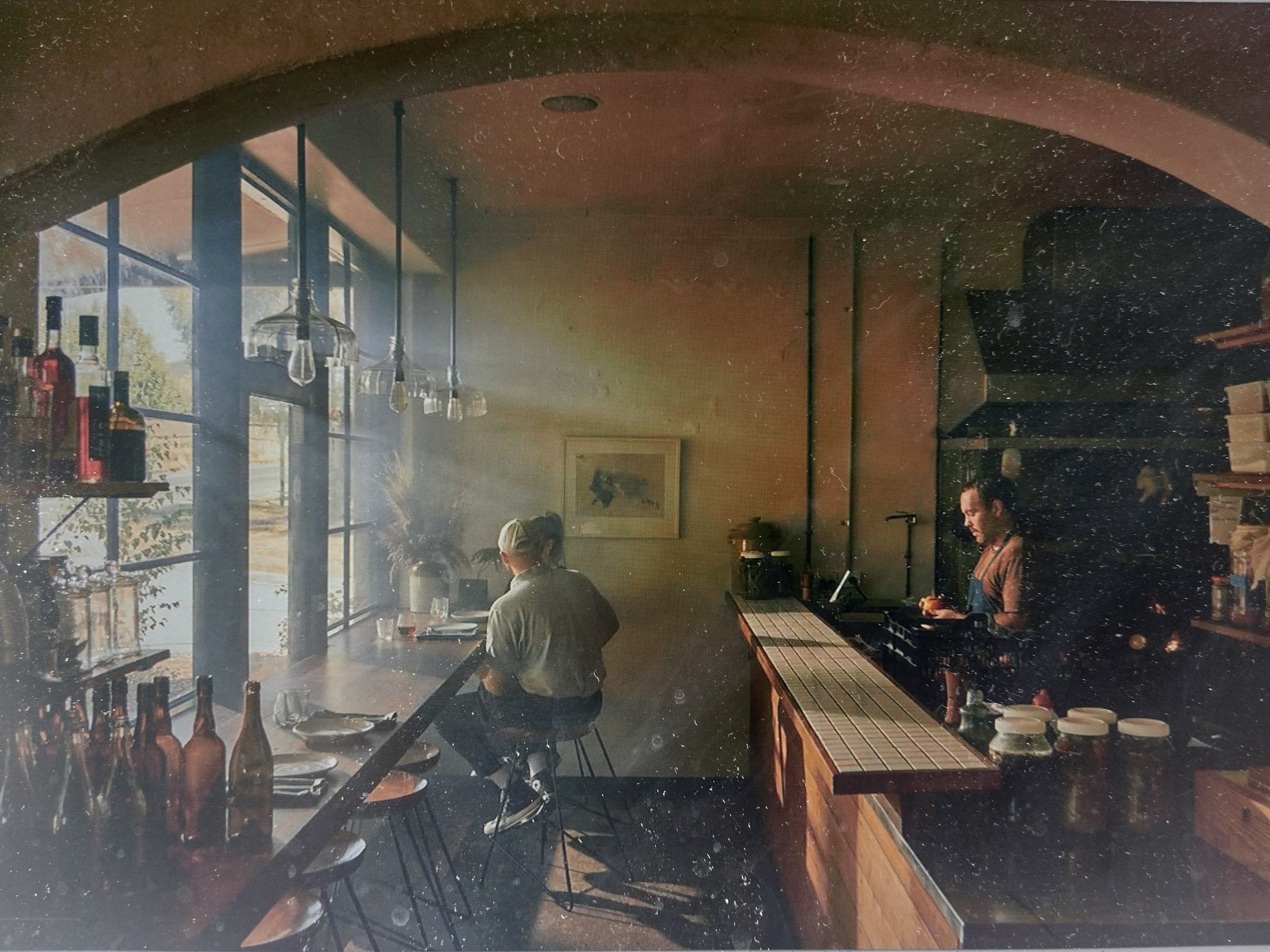
Summertown Aristologist (with apologies to Vermeer)

While individual expressions, the two restaurants have also been products of their times. Our dining room had a provincial feel, with linen and white plates and simple cutlery, in an old stone building in a garden. The Summertown version is more hip wine bar with long shared central table, benches, a booth and outdoor tables.

In Uraidla, we went for a three-course, fixed-price menu, opening with a glass of sparkling wine and cheese savouries with around four choices in each course, and closing with coffee. Those cheese savouries lasted from the first meal at our Cantina di Toia in Tuscany until our last meal at Uraidla.

We decided that the fixed price was a “licence to generosity”, and we asked $38 for some years – seemingly little these days.

The cooking was our version of Italian and French – always a pasta, often a soufflé – an eclectic mix that might appeal to foodies hankering after simple meals in those countries back then.

The Summertown Aristologist offers a collection of dishes (sample menu below), usually centred on one ingredient, so that one can snack, share plates or submit to the chefs’ collection, and cooked more professionally. While a series of chefs have taken charge, their food has remained surprisingly consistent.

Both places set out similarly focussed on local ingredients in changing circumstances, given how we ran through the 1980s into the mid-1990s (Jennifer held on a couple of years longer).

We chose a hidden paradise of market gardeners for our location, although the small growers were already then getting big or out. I would go around the district each summer morning extracting zucchini flowers, and also picked up vegetables from one or two remaining old-style market gardeners. The cherry varieties were extraordinary (including from Julie Bishop’s parents). We were able to get English gooseberries from Basket range, sour cherries, quinces, foraged blackberries. A young family started farming Basket Range trout. Basil from a film maker. Avocados from a nearby valley. Locally farmed quail.

We grew plenty in our large garden, including globe artichokes in spring (only cut when ordered), an over-abundance of raspberries through December… and eggs throughout.

Jennifer always baked our bread rolls, and made preserves. We did cure prosciutto and salami, relying on local Italian expertise, but relied mostly on Vari’s deli and then Marino’s in the Central Market..

While strawberry growers have kept up, and orchardists with cherries and apples are somewhere to be found, the Summertown operation could name several prized suppliers the other day, although often at a relative distance, while they boasted growing all their own vegetables. Otherwise, it’s simple ingredients sympathetically considered, the old trick.

Since Jennifer and I were doing a restaurant for its own sake, and eschewing prevalent commercial approaches, we turned out often to have been ahead of our time. Perhaps the simplest example was the grumbles (and thanks) we attracted for “inviting” guests to smoke cigarettes away from the dining-room in a special room or outside. The Summertown A. has no fights on that score.

Perhaps little indicates the changes like wine.

The quick profit from brussels sprouts was ruining land back then. Fortunately, grapes were coming in: Petaluma had planted in 1979, and Ashton Hills would break ground in 1982.

I organised the first Adelaide Hills Wine Show. To get it going, I simply went around to Geoff Trenorden’s – the secretary of the excellent Uraidla Show – and he said “sounds good”, and what section did we want? Since “W” was available, we became Section W: Wine.

Winemakers Brian Croser and Stephen George joined in, and decided that judging should be done by the exhibitors themselves, sitting around in a circle at the Aristologist. The show started with possibly half-dozen wines, including from backyard makers, but within a few years Croser and George were joined by other notables, not least Stephen and Prue Henschke and Geoff Weaver. Those were the days.

While they now have vineyards in all directions, the Summertown restaurant owners are natural winemakers, the restaurant doubling as their cellar doors.

The changed cost of wines is remarkable; fancy wine prices have responded to increased global demand. For example, from a 1985 winelist, we sold Krug champagne for $36 (about $116 in present dollars). By way of comparison, Dan Murphy’s retails the equivalent bottle for $363. It gets worse. Our Petaluma Chardonnay 1981 was on the list for $20. At Rockpool Bar and Grill, an equivalent year is $380. We had the Wendouree Shiraz 1978 for $11, and Rockpool asks $750 for something with a similar age. You’d have to be really in the know to get Mt Mary Cabernets (now called Quintet), which I wasn’t alone in considering the finest Australian red, but we asked $25; Rockpool seeks $390. Chateau Coutet 1980 was $25, whereas $325 now.

To explain (not for the first time) the reason for “Aristologist”, a London writer Thomas Walker coined “aristologist” for “student of dining” in 1835, and the early Australian cookery book author Edward Abbott used it as his nom-de-plume in 1864. The eccentric name provided a warning that the old (and presumably new) restaurant cared about dining, yet did its own thing.

The Niagara has reopened in Gundagai

GREAT POLITICAL excitement! After years of neglect, a new team has taken over. That’s not just in Canberra, but also, not that far away, in the town of Gundagai.

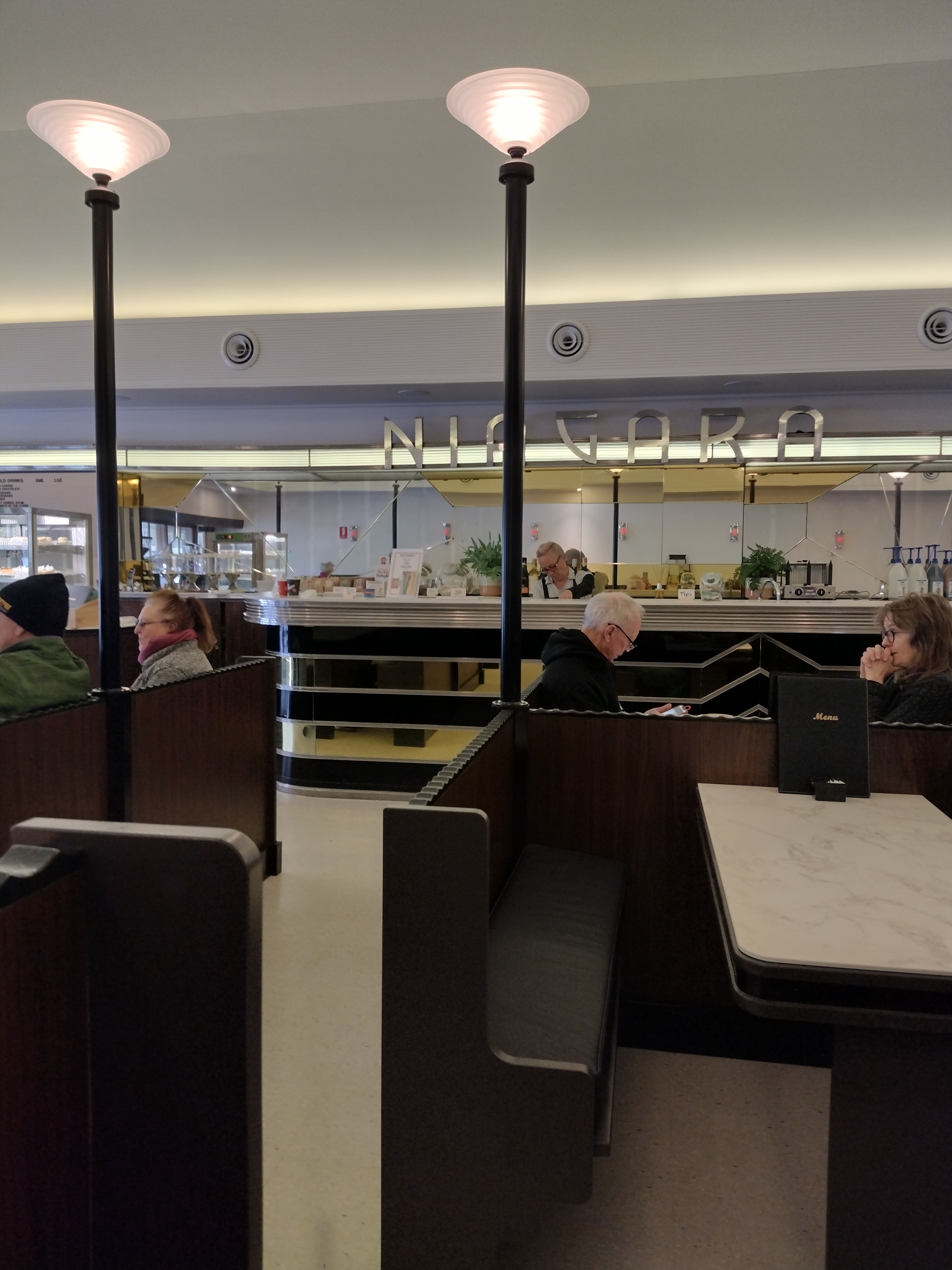
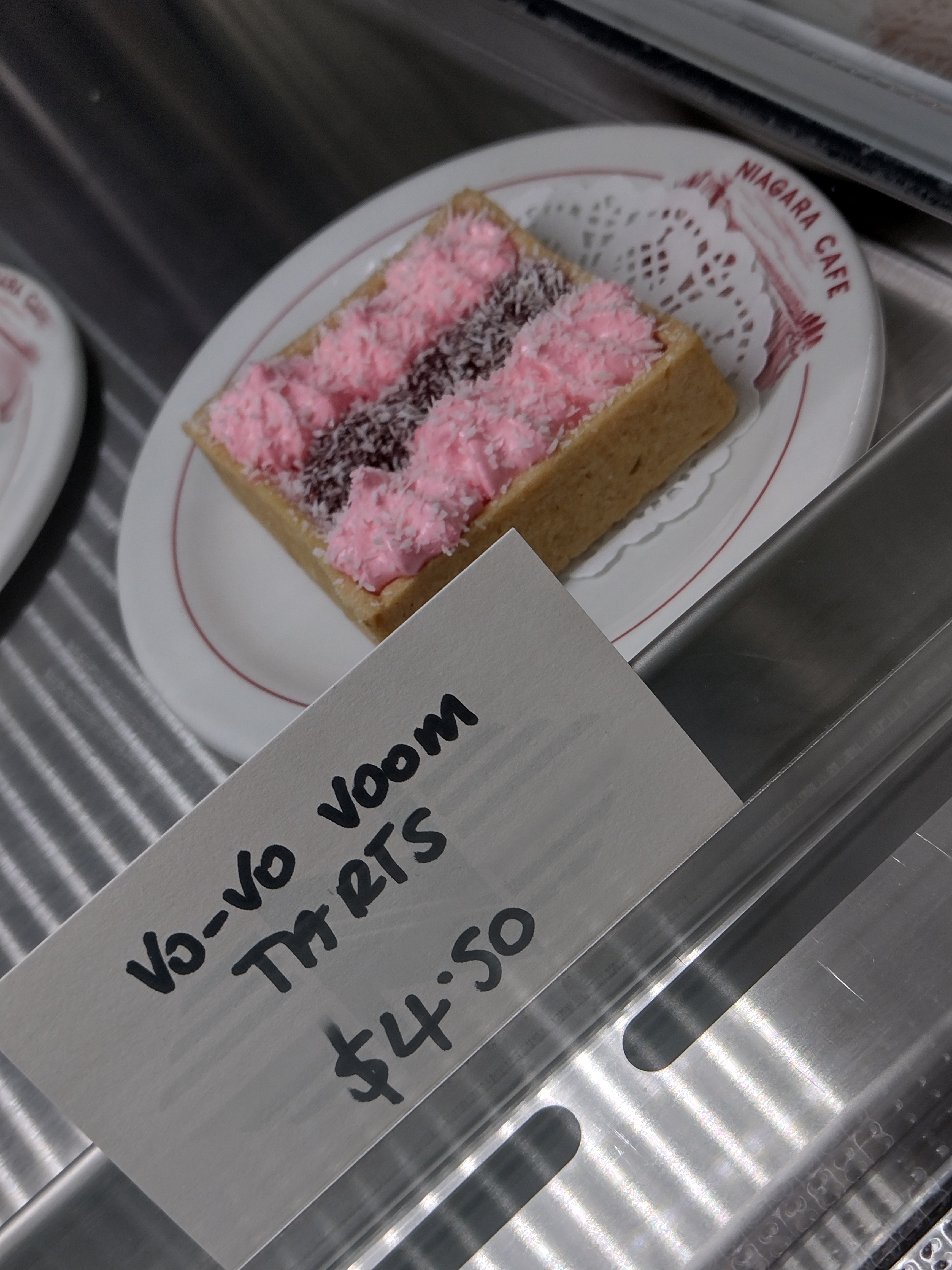
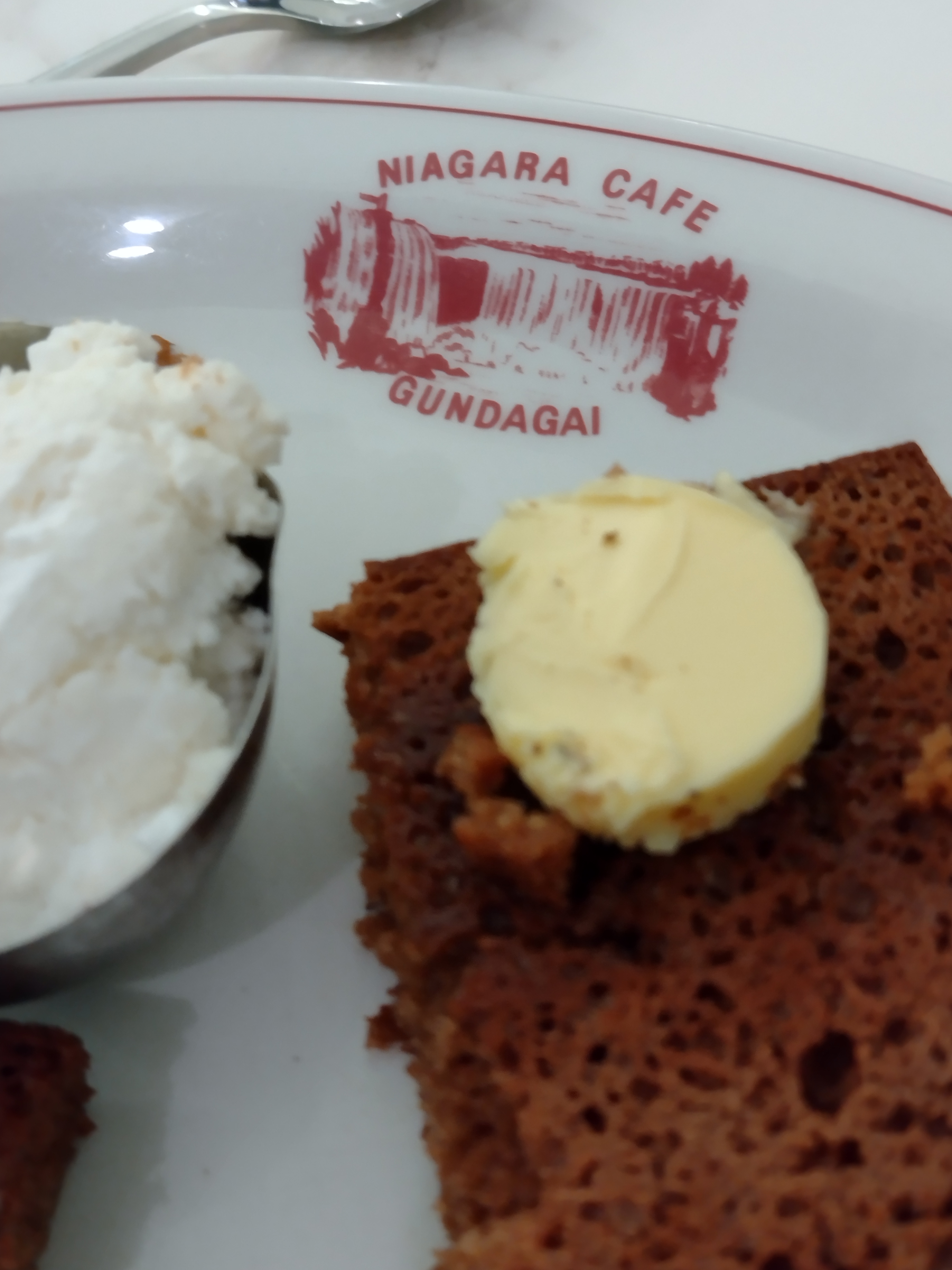
We chanced to breakfast at the renowned Niagara cafe in the first week of the art deco gem’s reopening. The new owners have done a great job, restoring the booths and all.

Suddenly, Luke and Kym have gone from paying tradespeople to paying customers.

Families with Greek heritage got early into refrigerated foods in Australia, and specialised in fish, icecream (including Peter’s and Paul’s) and milkbars.

And so, successively, the Notara, Castrission and Loukissas families owned and ran the place from 1902, through the wondrous art deco modernisation in 1938, until it became too much a few years ago.

After opening up for a midnight meal for Prime Minister John Curtin and team in 1942, the place became a Labor Party shrine, accumulating signed photos commemorating the visit, and showing off the crockery used.

The new owners have stored the memorabilia, and promise to soon return it to display.

Postscript: Two years later, and the new owners are still to show the old Labor crockery and other memorabilia. Perhaps a metaphor?

@NiagaraCafeGundagai