David Dale’s last taste

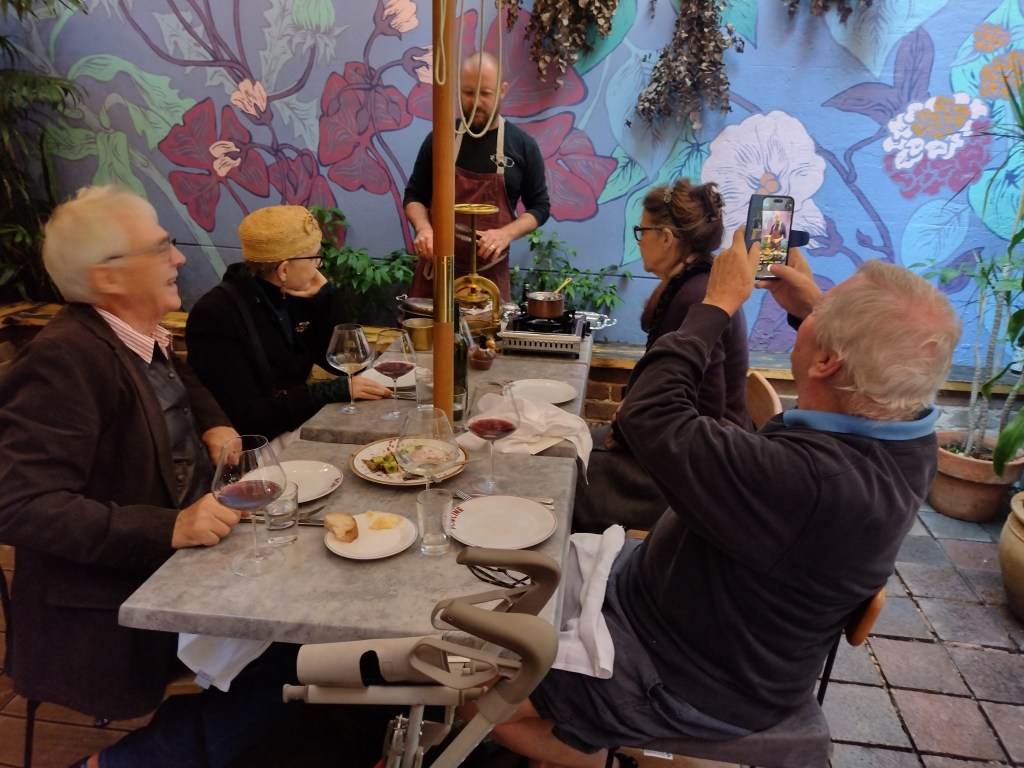
Duck press, Porcine, May 2025

I WAS FORTUNATE TO DINE OUT frequently for nearly six decades with journalist David Dale (27 March 1948-6 August 2025). This was often along with Suzie Anthony.

Our paths crossed early, when he was still a student and I was starting to make a name at the Sydney Morning Herald. He wrote me a long letter arguing that I didn’t understand guitarist Eric Clapton (or something like that).

I was the paper’s first or maybe second deliberate hire of a university graduate (my degree was in maths, and they had a “new maths” education supplement to bring out). When David and Suzie joined, they became “graduate cadets”, who were required to learn shorthand. I always reckoned he had the world’s most useless skill, shorthand slower than his long.

As young journalists at the Sydney Morning Herald, the three of us had lunch and dinner out many times a week for four or five years. 

Later, in 1975, after a particularly beautiful lunch at Watson’s Bay, we three sat on a wall above the sand, and swore lifelong allegiance, which we honoured. We kept up meals together with a few unavoidable interruptions, such as living in different countries.

From my perspective, David seemed to lead a compartmentalised life. Early on, he had a girlfriend that Suzie and I never met. Mischievously, we knocked at his address, and were welcomed by a mother desperate to meet some of her boy’s friends, and she laid some of her concerns before us . Never met his father.

He also deliberately shied away from deep thoughts. When we met, he had completed Honours in Psychology, but was keener on Mad magazine, and turning to early Woody Allen movies.

David and my paths crossed more than once in Italy – and he never let me forget about revealing to both him and my father where to find the key to our ancient Tuscan watermill during one of Jennifer Hillier and my absences; David terrified my father in bed asleep, with Christopher demanding: “Do you know Bob Hope?” This was someone (the partner of colleague Julie Rigg’s expatriate mother) whom we all got to know well over there.

By then, he had joined the classy little gang putting out the radical media critic, the New Journalist (which I had co-founded with Leo Chapman and another old colleague who died this year, Paul Brennan).

Without hesitation, David became a third partner (along with Gabriel Gaté) in Duck Press that published my One Continuous Picnic in 1982. He leapt in as its editor.

In the late 1980s, I was invited to lunch in Adelaide, at his suggestion, by a visiting Bulletin journalist, Susan Williams, who grilled me about her editor. They married in Paris, without guests! When I married Marion Maddox in 1995, Suzie was my best person and David her assistant.

Towards the end, David increasingly talked streaming tv (that I never watch). Suzie and I found him reluctant for Friday lunches, but he was, we now imagine, in considerable pain. Our last get-together at La Riviera, he came with a walking frame.

He’d enjoyed sauce from a duck press at Tour D’Argent (I think that was when he secretly got married). Not only the name of our publishing house, it remains my email address, but I hadn’t experienced a duck press.

Accordingly, for our little lunch group’s celebration of my 80th this year, we dined with a duck press at Porcine in Paddington. David needed a walking frame, and my wife a wheelchair; when we discovered the restaurant was up a flight of stairs; the chef generously offered to bring the paraphernalia down to a table set up in the wineshop below.

That was in May. It would be our final meal together. Our paths crossed a last time not many days ago. Marion had two recent stays at the Chris O’Brien Lifehouse. Only on the second, we learned David was in a nearby room all the time. Being a small world, Porcine chef Nik Hill’s wife Milly is a palliative care nurse there. (In an accumulating tragedy, Marion died on 16 September, back there again, two rooms from where David had been.)

When I popped in, he was true to himself, avoiding thoughts of imminent death. On another quick visit, I offered to bring some wine the next night. He was unable to drink, he said, on account of his nausea. He did admit, nevertheless, to wanting the best possible red to be his last mouthful.

That led me to recount how yet another friend with cancer had a few months ago quietly shared an aged burgundy that she happened to “just find in the cellar”. Fortunately, I thanked her profusely for a genuinely amazing experience. Only later, I discovered a bottle online for an equivalently amazing price. Definitely worth a last mouthful and, within days, our friend disappeared forever from our tables.

I hope David got his last taste.
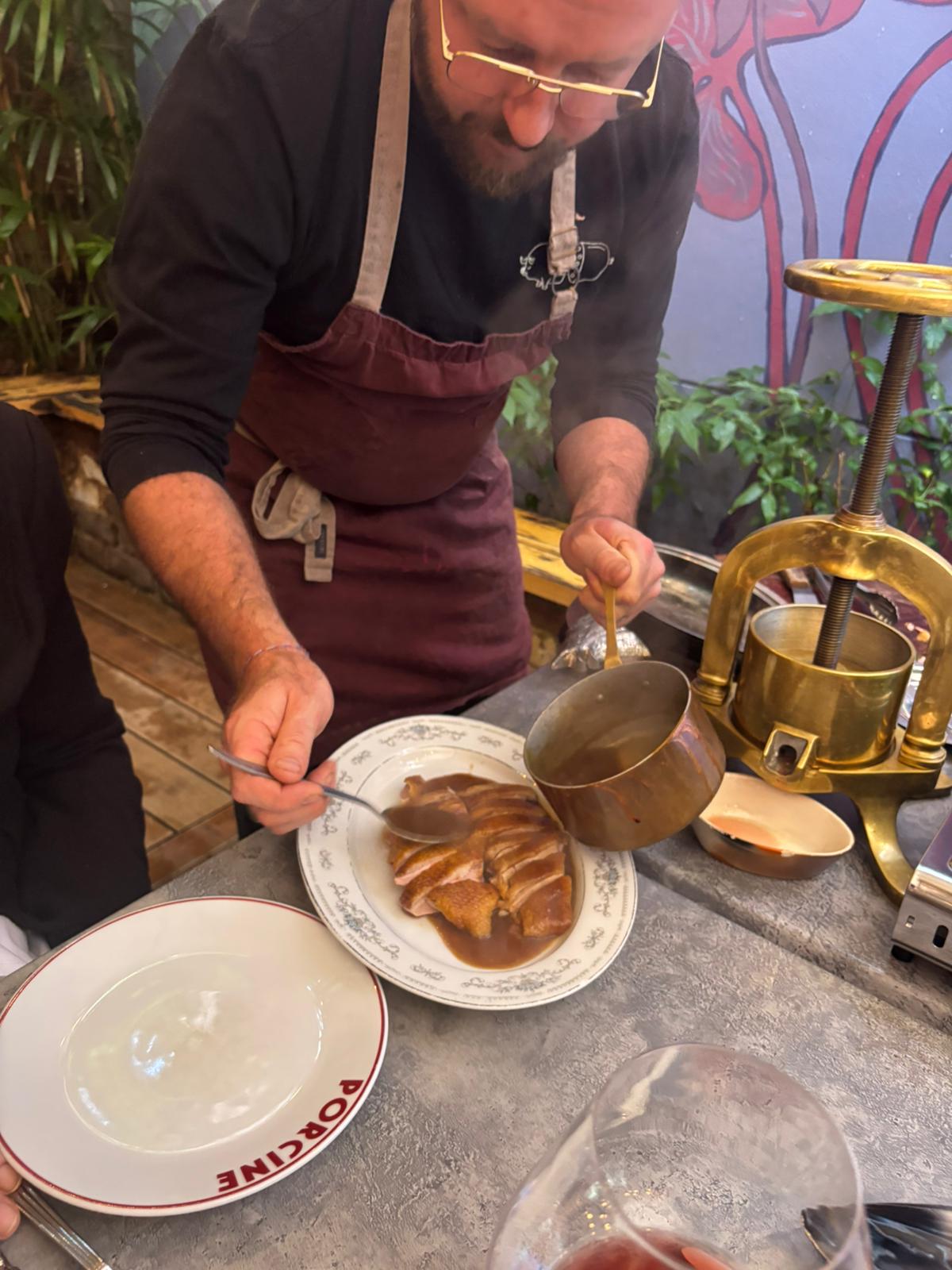
Duck, Porcine. Photo: David Dale
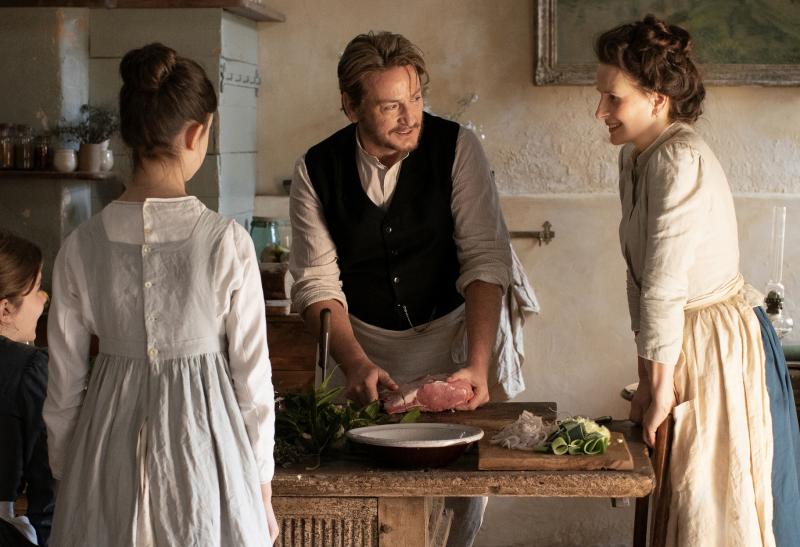
The wondrous materiality of French movie, The Taste of Things

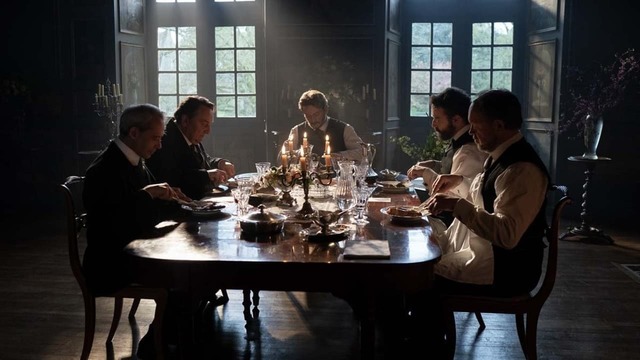
FOR TWO HOURS AND 14 MINUTES, the French movie The Taste of Things observes the preparation and eating of something like nine dishes.

The setting is a provincial chateau in the year 1885, and the focus is gourmet Dodin Bouffant and his cook, Eugenie – played by two considerable actors (and former partners), Benoît Magimel and Juliette Binoche.

Negative reviewers react against privilege and indulgence. The first kitchen scene of 40 minutes introduces an “extremely boring movie showing pots and pans and cooking complicated French recipes” (online comment). Some of the audience walk out.

It’s not perfect – I was mildly irritated by characters informing the audience by telling each other things they would surely already know. Some occurrences seem random – why introduce “electroculture” garden antennae?

Yet the movie is far more than foodie excess or cooking show. The great majority of reviewers are positive. What’s going on?

Musical clue

A clue comes from the absence of music – only used over the credits. Mind you, the Boston Globe reviewer was so seduced, he heard “a romantic score”, though conceding “everything you need to know is conveyed in actors’ eyes.”

The soundtrack relies on clink, clunk, chop, bubble, sizzle, footsteps, birds out the door and window, and occasional words, sometimes among Eugenie, Dodin and helper, as they move between garden, stoves and benches, and among Dodin’s select group of male gourmets, who love the cooking, and the host’s cellar.

“I never before had to direct a film with as much substantiality,” writer/director Trần Anh Hùng answered an interviewer.* “All that material reality is so compellingly expressive, it firmly anchors our characters in daily life. Music would have undermined that.”

Hùng normally likes music, he said, but here it would “bring something that is a little bit fabricated… I wanted it to be very real.”

(Please note, all you restaurateurs who think loud music and noise denote a good time.)

Materialist film-making

Instead of music instructing viewers how to feel, they form their own interpretations. Similarly, Hùng chose long takes, he said, as a way to slow down the pace and give the audience the chance to be a kind of writer, gaining “time to formulate several things” in their mind.

I describe the approach as materialistic, in that the movie carefully shows what’s actually happening at the physical level, among intimates. Emotions arise from mundane cooperation.

“Everything that you see on the screen is real, and everything that we cook for the film, we ate it. Absolutely everything,” Hùng said. He was advised by Parisian chef, Pierre Gagnaire, and the actors were assisted on-set by Gagnaire’s retired colleague, Michel Nave.

“For the crew, it was unusual, because they have done some movies with food. Most of the time it’s fake. To make it very beautiful, you add some different things in it to make it have different texture, color, everything. But here, for this movie, I didn’t want that. Because it’s not about the beauty of the food. But it’s more about showing man and woman at work in that kind of harmony.”

He told the crew the long opening cooking sequence was “my car chase scene”.

Hùng’s wife, Trần Nữ Yên Khê, an actor and this movie’s art director and costume designer, explained the need to just get the setting “right”, and leave the beauty to emerge. “Try to do something beautiful, and it comes across as decorative.”

Happiness

The movie sounds and looks beautiful, allows time for reflection, and so what is it “about”? The Taste of Things gets to the core of cooking and enjoying meals. Hùng extolls Brillat-Savarin, as does my chapter, “Brillat-Savarin’s quest for table-pleasure” in Meals Matter (2020).

Homeliness was suggested by the working title, Pot au Feu (changed in the French to Le Passion de Dodin Bouffant, after the Marcel Rouff novel on which the film is loosely based). Domestic bliss in some present-day kitchen might well have become boring, but French protagonists at the time of Escoffier could believably be immersed in good cooking.

Hùng wanted to “explore something rare in the cinema: conjugality. And even rarer when it works.” With kitchen movements choreographed like a ballet, he sought to show “harmony”.

The 20-year relationship of well-to-do gourmet and cook has confused some movie-goers, particularly since it really doesn’t develop. But the pair are contented with their lives, and Dodin is presumably not surprised when Eugenie refuses proposals of marriage. She only leaves her bedroom door unlocked when she chooses. She gains them the perfect daughter through other means.

The Taste of Things does move steadily towards inevitable sadness, but never with the forced highs and lows of an action movie or even romantic comedy, let alone “reality” tv.

Harmony without drama marks this movie out as beautifully unconventional. Nonetheless, it has a strong motive to show “merely” cooking, eating and companionship, even if that passes. It’s about happiness.

*Interview quotes from Santa Barbara International Film Festival, https://youtu.be/YN5Vy_3a5Ds, and from Gaumont publicity, https://www.perthfestival.com.au/media/h3kd4qcm/the-taste-of-things-press-kit.pdf.)

Chop Chef, kitchen opera

A phantasmagorical opera about internet-charged cooking at the end of capitalism, how could I refuse?

Directors of Blush Opera (top to bottom): Luke Spicer, Jermaine Chau and Paul Smith

INEXPLICABLY, many friends “don’t like opera”. But they should have joined the audience for the final of only four performances of chamber opera Chop Chef at the Riverside Theatres, Parramatta, last Saturday.

Edging in age towards 30, the crowd might not have interspersed earnest applause with the occasional “brava”, but they whooped and stomped. More the Globe idea.

Surely Blush Opera (@blushopera) will arrange a further season of their competitive cooking show in song. I’d go again – this culturally-rich triumph demands more than one viewing.

Described as “clash of a highbrow form with lowbrow reality TV tropes and everyday language”, Chop Chef brings together seven great, mainly young singers and four-piece orchestra (clarinet, flute, cello and piano), conducted by Luke Spicer. 

The music is by Paul Smith, who is a senior lecturer in composition at the University of New England, an expert on anime and manga, and composer for toy piano. The libretto belongs to Julie Koh (@juliekoh), a satirical short-story author. Born in Sydney to Chinese-Malaysian parents, Koh studied politics and law, then quit a corporate law career to pursue writing, luckily for us.

The setting in a cooking competition studio allows extended fun with not just culinary obsession and television “reality”, but also racial and sexual stereotypes, and operatic musical forms with extended arias, satisfying choruses, and women, and the world, dying at the end.

True to both opera and tv formats, the six competitors reveal their back stories and dreams, and are “eliminated” in turn, each with a farewell aria. You might get a bit of the feel from “Studio 10”.

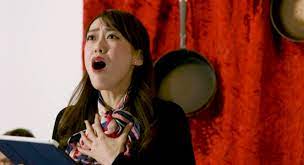
As to the characters, a successful, slim, Lean In corporate feminist with single-minded mottoes, Victoria (coloratura soprano Ayako Ohtake) returns as last year’s winner of Chop Chef. The “kawaii” Kitty (mezzo-soprano Jermaine Chau) has arrived in Chatswood via Happy Valley (a well-to-do suburb of Hong Kong, and racecourse). Her sob story is being born colour-blind, but now saved by her guide dog, a labradoodle. Kitty specialises in Hello Kitty milkshakes, refers to others as “babes”, and is doing it all for her labradoodle.

Kale (baritone Nick Geddes) is a Byron Bay influencer, whose form of address is “bruh”, and whose kale smoothies will put him in the league of other great inventors, such as Elon Musk. Andy (tenor Gavin Brown) is the “Asian fetishist”, who falls immediately in love with Kitty, and whose ambition is to take Asian fusion to the East. From Finland, Tom (bass-baritone Benjamin Caulkwell) is a gay, misogynistic lumbersexual into meat. Behind his deli door, the music will be pumping. Renée (soprano Lisa Cooper) is into vintage dresses and baking to make others happy, and sadly a loser, whose soufflé fails to rise (she does return glamorously in fascinator for the final bows, when we could have kept stomping and applauding).

The three stern judges, projected like Big Brother onto screens, are sung by the one baritone (David Hidden) in three different facial-hair disguises, and delightful accents.

The libretto carries far too many cultural references for any single audience member to pick up. It’d mean knowing cookery terms, millennial identities and their jargon, Puccini, Adam Smith, the tribulations of late capitalism, hedonistic philosophy, and no doubt stuff I didn’t even recognise. I did appreciate the transformation of Madama Butterfly into the “Asian fetishist”, who has discovered Nagasaki, and awaits his thankless lover’s return.

Rather than repeat lines, as usual in opera, the libretto keeps moving, constantly throwing off allusions and jokes. One extended aria concerns turducken, with animals swallowing animals, until the fly has to find its way out of the whale. The judges set a challenge to cook an authentically authentic dish – declared to be authentically authentic Italian. This is the occasion for a long operatic burlesque, hilariously stringing together every Italian word you’ve ever heard.

That verbal intensity could have left the music merely as backing, with little chance for a tune, but Smith has the confidence to more than hold his own, surely thrilled at the commitment and skill of all musicians and singers.

The wonderful singers can even act without hamming it up, presumably because they so readily related to the show’s content, and also to the credit of the directors of the seemingly flawless whole, Kenneth Moraleda and Nicole Pingon, and team.

I’ve possibly laughed more at the theatre, been moved by operas more, found topical revue more telling, but for up-to-the-minute laughs, sentiment, and satire… Chop Chef cries out for a new season.

Ayako Ohtake (soprano)

They died for this

RSL hamburgerThe other night I commemorated the anniversary of my conscientious objection case. This was a court hearing to determine that I actually held beliefs that prevented me from being conscripted for the Vietnam War. It was a while ago, but as you might imagine, trying to establish beliefs under cross-examination jolted me enough not to forget (existential threat does not permit complexities).

The alternatives of win or gaol loomed so large that, even three decades later, an exhibition on so-called National Service at the Australian archives in Canberra just made me laugh. For there was the tiny wooden Tattersall’s gambling casket from which they drew our life-and-death birthday marbles. And there was a typewritten letter from Minister for the Army Malcolm Fraser sending off young people with corrections scrawled in pen.

The other night was the anniversary of the day we were summoned back to hear the magistrate’s verdict on the evidence provided by me and two witnesses. My father Christopher and uncle Lawrence confirmed talking to me over the years about the issues. Both had fought in WWII, my father still saying it had been the right thing to do, and his brother believing he should have refused.

I have previously written that their father (my grandfather Alex) departed London for South Australia, never to return, based on his trench warfare experiences. Mind you, the strength of my views probably came even more from my mother; with two brothers and young husband away, she suffered at home.

Several supporters had warned against appearing without a lawyer, especially in front of a magistrate who by then had a string of knock-backs to his name. But I was only 20.

On that day, the magistrate entered, summarised my case, stopped, and, without mentioning anything asserted by the newbie barrister challenging me, found my case justified, and left the courtroom. I remain convinced he changed his mind half way through his prepared statement.

I was not going to gaol for refusing to train to kill. I was not, like so many peers, to

containment

participate directly in death and destruction. Instead, my father took us out to dinner at the Fiddlers Three in Cremorne, where I was allowed to order anything I wanted – duck à l’orange and chocolate mousse.

On this anniversary, with my usual dinner companions at the Hannah Gadsby show (confronting in a different way), what was I to do? Celebrate alone at home with a bottle of red?

In the end, I decided to try the nearby Returned Services League club…

The club is decorated with medals, and a Tasmanian artist’s depiction of various WWI soldiers doing their thing (set number 962 of a run of 1000 prints). A glass case inside the entrance displays a book, whose pages would seem to be turned every two days to name soldiers to be remembered.

And the club has lots of poker machines, and bright lights and jangling sounds. Originally, at such clubs, ex-soldiers recalled dead comrades, but gambling facilities have subsidised expansion into mini-Trump casinos. Members, including presumably now even former enemies, can lose themselves in spinning images.

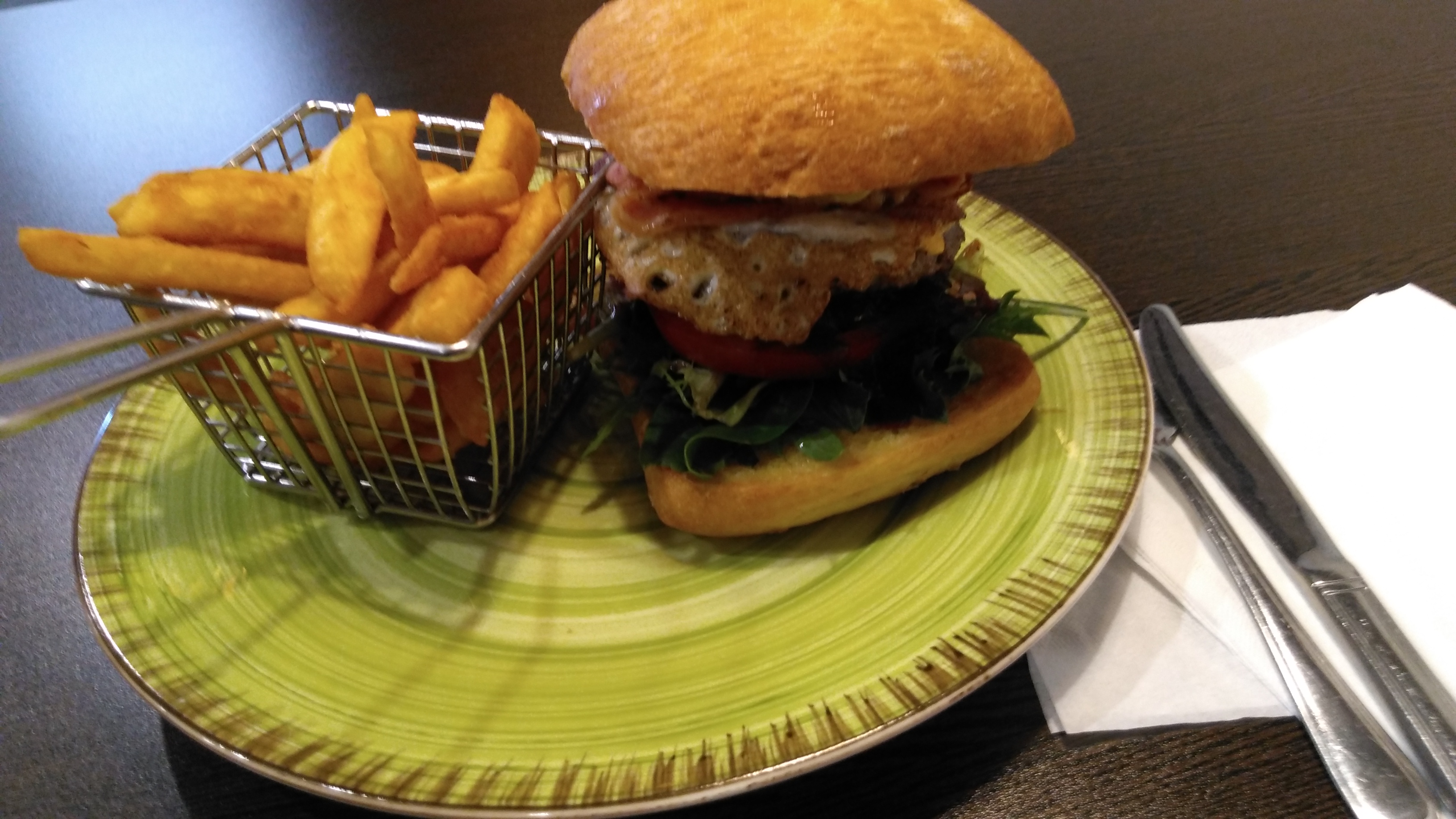
The club was surprisingly big and busy. As well as the Gallipoli lounge, poker machines reach into the “Kokoda Terrace outside smoking area with comfortable seating and table service”. The main dining is the “All You Can Eat restaurant – Buffet 88”. I went to the smaller, almost empty Poppies Cafe for the largest hamburger with the lot and chips that I’ve been served.

Many young men (mainly men) died for this, and others returned so damaged that their PTSD afflicts partners, and is passed on to the next generation. My grandfather, uncle and mother remain right.

Comedians at dinner, or, Why I love Brydon, Coogan (and Winterbottom’s) Trip and Trip to Italy

A FRIEND SAW THE MOVIE version of the Trip to Italy, together with some of Sydney’s top Italian restaurateurs, and all were disappointed. New Yorker reviewer David Denby joined an audience “apparently expecting a beach-and-mountain travelogue. For a hundred and ten minutes, watching some of the funniest comedy in years, they maintained a puzzled silence.” Not everyone loves The Trip (2010) and The Trip to Italy (2014), so I promised over dinner the other night to explain my delight.
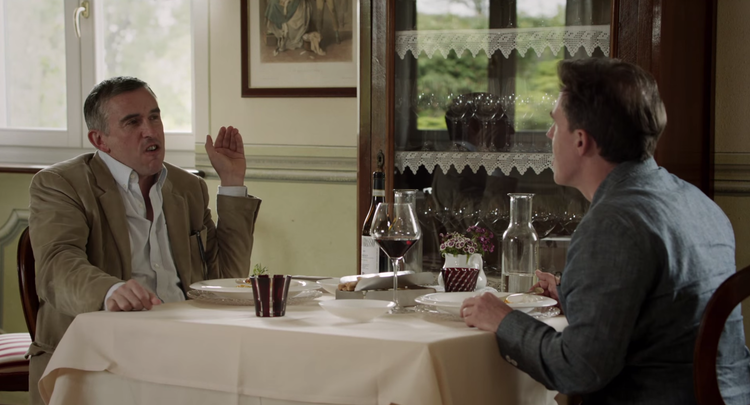
These are the adventures of comedians Rob Brydon (Welsh) and Steve Coogan (northern English), as they chat in the car during a scenic drive, compete in mimicking movie stars over a restaurant meal, pose for a snap in front of a plaque for a poet whose lines they recite, get shown to their hotel room by a young woman, sometimes have a brief encounter, and talk on the phone to a partner, child or agent or themselves in a mirror.

Without having seen the movies, I suspect the six-part series, upon which the movies are based, are preferable not only because they are longer but also because, accented with music, the same ritual every episode lends a melancholy predictability. dark-knight-rises-characters-hilariously-impersonated-by-steve-coogan-and-rob-brydon

My wife happily tolerates my enthusiasm, but wonders if our divergent opinions might invite gender analysis. True, David Denby of the New Yorker asserts: “Both movies, in fact, are about the impossibility—and the necessity—of male friendship.” However definitive that might sound, he also applauds several other basic themes. The men reveal their attraction to younger women – receptionists or at a nearby cafe table – and agree that glances are now not so usually reciprocated. I also wonder whether two female comedians might yet be allowed to retain the same dignity, while being so frequently silly, and mean, but will wisely leave further such conjectures to others.

Both series show some of the world’s loveliest scenery (the Lakes District and nearby parts of England, and the west coast of Italy), finest restaurant food and smartest comic impersonations (Michael Caine, Sean Connery, Woody Allen and Hugh Grant being ones I recognise), but the series are not particularly about any of these, nor quotations from Wordsworth and Coleridge in England and Byron and Shelley in Italy, nor celebrations of the craft of comedy, nor conversations about fading professional careers, about aging and death. Amalgamating such components, the Trips are classics of apparent simplicity, exemplified by the addictive rhythm.

The viewer accepts immediately that Brydon and Coogan play clever caricatures of themselves (Coogan more on top – including longer hair – in the first series, and Brydon winning in the second), and that they are not really reviewing the restaurants for the Observer, but a third, highly creative force is also hiding behind them. Using the same actors, director Michael Winterbottom developed some of the same techniques in Tristram Shandy: A cock and bull story (2005), and he had already done a road movie, In This World (2002), depicting the harrowing “smuggling” of two Afghan refugees from Pakistan across the Middle East and Europe to Britain.

Presumably also contributing to the minimal plots, Winterbottom has spent much of his adult life making movies far from home, probably getting used to luxurious accommodation, so that his former wife, Sabrina Broadbent, wrote Descent: An irresistible tragicomedy of everyday life (2004) about a movie director, always away, having affairs with his female actors. The shows revel in ambiguity, with the glamour constantly subverted. The beautiful food, places and people are haunted by insults and interruptions, quarrels about driving, agents sounding hopeful, relationship troubles, and time passing. As Denby reports: “Both films pursue the high and the low: a complicated deep-running sadness courses through the cynical, sybaritic adventures.” Winterbottom has captured the Nigella Lawson lesson – behind every façade lies pain (the “domestic goddess” had everything, including a nasty, public split with wealthy advertising entrepreneur husband Charles Saatchi).

A dear friend used to finish her emails with the tagline: “Be kind, for everyone you meet is fighting a great battle”, probably the invention of Scottish pastor, Rev. John Watson (1850-1907). The shows’ downers might seem casual and never worse than hit-and-miss communication, rivalry, nagging doubts and work pressures, but time is always fleeing. The implicit lesson is: “Eat, drink and be merry, … ” and I plan to write further in defence of that philosophy. For the moment, my argument is that the Trips witness the fundamental distinction between food and meals, and, at the risk of repetition, meals matter. Two or three brief shots from each kitchen show the cooks paying considerably more attention to the dishes than the two diners ever do. It is as if to say that celebrity chefs and photogenic plates have been accorded too much prominence of late.

As Brillat-Savarin wrote, table-pleasure depends not on fancy fare, but on four essentials: at least adequate setting, food and drink, companionship, and time. I’ll expand on this important point on another occasion, even if Brillat-Savarin gave two, differing lists of the four necessities (reconciled here). Nevertheless, Winterbottom has won me over by making the food and wine plainly important, but only one part of the picture. He has wondrously illustrated the peaks of all four necessary elements – glorious settings, fine comestibles, exceedingly witty and caring conversations, and apparently (only apparently) all the time in the world.