The things people will do for a story … war reporters are one-sidedly “embedded” with troops; bloggers cook their way through Mastering the Art of French Cooking …
As a food columnist for Australian Society magazine, I once hosted a dinner party using supermarket “gourmet” items. Not a successful night. Not even funny, despite our best efforts. Factory fanciness was a downer.
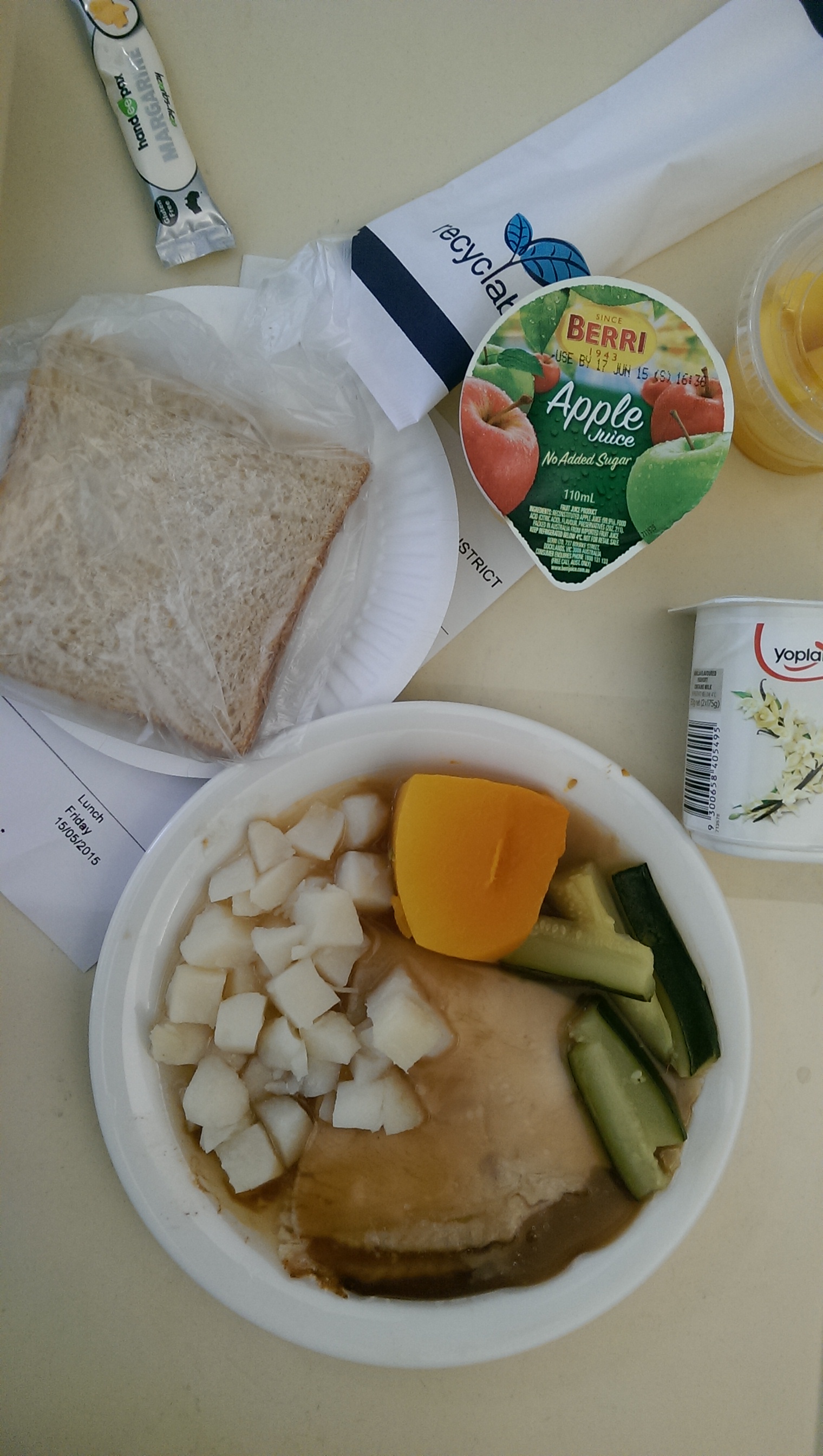
Undaunted, my latest project has been to test hospital food (and also, now that you ask, to fix a body part). Again, the succession of trays was not funny. Hospital food remains proverbially drear.
Why is it barely edible? With the underlying question: why can’t our society accept that meals matter – in particular, that table-pleasure is recuperative?
Soups seemed to work best. Sweet Corn Chowder reminded me of creamed sweetcorn from a can, when I was a child. Orange-coloured vegetables – pumpkin, kumara (sweet potato) and carrots – almost survived. The “Fish with Hollandaise Sauce” was a surprisingly edible, although from low expectations.
But chicken lost far too much taste and texture. Overly soft beans, zucchini, broccoli, potatoes and cauliflower all gained the same taint. I just had to leave much aside.
The food was brought to the ward in insulated trollies, with one side of each tray kept cold and the other warm, making the metal cutlery cold at the weekend (“recyclable” wooden cutlery was used on weekdays). The items mixed packaged foods (fruit juice, yoghurt, dessert), and previously packaged foods (meats, gravies and vegetables).
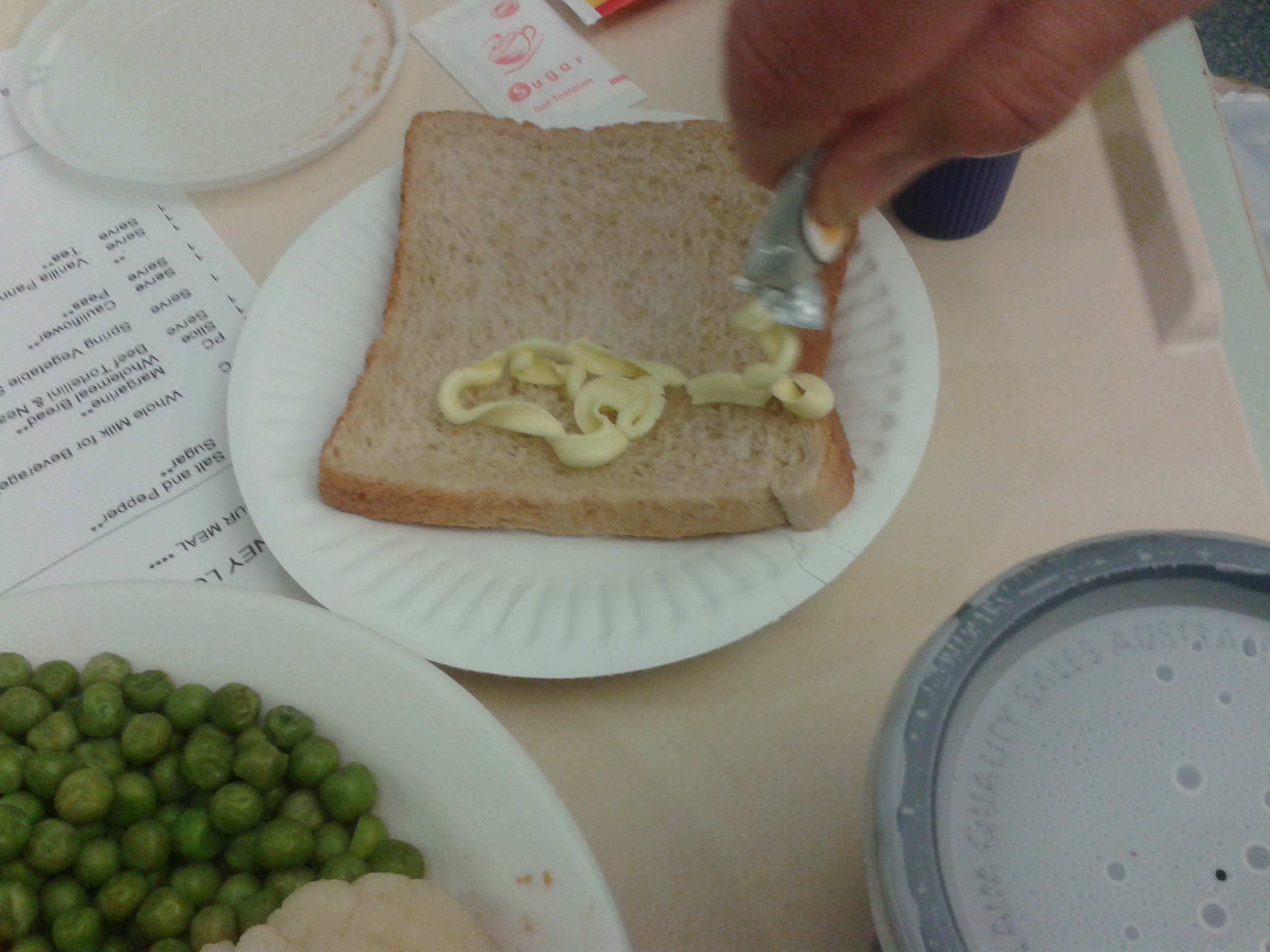
A demonstration of eezy-squeezy margarine
Berri Apple Juice No Added Sugar was “reconstituted” from imported juice; the yoghurt was “lid lickingly good”; and the “handeepax, eezy squeezy margarine” had faint echoes of molecular gastronomy. Maple flavoured syrup was “batch” made, but still “maple flavoured”.
The biscuits with morning and afternoon tea or coffee came in wrappers boasting, not reassuringly, “Nut Free, Seed Free, Egg Free”. The claim, “Easy to Open”, was “certified” by Arthritis Australia. Struggling to open the “Tear Here” cylinders of margarine, I welcomed such certification. But why no “attentively cooked” boasts?
My book, One Continuous Picnic, sought to comprehend the striking contrast between eating in Italy and industrial Australia, even more pronounced in the 1970s and 1980s. I found Italian freshness, care, taste and pride, and our detachment from the soil – Australia was a “land without peasants”. A recurring theme in the twentieth century was the “Great God Cheap”, as money trumped meals.
Likewise, expensive drugs and medical equipment presumably push kitchen cost-cutting. More doctors and nurses seem more essential than cooks.
My books have studied anti-gastronomic rationalism, but can some good cook out there get beyond the generalities and explain the core culinary problem here? Cheap ingredients? Inappropriate menus? Corner cutting? Too much freezing? Over-cooking? Standing around? Can anyone provide hospital caterers with one good tip, or is it all-the-above, and so the furthering of a grand revolution?
I sought out the wisdom of intellectual Sydney cook, Gay Bilson (Tony’s Bon Goût, Berowra Waters Inn, author of Plenty: Digressions on food). As associate director of the Adelaide Festival of Arts in 2002, she organised “Nourish”, bringing in chefs and volunteers to an un-ergonomically “monstrous” kitchen at Queen Elizabeth Hospital. She sent me an unpublished article about her experiences.
The team served dukkah, olives, olive oil and sourdough bread; chilled tomato soup; chicken salad, rice and chutney; and colourful trifle in a proper glass.
With this, they replaced the “re-hydrated dry goods” and sealed, single-serve portions “straight from a factory”. With feeding patients “an exercise in budget control”, the successful manager “spends as little as possible, ensures that prescribed dietary guidelines are adhered to … that there is no incidence of food poisoning.”
Bilson could scarcely conceal her anger at the local press’s treatment of any introduction of cooking into the Festival as a betrayal of the Arts and, further, entering a hospital as a mere foodie indulgence. The media reported, for example, that patients “volunteered” to take the festival menu, when, “in truth those who ate our food chose to eat it.” Good food was assumed to be expensive, when the team kept to a tight budget.
Bilson decided that the “Nourish” experience would have to prove valuable, if belief in “food in a gastronomic sense (that eating well nourishes the body and enhances well-being) is ever going to be taken seriously as part of caring for patients”.
A further issue, leaving aside the actual food, is the hospital meal as a social occasion, these days accepted as crucial for health. Normally, anonymous forces supply solitary diners, sitting up alone in their beds. No passing the salt, or exchanging chit-chat. Exacerbating that, I got stuck into my tray, cognizant that one man opposite was too nauseous to eat, while the other was classified “nil by mouth”, until he had passed wind (music to the ears of doctors and nurses).
Yet our separation did not feel as dire as the food, which set me pondering. Perhaps, in fact, we were otherwise unusually close. Sharing a room, we survived nights of cries and whimpers together; we saw the daytime trail of visitors (or lack of them); we commiserated about our states of precariousness (an aborted operation because unexpectedly-required equipment was unavailable; with cancer and young children …); we talked about our lives and fears.
A dear friend had advised, “think of everyone in the hospital, together, trying to get better”. At least in that general sense, we had joined some big, collaborative, health-giving meal.
Just a thought, but the expression “hospital food” overly stresses nutritive soundness, and cost-cutting, at the expense of companionship. Perhaps we could push improvements by demanding “hospital meals”?
Many of us enjoy cooking, especially with good produce, and perhaps with a glass of wine. But why do human-beings cook in some anthropological sense? Why could James Boswell call Homo sapiens the “cooking animal”?
For such a fundamental question, it has been left surprisingly unanswered. Too often, cooking has been ignored as “women’s work”, “drudgery”, “leisure” or “indulgence”. For too long, scholars went along with Plato’s warning against cooking as pandering.
Anthropologist Claude Lévi-Strauss might have written about the “raw” and “cooked” in the 1960s, but somewhat mysteriously. Cooking expressed human cultural structure, or something. Still, he started gastronomic reflections on the slow road back to academic respectability.
In recent years, two books have promoted versions of what might be termed a “transformational” theory of cooking. Where Lévi-Strauss saw cooking as a “language”, evolutionary biologist Richard Wrangham wrote about the energy advantages of cooking as a form of pre-digestion. His Catching Fire: How cooking made us human (2009) thus aligned with the dictionary meaning, “to prepare (food) by heating”. Heat transforms raw ingredients to make them more digestible in Wrangham’s case, or possibly also tastier or more expressive. As the subtitle indicates, Michael Pollan’s Cooked: A natural history of transformation (2013) went along with fire.
The flame is important for me, too, but not as basic as the knife – I often put down the glass of wine to pick up a knife. The knife fits another, and more basic, theory of cooking. This is distributional. According to this approach, the cook’s essential duty is dividing up the food among the diners. This makes the “cooking animal” much older than the fire-maker, taking cooking back to the beginning of the stone age, and the sharp flint.
The importance of food sharing for the human story was the topic of my book, originally published in 1998 and currently available under the title A History of Cooks and Cooking (http://www.press.uillinois.edu/books/catalog/87xzf7wp9780252025808.html ). That’s where others found the Boswell’s “cooking animal” quote, without them always transmitting the beauty of the distributional theory.
The distributional foundations had already cropped up occasionally, and were touched on by Launcelot Sturgeon in his Essays, Moral, Philosophical, and Stomachical in 1822. I’ve since read a claim that Sturgeon might have been the nom-de-plume of Charles Lamb, but, whatever the case, look out for the clever pair of essays, “On the physical and political consequences of sauces” and “On the importance of forming good connexions; and on the moral qualities of the stomach”.
I can see how a transformational theory would appeal especially to anthropologists in their fascination with culture. The refinements are often highly civilising. However, the more social slant of distribution should attract sociologists, and also economists. That’s because the distribution of food at the meal is the concomitant of the distribution of labour. The often-quoted early section of Adam Smith’s Wealth of Nations on the division of labour could hardly by more gastronomic.



 Meals Matter