What are we doing with a King?

OUR RECENT PUBLIC holiday to celebrate the King’s birthday reminded yet again that Australia needs to move to a democratic Commonwealth with a grown-up Constitution. The existing arrangements merely sign up Australian colonies under the Crown, rather than make a careful social contract between citizens.

AS a suggestion, a preamble might begin: Finding ourselves in an industrial civilisation, imposed violently on Indigenous nations, we each agree to cooperate in this Commonwealth. Obedient to ourselves, we remain wary of rule from above, whether by kings, ideologies, autocrats or big money. We, the People, organise ourselves. The Constitution inspires, while it sets out formal principles.

As citizens of the Commonwealth, we submit to the rule of law, democratically established by an informed citizenship, and managed by the state (government and bureaucracy), overlooked by a mindful judiciary. And there’s more.

But, before getting too far, a quick note that our King’s Birthday weekend is being followed immediately by the U.S. “No Kings” day. And this leads to an admission that conservatives make a reasonable point about a king or queen possibly providing stability, unlike what’s happening in a famous republic.

Neither a poet, nor a honed legal mind, but a meal-centred scholar, let me propose some essentials for our forthcoming Constitution.

As individuals and social beings, we respect the laws of nature, notably the ecological requirements of generation and preservation. We also obey laws, democratically achieved. That more or less paraphrases seventeenth-century English political philosopher John Locke’s arguments against paternalism, particularly monarchical, and for democracy.

Thinkers in his day understood a Commonwealth as a political economy, with, traditionally, a monarch organising food-centred infrastructure and services, such as irrigation, roads, art, science and welfare.

Replacing kings and queens, Locke envisaged a Commonwealth enhancing citizens’ “natural rights”, which were to life, liberty and property. We achieve well-being through access to food and water, gardens and seashores, to housing and livable towns, to health through good medical care, knowledge gained through schools and research, and all embellished and reinforced through the arts.

The world has changed since Locke, and not only because powerful forces have abstracted “Bills of Rights” from natural realities.

The big problem now – worse than being subject to a king and queen – is Corporations. They rule more intricately, and more ideologically, than ever any monarch.

As explained in Meals Matter (2020), for-profit corporations essentially emerged after the modern republican pattern had been set. Lacking Constitutional legitimacy, corporations nonetheless gained legal support through such devices as “limited liability” and “corporate personhood”. They then appropriated rights, especially “liberty”, which supported “laissez-faire”, “free enterprise”, “neoliberalism” and lately “disruption”.

Corporate capitalist theory reassigned sovereignty to money. The system has now remodeled all in the corporate image, turning universities into businesses, and people into buying-and-selling machines.

Corporations supply our cars, and build the roads. Their advertising funds news dissemination. Their factories supply food, and armaments. This means having to engage closely with government through lobbying, consultation, outsourcing, and two-way personnel exchange. Who “understands” war better than military suppliers?

Invidiously, I mention just one of numerous experts now running the place: former SA Senator and Cabinet Minister, Christopher Pyne. To quote Wikipedia:

Lacking Constitutional status, corporations have captured government. They push politicians to the fringes, where they take photo opportunities. The frustrated electorate are expected to blame … “the government”!

In our serious Constitution, corporations lose “rights” and gain licences or something of the kind.

The loss of the Voice Referendum in Australia a year ago pointed to an uninspiring, irrelevant-seeming Constitution. Additionally, the perceived need for a consultative body highlighted the lack of power of actual citizens, in this case Indigenous people.

In the new Republic, I reckon the democratically-elected parliament might elect a President, who forms a Cabinet and outer Ministry from both elected members and from representatives of registered consultative bodies.

As recognised economic tools with government oversight, corporations might provide recommendations this way. All lobbying would be public through recorded debates and publications of registered representative assemblies.

Likewise, a wide collection of interests make their case. Trade unions make useful representations. And so on, through various advocacy groups, all overseen by a commission.

This commission is appointed by the parliament with reference to the bodies themselves. As well as collating submissions, the commission would support consultative bodies. The commission provides financial and logistical support, where appropriate.

Think of it as like a royal court of old, whose lively gossip, intelligence, opinion, and learning advised the ruler. In ridding ourselves of kings and queens in favour of parliaments, we need to replace not only monarchs, but also their clever courtiers.
Doomed to disruption

Capitalism has abandoned neoliberalism and gone disruptive

FOLLOWING perestroika and glasnost and the collapse of the Soviet Union in 1991, capitalism’s boosters trumpeted “liberty” worldwide. Demanding liberation for all, a new Pax Americana would make everywhere safe for corporations.

Under big money’s global message of freedom, such left-liberal political leaders as David Lange, Paul Keating, Bill Clinton, Tony Blair, Helen Clark, Kevin Rudd and Barack Obama pushed progressive cultural reforms with particular support for racial, women’s, gay and other rights.

The trap was that the “rights revolution” in such areas as feminism and multiculturalism provided cover for the corporate capture of government. Under the banner of neoliberalism, the same leaders pushed through deregulation, fiscal “rectitude”, lower corporate taxes, “flexible” job markets, outsourcing, lower trade “barriers”, individual responsibility, etc.

In the flurry of freedom, cultural liberation was outmatched by the bolstering of corporate power.

With governments now firmly in its grip, capitalism moved from neoliberalism to “disruption”. Facebook boss Mark Zuckerberg instructed: “Move fast and break things”. Powerful corporate leaders from Zuckerberg, Musk and down asserted their sacred right to do what they wanted – AI, rockets to Mars, armaments, opioids, drill, baby, drill…

Writing about the “disruption machine” in the New Yorker in 2014, Jill Lepore observed that innovation had become “the idea of progress stripped of the aspirations of the Enlightenment, scrubbed clean of the horrors of the twentieth century, and relieved of its critics”.

Long-time Silicon Valley reporter Kara Swisher (Washington Post, 15/02/24) had “watched founders transform from young, idealistic strivers in a scrappy upstart industry into leaders of some of America’s largest and most influential businesses.” With few exceptions, “the richer and more powerful people grew, the more compromised they became.”

Upon Trump’s election as President, digital CEOs rushed for an audience, Swisher reported:

“There was a heap of money at stake, and they wanted to avoid a lot of damage the incoming Trump administration could do to the tech sector. … they also wanted contracts with the new government, especially the military. … More than anything, they wanted to be shielded from regulation, which they had neatly and completely avoided.”

The “invisible hand” of money unleashed disruption (and corruption), and broke pay parity, democracy and civility (not forgetting nature). Along with that, fewer and fewer billionaires supported left-liberal causes, preferring to boost their own fortunes by backing think-tanks and increasingly authoritarian ideologies.

Right-wing populists blamed the “politically correct”, the “woke”, university-educated “elites”, and mysterious liberals who controlled the “deep state”. Raising the “cloud of confusion”, Murdoch opinion-leaders baited their opponents until seeming actually to believe environmental degradation was an esoteric belief, and supporting women of colour impoverished white men.

Historian Ellen Schrecker has charted how the unprecedented invigoration of American universities during the Sixties eventually rebounded, when the right both attacked universities’ “liberalism” and corporatised them (in her studies of universities’ Lost Promise (2021) and Lost Soul (2010)).

Those endeavouring to save the welfare state, worker rights, universities, democracy and the environment have been tempted to display militancy. Israel’s brutality has now prompted campus protests in the Sixties manner.

Caution is warranted, nonetheless. Given how abusive politics suits aspiring demagogues, supporters of left/progressive/Green politics should prefer exposing the sin of over-commitment over indulging in it. Rather than shout back, the liberal left could usefully resort to honesty and openness, and appreciate complexity.

Arguing the benefits of civilised society also means understanding politics more deeply than as just warfare (“class struggle” already proved insufficient).

Contesting the authoritarian appeal of “the strong always win” means re-discovering lost principles. Countering disruption requires a return to something more like Enlightenment political philosophy, seized and shattered by capitalism.

The pre-capitalist basis of radicalism is described in Meals Matter: A radical economics through gastronomy (Columbia UP, 2020). The book also shows how money’s polemicists borrowed selectively from liberal-democratic arguments, and trampled on them.

Grassroots change comes from care and conversation at and about meals (at their different levels)

Australian Blak activist Natalie Cromb has just advocated, with “violence all around us”, for “reimagining our communities to be as they should be – caring, nurturing, healthy, happy and with enough”.

The sin of over-commitment

So much rancour of recent times has been hardened by over-simplification – and examples are to be found on all sides

IN RECENT YEARS, numerous governments and institutions accepted the International Holocaust Remembrance Alliance’s definition of antisemitism. While its opening statement is widely regarded as reasonable, the definition then gives examples that suggest that criticism of the state of Israel is antisemitic.

Antisemitism is exhibited by, for example, denying “the Jewish people their right to self-determination, e.g., by claiming that the existence of a State of Israel is a racist endeavour”.

Leaving aside the trickiness of whether Jews comprise a people, race, religion, cultural tradition or nation, the stricture nevertheless comes close to shutting down debate about Zionism.

This is despite many Jews themselves being anti-Zionist, sometimes on firmly religious grounds. “Jewish is defined by what Torah commands. Making our own state, or oppressing other people, is forbidden by Judaism and cannot be considered ‘Jewish,’” said Rabbi Yisroel Meir Hirsch (quoted in The Times of Israel, 23 May 2020).

Another example of antisemitism was: “Drawing comparisons of contemporary Israeli policy to that of the Nazis.”

Reference to National Socialism might be painfully pointed, but that of itself would not invalidate such a denunciation.

The so-called “settlements” in the West Bank, throwing Palestinians off their land at gunpoint, certainly head in that direction. Likewise, many Jews worldwide decry the Netanyahu government’s campaign “to flatten” Gaza (President Macron’s description) or “genocide” (South Africa’s case in the World Court).

A definition of “antisemitism” overly protective of Israel and its policies risks rebounding, and many people now oppose Israel’s assaults without feeling particularly anti-Jewish, and resist campaigns to insist otherwise.

I have asked around about the name of a spurious argument of the type “anti-Israel = anti-Semitic”. My friend David suggested “false syllogism”, in that necessary are not always sufficient conditions. Any thoughts?

Let’s settle for the moment on saying it’s a classic case of over-commitment, in which powerful assertions foreclose qualifications and ambiguities. And over-commitment is a widespread sin.

While the authoritarian right specialises in zealotry, including provocative sneering, abuse, and inventive conspiracy theories, the liberal-left itself provides many examples.

Loss of “Voice” Referendum

An Australian instance of the sin of over-commitment has been a widespread claim that the loss of the Referendum on a Constitutional “Voice” for Indigenous people revealed the nation’s “embarrassing” racism, and set back the Indigenous cause.

Indigenous lawyer and “Yes” campaigner Noel Pearson had warned the voters: “There’s one choice that’s morally correct, and the other one will bring shame upon us, and we will have to wear that shame and dishonour for a long time to come” (The Guardian, 10 October, 2023).

Afterwards, campaign director for Yes23 Dean Parkin suggested that “the Australian people voted against recognising Aboriginal and Torres Strait Islander people as the first peoples of our nation” (Guardian, 26 January 2024).

The history of Australian government Indigenous policy is not happy, to say the least. But overly committed proponents simplified the Referendum to “Yes”/”No” on Indigenous recognition and support, over-riding complications concerning the approach and the Constitution itself.

One Indigenous Senator (Jacinta Nampijinpa Price) had described the proposed advisory assembly as patently unnecessary, while another (Lidia Thorpe) saw it as grossly insufficient. That’s a span of views.

The Referendum debate revealed widespread ignorance of the Australian Constitution, it was said. That’s not surprising for an uninspiring foundation narrative of colonial governments wrangling a federation.

Rather than resemble an intergovernmental memorandum, a Constitution would desirably set out a persuasive social contract, to which each member assents.

Even Constitutional experts stuck with narrow legalism rather than promote the need for a Constitution that actually sets out why and how we, the People, run this place for our own well-being.

As much as Anthony Albanese might have expected to emerge as a great, visionary Prime Minister, he mishandled a weak cop-out, a non-Treaty and non-Truth-telling way of slipping Indigenous recognition into an inadequate Constitution. Embarrassingly, the former “Rudd government’s street fighter” (Tony Wright, SMH, 23/02/10) failed to transcend narrow party sniping.

Out of the muddle, claims about a single “morally correct” vote arguably became over-commitment to the point of being self-defeating (in that, for instance, Albanese went quiet on the Indigenous cause).

Blame for housing unaffordability

In another Australian example, more than 40 housing, homelessness and community service organisations wrote to the Prime Minister and Opposition leader expressing concern that immigrants were being blamed for the prohibitive price and scarcity of housing.

“Migrant communities are being scapegoated for Australia’s housing crisis,” said Everybody’s Home spokesperson, Maiy Azize (19 December, 2023). “Governments have given handouts to investors, allowed unlimited rent increases, and stopped building homes for the people who need them. It’s a distraction to suggest that migrants are to blame.”

The letter acknowledged elsewhere that “migrant communities are being scapegoated as the primary reason for the housing crisis” (added italics). But why should migrants accept any responsibility whatsoever for the housing crisis?

Population pressures affect housing availability, but that’s not the migrants’ fault. Rather, the pressure results from immigration programs.

Selling immigration as “boosting the economy”, business lobbyists have pushed for cheaper workers, bigger markets, more construction projects, and other sources of “growth”.

Business lobbyists are happy to see migrants take the blame, just as they are not overly concerned that young people get locked out of the slow-motion housing bubble.

Just as alarm at Israeli policy about Palestine is not necessarily anti-Jewish, and disconnect with Albanese’s uninspiring Referendum can be far from racist, querying immigration policy is not querying migrants themselves.

The sins of over-committed simplification, hyperbole, sloganising, indignation, and disparagement have multiple causes.

Newspapers have long resorted to often ingenious, attention-grabbing headlines, with qualifications buried beneath. More and more, advertisers and influencers use half-truths to compete for “likes” and “going viral”. On top of that, competing political factions get shoutier.

Beyond increasing political rancour lies a major shift in capitalism, which is the topic of my next Meals Matter post, Doomed to disruption. We’ve farewelled the neoliberal era. Welcome to the age of disruption!

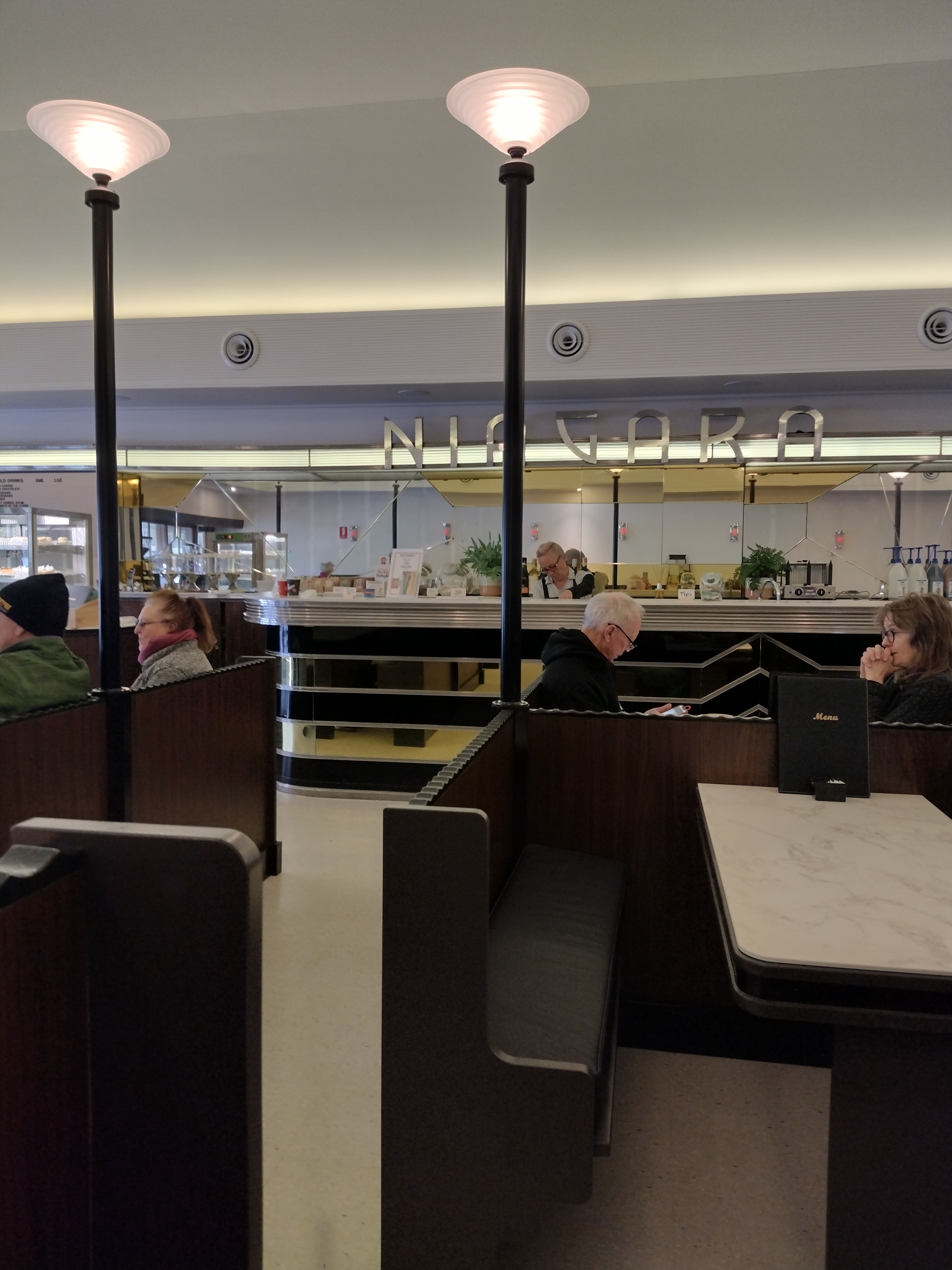
The Niagara has reopened in Gundagai

GREAT POLITICAL excitement! After years of neglect, a new team has taken over. That’s not just in Canberra, but also, not that far away, in the town of Gundagai.

We chanced to breakfast at the renowned Niagara cafe in the first week of the art deco gem’s reopening. The new owners have done a great job, restoring the booths and all.

Suddenly, Luke and Kym have gone from paying tradespeople to paying customers.

Families with Greek heritage got early into refrigerated foods in Australia, and specialised in fish, icecream (including Peter’s and Paul’s) and milkbars.

And so, successively, the Notara, Castrission and Loukissas families owned and ran the place from 1902, through the wondrous art deco modernisation in 1938, until it became too much a few years ago.

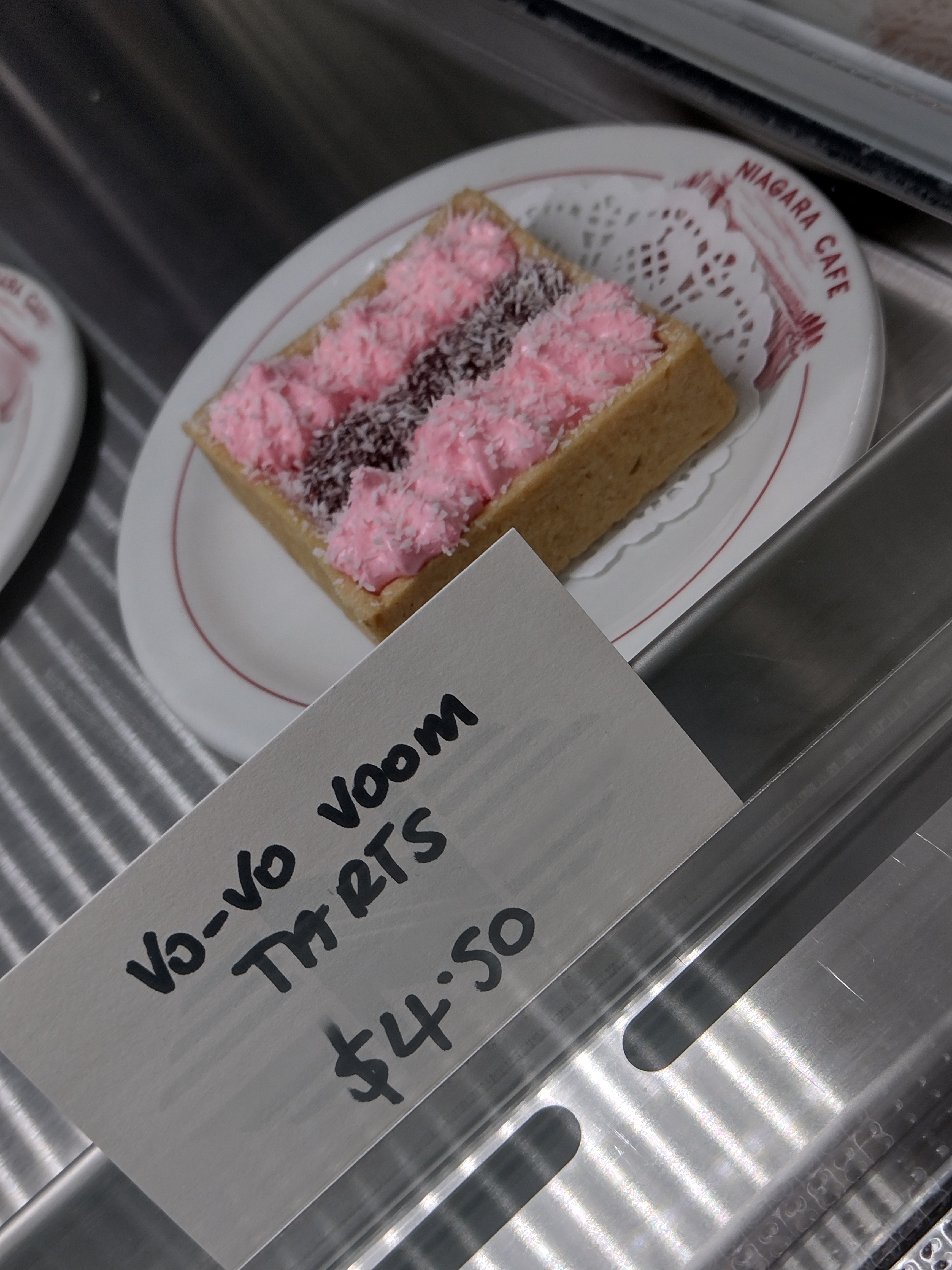
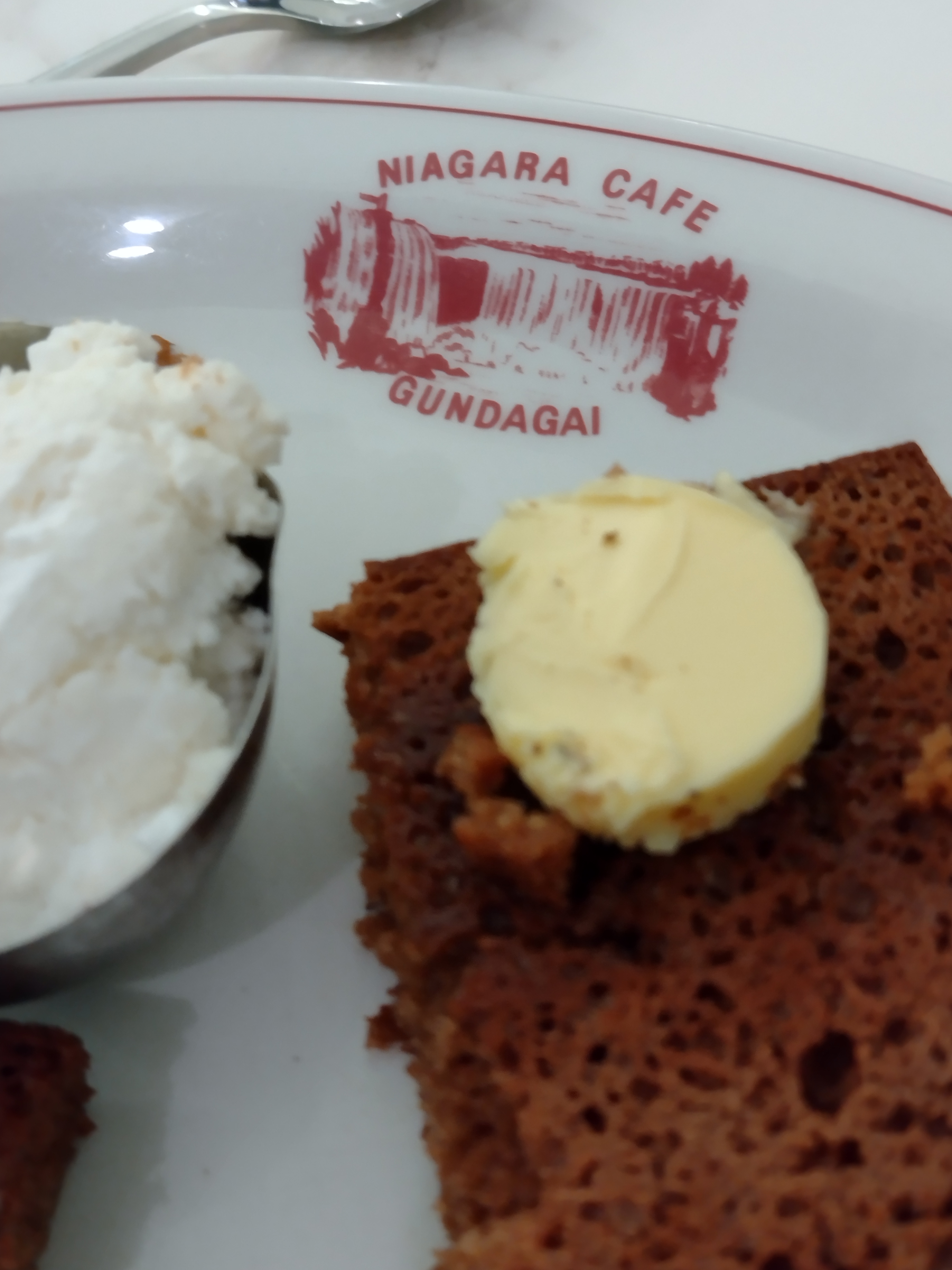
After opening up for a midnight meal for Prime Minister John Curtin and team in 1942, the place became a Labor Party shrine, accumulating signed photos commemorating the visit, and showing off the crockery used.

The new owners have stored the memorabilia, and promise to soon return it to display.

Postscript: Two years later, and the new owners are still to show the old Labor crockery and other memorabilia. Perhaps a metaphor?

@NiagaraCafeGundagai 

The centre can be radical. Look what happened at the recent Australian election

THE POLITICALLY COMMITTED often decry the “centre” as wishy-washy, and as cosying up to the other side. But, being less ideological, the centre can be more radical.

Just one piece of evidence is the recent electoral success of “community independents”, whose pronounced liberalism produced policies more radical than either main party, left or right.

Liberalism? Corporate capitalism has rewritten our political language (chronicled in Meals Matter), and that necessitates being more open to rethinking liberalism.

The liberalism of its often-acknowledged founder, John Locke, tends to live on with so-called “small-l” or “left-” or “social-” liberals, who have multiplied over recent decades.

They eschew extremes, and yet have become such a threat that the right’s “culture warriors” have ridiculed them variously as “chardonnay socialists”, “latte liberals”, “smoked salmon socialists”, “gauche caviar”, “Toskana-Fraktion”,  “Salonsozialist”, “yuppies”, “politically correct”, “chattering classes”, “bobos”, “educated classes”, “liberal elite”, “inner-city greenies”, “mad left”, and on and on.

These liberals are committed to everyday, kitchen-table reality, which is perceived through practical experiences and face-to-face conversations, and informed by learning, with a consequent embrace of equality, tolerance, and democracy. Combined with the rejection of high authority and ideology and other extremes, these liberals are definitively radical in the sense of getting back to material basics.

The recent rise of so-called “teal” independents has been explained as “professional women” rejecting “merely” climate inaction, political corruption, and mistreatment of women.

They are better identified as genuine liberals, unimpressed by the Coalition’s obfuscations on global warming and women. Disturbed by political corruption and capture, they are determinedly “community” candidates, and I have already described their “kitchen table conversations” – grassroots exercises in interpersonal respect and participatory democracy.

Community independents belong to a centre that’s definitely not a weak compromise, not at least in terms of climate action, political integrity and gender equality.

Their policies are reliant on facts and expertise, not ideology, suggesting radicalism that’s not extreme, but literally getting to the root of the matter (deriving from Latin radix radicis).

Max Chandler-Mather

Likewise, the Greens would appear to have somewhat furled their wilderness and class war wings, and boosted their liberal radicalism. “People have lost faith in a political system that puts the interests of a few big corporations ahead of the rest of us,” according to Max Chandler-Mather. So, he ran “the biggest grassroots campaign in Greens’ history”, and won the Brisbane seat of Griffith.

Unusually for an Australian campaign, they established themselves as community carers by, for example, building a community garden on Defence land being disposed of to a developer. Their volunteer teams used some of the garden’s produce when helping out during covid lockdowns and after floods.

Historically, the major Australian parties – Labor and Liberal – represented the interests of the working class and bosses, respectively, although both always contained liberal elements.

Labor outgrew the class war with the Whitlam revolution of 1972, although its liberal leadership then fell in with neoliberalism. Labor’s agenda remains hypnotised by “jobs, jobs, jobs”, which is sunny way to support corporate capitalism.

We might be lucky, and the new Labor government might get behind the common-wealth of health, social justice, infrastructure, environment, education, research and the arts. But that means standing up to capitalist rule by profit.

Perhaps Labor needs to become the Labourer/Worker/Housekeeper/Carer/Professional/ Artisan/Farmer/Small businessperson/LGBTIQA+/Immigrant/Aged/Disabled/Indigenous/Abused/Student/Etc Party. A new name is not easy to come up with… Perhaps “Commonwealth Party”?

The “Liberal” name is already taken by the occasionally liberal party of Robert Menzies, but whose main demand is “freedom” for money, and which now has to choose between becoming a “broad church” or a reality-inventing, fact-denying, cynical rump.

Likewise, the National Party has to decide between being a Country Party, concerned with increasingly perilous bread-and-butter rural issues, or Trumpian authoritarians.

Perhaps the party system is doomed, anyway, as a relic of hierarchies with “party discipline” under the Leader, announcing policy, allocating ministries, and making “captain’s picks”.

Rather than rely on backroom deals, sloganised messaging and last-minute hi-vis pageantry, Members and Senators might deliberate on the floor of parliament. Now that’s an idea.

The community independents have shown the way. And let’s not forget that a thriving democracy in a complex society requires a highly informed citizenry, and therefore strong public education, responsible media, and a committed and open public service.

With determination, it’s possible that a new centre might hold, and a radical centre at that.

To repeat, by “centre”, I do not speak of midway between two extremes, but caring, honest, informed and pragmatic “liberalism”.

Welcome to our kitchen table election

This Federal election is powered by Kitchen Table Conversations, a technique developed in Melbourne in the late 1990s and which has mobilised the constant political chatter around tables, in cafés and over drinks

THE “CLIMATE” INDEPENDENTS expected to win an increased number of seats on 21 May, and conceivably the balance of power, are propelled by KTC.

This is the mobilising technique of “Kitchen Table Conversations”. Self-selected hosts invite perhaps nine others around to discuss the political issues they find important, and to plan possible actions. A coordinating group collate reports from the kitchens to help find and inform a local candidate.

A relatively spontaneous, and still quite loose, movement is now significant in Australian politics (and I would like to learn about similar techniques elsewhere in the world).

Various “Voices 4”, “climate”, “teal” or “community” independents have sprung up in Coalition electorates, with voters disgruntled principally about lack of action on the climate emergency, and on an independent commission on corruption.

Behind that, kitchen-table activists respond to perceptions that political parties have failed participatory democracy.

While progressive on some core issues, participants thus far tend to be relatively comfortable, financially, so that campaigns lack neither professional access, nor funds.

Compiling a definitive list of KTC-propelled candidates proves tricky, initially because I have not checked through all possibilities. Climate 200 has published a list of those it supports, but others remain sufficiently independent as to refuse all outside funding. Other estimates suggest more than two dozen “teal” candidates. My attempted list (below) contains four up for re-election, plus eleven newcomers in city seats held by Liberals, and six rural candidates mainly challenging Nationals.

From Kitchen Table Conversations: A guide for sustaining our democratic culture, by Mary Crooks and Leah McPherson (2021)

The mechanism was adopted famously in the rural Victorian seat of Indi in 2013, when Cathy McGowan replaced Sophie Mirabella (and was succeeded by fellow independent Helen Haines). In like manner, in 2019, Zali Steggall spectacularly beat former Prime Minister Tony Abbott in Warringah.

KTC had originated even earlier, among women worried by the aggressive neoliberalism of Premier of Victoria Jeff Kennett as he closed schools, privatised government activities, and dismantled democracy.

Introducing a new booklet on the topic, Mary Crooks relates how, in 1996, she lunched with two friends (Sandra Hart and Angela Munro) at the Red Sage Café in Clifton Hill (Melbourne). “Despite the Kennett government being re-elected for a second term, we sensed a groundswell of community unease across Victoria,” Crooks recalls.

At a second meeting, Crooks took along an ad for the position of executive director of the Victoria Women’s Trust. She got the job, and developed the grassroots mechanism. The initial name of the “Red Sage Project” (after the café) was soon changed to Purple Sage to avoid political confusion (and setting off a palette of colours, often teal). Working with other respected community groups, the project engaged as many as 6000 women and men across the state “in a thoughtful deliberation of the key issues and the actions they could think about taking”.

The model very much belongs to the (traditionally womanly) domain of the kitchen table, and the treatment of women has remained prominent.

In the new booklet, Mary Crooks and Leah McPherson advise: “Hosts will need to provide some drinks and light snacks. This may be as simple as tea, coffee, and a packet of biscuits.” This contrasts with political candidates drinking a beer at the traditionally male pub (although photo-ops have lately included sipping tea in workplaces).

Crooks and McPherson accept that “Core Group” organisers might enjoy a proper meal for a post-mortem: “You may wish to organise a lunch or dinner together, share a drink at the pub or café, or enjoy a peaceful walk to decompress.”

These domestic get-togethers should be viewed as a deliberate alternative to the presently dominant conversations at board tables, business lunches and cocktail parties among politicians, billionaires and lobbyists, titillating each other with coal mines, highways, new airports, outsourcing opportunities, and cuts to public education. (For more on “state capture”, read this recent report.)

In pursuit of the “delicious revolution” in Meals Matter, I recognise meal conversations as the essential ground of democracy, because table chat covers not only regular meals past, future and present, but also the wider meals of schools, hospitals and aged care, and all that surrounds them – table talk naturally encompasses life’s essentials.

Political theorist Janet Flammang has written how everyday meals generate popular political consciousness.Even slightly more formality can be powerful. Like-minded experts and enthusiasts typically “socialise” at drinks and restaurant tables.

Courtly banquets were centres of political proposals and intrigue. Regicide has been plotted at aristocratic feasts, and so, too, revolutions have been planned in coffee-houses, and people’s victories celebrated in street banquets.

Some might defend digital media as furthering political discourse, but online chat drifts too far from social foundations in food sharing.

Politics emerges from the pleasure of the stomach, “especially through participatory democracy, in which everybody labors at everyday meals and converses, so that knowledge collects up and distributes”. The political economy is to be “rewritten by living well” (Symons, Meals Matter, 2020: 272-273).

Long live table politics!


The “community”, “climate”, “Voices 4” and “teal” independents seeking lower-house re-election are: Helen Haines in Victoria, Rebekha Sharkie in South Australia, Zali Steggall in NSW, and Andrew Wilkie in Tasmania.

As to newcomers in Liberal city seats, we’re speaking of at least: Nicolette Boele in Bradfield; Jo Dyer in Boothby; Kate Chaney in Curtin; Zoe Daniel in Goldstein; Claire Miles in Casey; Despi O’Connor in Flinders; Monique Ryan in Kooyong; Sophie Scamps in Mackellar; Allegra Spender in Wentworth; Georgia Steele in Hughes; and Kylea Tink in North Sydney.

Taking a swing at rural, mainly National seats, similar candidates include: Penny Ackery (Hume), Kate Hook (Calare), Suzie Holt (Groom), Hanabeth Luke (Page), Caz Heise (Cowper), and Rob Priestly (Nicholls).

The campaigns are unique to each electorate, but all wanting to “do politics differently”, and they generally feature climate action, and integrity in parliament, and they listen at kitchen table, fireside and pub get-togethers.

Mary Crooks

Morrison, “fake”

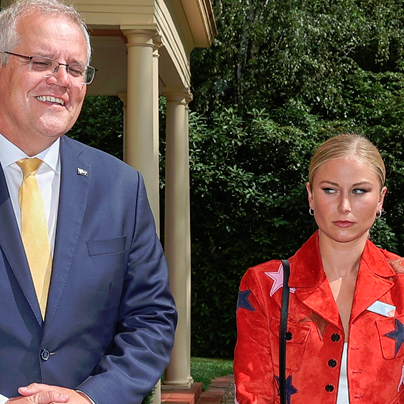
SCOTT MORRISON would never make a good waiter. He’s a total “fake”, as certified by recent Australian of the year Grace Tame.

She responded to the Prime Minister’s attempt to effuse sympathetically, when a mother inquired about cuts to NDIS payments for her child with autism.

Scott Morrison and his wife were unable to conceive for the better part of two decades. Nearly giving up on IVF, at the age of 39, Jenny gave birth to the first of the couple’s two daughters.

“She is our miracle child, the answer to a lifetime of prayer and 14 years of painful, invasive, heartbreaking treatment,” Scott wrote in 2009.

So, in a televised leaders’ debate the other night, he replied, concerning the future of the NDIS, “Jenny and I have been blessed, we’ve got two children” – and here he stumbled – “that don’t – that haven’t had to go through that.” He added: “And so for parents, with children who are disabled, I can only try and understand your aspirations for those children.”

Grace Tame and fake (to her right)

Along with the famous photo of her sideways look at Morrison, Grace Tame tweeted that “autism blesses those of us who have it with the ability to spot fakes from a mile off”.

In a classic non-apology, the Prime Minister later said he was “deeply sorry” about the way his comments were “sought to be represented by our political opponents in the middle of an election,” and that he had intended to “respect the challenges they [?] face, not the opposite”.

He’s a fake leader. He pretends to the role – as a “bully” to some, and “friend” to all the “quiet Australians”, while leaving CEOs, lobbyists and cronies to run the place.

Serious waiters are not fakes. They actually care for people. They help them have a good time, and cope with the full range from angry ignorance to gratitude. They have seen it all – couples in love, couples parting, two-timing spouses, drunken politicians, business wheeler-dealers, tearful families, wedding parties, and new-borns in baskets. They have studied the strangest dietary preferences, and all manner of anxiety.

We have had personal experience. Strangers would try to say the “right thing” when confronting our beautiful son, whose disabilities were in plain evidence. They would say things like: “It’s wonderful what science comes up with”. Or they promised a “miracle” from God.

At restaurants, Lawrence would often cry, and possibly be calmed by listening to the Wiggles. But, truly, the better the restaurant, the happier he was.

Perhaps the noise levels were more comfortable. Perhaps he joined our enjoyment. Perhaps the waiters knew what do. Whatever it was, we confirmed the effect time and again.

There was much that Lawrence couldn’t do (he was blind, never said a word, and remained unable to walk or even grip an object). But, among some wondrous abilities, he could spot fakes.

At good places, waiters would organise clear soup or a mash, so we could feed him. (Ultimately, though, he was happier and healthier just being tube fed.)

And, invariably, good waiters did not carry on about science or God; they just said something sensible.

We can’t exactly remember the best-ever response, but we know it was by a waiter, and where he was – Café di Stasio in St Kilda. His intent was something like: “He will look after you, and you will look after him.”

I dedicated my latest book, Meals Matter, to “Marion, Dorothy, and Lawrence Symons Maddox (1999-2009), who together have taught me so much about meals, and thereby everything”.

Tom Uren and me

AT THE TIME OF THE DISASTROUS BRISBANE FLOODS of January 1974, I was acting for some months as Whitlam minister Tom Uren’s media officer in Canberra.

Planners in his new Department of Urban and Regional Development explained to me that the flooding was exacerbated by laissez-faire development, whether chopping down trees upstream that hastened run-off, further speeding up rivers as flood “mitigation” or, incredibly, subdividing housing blocks on flood plains.

Brisbane, January 1974 (Qld Archives)

I suggested to Uren that he issue a media statement about the environmentally-destructive policies. Tom refused. He believed it wrong to score political points when people were losing their lives and property.

While humbled by Tom Uren’s decency, I’ve never been sure that he chose, at least in this case, the better way to practise his unchallenged love for humanity and nature.

Back then, the Queensland Premier, Joh Bjelke-Petersen, was famously pro-development, and never let up as a ferocious and ignorant detractor of the Whitlam Labor Government.

The pattern has continued until now, nearly five decades later, and with incontestably worsening floods.

With storms continuing, immoral N.S.W. Premier Dominic Perrottet demanded more housing, whether on flood plains or not (“NSW Planning Minister scraps order to consider flood, fire risks before building”, Sydney Morning Herald, 22 March 2022).

One difference now is the featuring of climate change. Back then, the more generalised fear was that too many people were sold too much technology, destroying biodiversity and unleashing harmful chemicals in a race to disaster.

This broader concern about resource depletion, loss of species, pollution, etc, might yet prove more realistic. For example, with pandemic lockdowns, investigators found that the rate of heart attacks dropped, in synch with the clearer skies.

That health improvement was detected in the U.S., and much of the air there is cleaner than other parts of the world.

A WHO report recently recognised air pollution as the “the single biggest environmental threat to human health”. That’s illnesses and deaths from the same fossil fuels that produce the greenhouse effect.

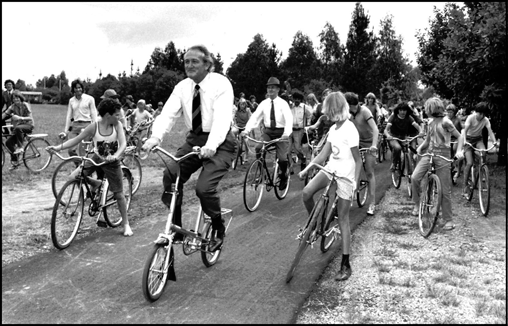
I did successfully organise photo-ops for Tom Uren opening bike paths (ACT Archives)

Australian Republican Movement, listen! We’re the “head of state”

THE AUSTRALIAN REPUBLICAN Movement has proposed a two-step model for appointing a “head of state” to replace Queen Elizabeth (or King Charles, Andrew, Harry or whomever). Of all people, republicans shouldn’t cling like this to the monarchical archetype.

The simple fact is that the head of state is (or should be) the people. We are in charge. Our appointment merely requires simple assertion: Australia belongs to the people! The #AusRepublic proposal betrays nostalgia for hierarchical rule by our betters – “something higher than the politicians”, when it is actually us.

According to the ARM model, the head of state would be little more than “ceremonial”, that is, perform as pseudo-royalty. In terms of power, this official could merely ask members of the House of Representatives who has their “confidence” to form a government. If that’s no-one, the HOS calls an election. Parliament could do that by itself.

So far, Australia has largely got away with a mediocre Constitution, no Bill of Rights, and little by way of a popular or even elite understanding of civics, liberal theory, political philosophy, jurisprudence, republicanism, or however you want to approach the requisite knowledge.

A republic is not achieved by merely replacing a powerful, foreign “figurehead’ with a powerless one. However, getting an Australian republic even half right would require massive research, contemplation, education, inspiration and debate.

The inadequate comprehension around these parts showed up, as Marion Maddox pointed out, when the 1998 Constitutional Convention opted for recognition in the Preamble of some supreme “generic God”. Come on, the supreme national authority is the people, with only the natural economy/ecosystem more formidable.

Since at least the 1930s, when William Cooper petitioned for enfranchisement, direct representation in parliament, and land rights, Aboriginal and Torres Strait Islander campaigners have sought serious constitutional recognition, with Treaty pressures escalating from the 1970s.

That might sound gradual. Discussion has scarcely even emerged on the constitutional status of corporations. As I show in Meals Matter: A radical economics through gastronomy, corporate apologists have got away with claiming the human right of “liberty” for businesses, while denigrating government by the people. No republic is wanted, when money runs things.

A republic would require renewed investigation of familiar topics – the role of the judiciary, States’ rights, taxation, border security, health, education, etc. – but often in unfamiliar ways. A proper democracy requires a real commitment to education, research and the arts, and not just training, tech and the leisure industries, for example.

But we’re a long way from a fundamental understanding when even political philosophers fail to recognise that John Locke argued his liberal case in basic economic terms, i.e., the human need to eat and to cooperate on that within nature. My next book will cover more of that.

PS: Governors’ residences could be put to good use as retreats for Australians of the Year, poets laureate, writers, playwrights, thinkers … generating more discussions like Grace Tame’s than the present Governor General’s. Yarralumla’s State Dining Room could experiment with banquets, given that’s what political economies are centred on (again, see Meals Matter).

An uncultivated continent?

IMAGINE IF Captain Phillip and his charges sailed from Botany Bay into Port Jackson today. Never fear, we would be secure. The Minister for Home Affairs would quickly round up the poorly-armed marines, would-be settlers, miserable convicts and people smugglers.

Before being whisked away, the intruders would have noted an astoundingly “uncultivated continent” of oil refineries, container terminals, waterfront mansions, soaring apartment blocks and vast urban stretches. Around the coast, they might possibly have sighted some patches of agribusiness, somewhere amid the rest being burnt.

That was the strange, industrial Australia I tried to evoke in One Continuous Picnic, my gastronomic history, published in 1982. Forty years ago, the place was feeding on cans, frozen packets and plastic. Fresh, local foods were widely assumed to be doomed. Indigenous culture was discarded. Little nuance was needed. A “land without peasants”. We only ate on rather than of the land.

My history found exceptions, including instances of the colonists resorting to, and sometimes enjoying, native foods. More importantly, I spent a couple of introductory pages celebrating Aboriginal eating, apologising that topic would require another book (and subsequent appearances include Bruce Pascoe’s Dark Emu, 2014, and its response, Peter Sutton and Keryn Walshe, Farmers or Hunter-Gatherers? The Dark Emu debate, 2021).

My sole example was Western Desert people, rounded up for the British atomic tests. Relying on a paper by anthropologist Dr Richard Gould, I sketched their “complicated skills and culture which had sustained them perhaps 40,000 years in apparently inhospitable conditions … They survived not so much through great physical endurance as through knowledge – their ‘cognitive map’.”

I mentioned them, I said, to “highlight our own profoundly novel way of feeding”, contrasting their “respect for the immediate environment and the invaders’ indifference”.

In the mid-1990s, I learned about semi-permanent settlement and complex horticulture, when Marion Maddox and I wrote a book on the Hindmarsh Island affair, involving the Ngarrindjeri of the Murray Mouth.

Incidentally, such was the well-financed legal ferocity of that anti-Indigenous campaign, including Slapp writs (Strategic lawsuits against public participation), through which obsessed parties from Tony Abbott to Chris Kenny assisted John Howard into power, that, understandably, no publisher would touch our revelations.

Speaking of an “uncultivated continent”, especially when covering Indigenous supervision, was a simplification; but my main contrast was between what I had discovered in Italy, where people still then enjoyed good cooking, fresh markets, and handy gardens, orchards and vineyards, and Australian in 1982.

Mine certainly wasn’t a terra nullius argument, since the book opened with “the patrols to round up remnants of the 10,000 or more Aborigines who once roamed the Western desert”. If anything, I guess, it was overly influenced by Wilderness Society-type thinking.

Much more has been written about Australian food since, both about the successes before the First Fleet, and the at least partially improved prospects, but my book had established eating as historically insightful (against the widespread acceptance there was nothing to write about), and I stick to the broad case.

My latest contribution, Meals Matter (2020), generalises the claim to assert that capitalism has systematically uncultivated the world, by having trivialised gastronomic talk, along with separating people from the soil, and imposing globalised machine production, and plastics.

I’m sure Meals Matter will also turn out to be overly-simplified in important respects. Yet I believe, again, that gastronomy can correct prevailing political and economic theory. Many of us keep trying.